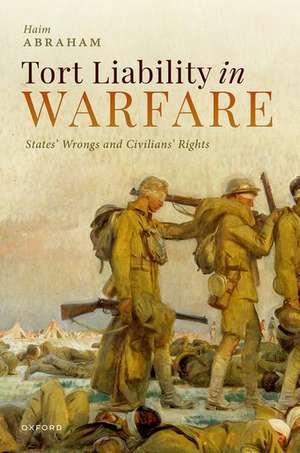
Tort Liability in Warfare: States' Wrongs and Civilians' Rights
Autor Haim Abrahamen Limba Engleză Hardback – 12 dec 2024
Preț: 692.97 lei
Preț vechi: 899.97 lei
-23%
Puncte Express: 1039
Preț estimativ în valută:
122.60€ • 142.54$ • 106.27£
122.60€ • 142.54$ • 106.27£
Carte disponibilă
Livrare economică 11-25 februarie
Preluare comenzi: 021 569.72.76
Specificații
ISBN-13: 9780198893356
ISBN-10: 0198893353
Pagini: 208
Dimensiuni: 162 x 240 x 16 mm
Greutate: 0.46 kg
Editura: OUP OXFORD
Colecția OUP Oxford
Locul publicării:Oxford, United Kingdom
ISBN-10: 0198893353
Pagini: 208
Dimensiuni: 162 x 240 x 16 mm
Greutate: 0.46 kg
Editura: OUP OXFORD
Colecția OUP Oxford
Locul publicării:Oxford, United Kingdom
V-ar putea interesa
-
 Diary of a Bad YearJ. M. Coetzee-21%Preț: 53.87 lei68.12 lei
 -
 -34%Preț: 586.61 lei883.35 lei
 -
 WarAndrew Clapham-13%Preț: 271.53 lei311.71 lei
 -
 Torts and Other WrongsJohn Gardner-20%Preț: 268.68 lei335.06 lei
 -
 Law and Morality at WarAdil Ahmad Haque-7%Preț: 323.10 lei348.15 lei
 -
 Crimes of War 2.0Anthony DworkinPreț: 135.43 lei
 -
 -8%Preț: 489.51 lei532.08 lei
 -
 Principles of Tort LawRachael MulheronPreț: 407.91 lei
 -
 Finch, E: Law Express: Tort LawEmily FinchPreț: 130.66 lei
 -
 Urban Warfare in the Twenty-First CenturyAnthony KingPreț: 160.98 lei
 -
 GazaJulie M. NormanPreț: 152.01 lei
 -
 The State and the SoldierKori SchakePreț: 160.25 lei
 -
 Private Law and the StateProfessor Andrew Robertson-34%Preț: 678.12 lei1021.76 lei
 -
 War Ethics: Theory, Practice, and MemoirBrian Orend-22%Preț: 458.24 lei588.11 lei
 -
 An Emerald Guide to The Law of TortRoger Caldwell-20%Preț: 61.23 lei76.15 lei
 -
 Foundations of Law - TortCarl PricePreț: 364.19 lei
 -
 Tort Liability for Human Rights AbusesGeorge P. Fletcher-26%Preț: 269.64 lei366.20 lei
Recenzii
This is a fine book that is a source of inspiration and optimism for scholars and practitioners interested in tort liability in warfare. It offers a compelling moral and legal justification for imposing tort liability for belligerent wrongs. In explaining how tort law could and should apply in this context, it demonstrates a means to achieve much-needed redress and accountability for wrongful belligerent activities. The book also provides a useful analysis of key constituent elements of such a tort liability regime. Dr Abraham's book will undoubtedly be an indispensable resource for conducting future work in this field.
At its core, this book serves as a compelling call to recognize the delicate balance in tort law-one that provides procedural protections for all parties while ensuring that military commanders and soldiers are not paralysed by the constant fear of litigation, provided they comply with their legal obligations and rules of engagement. More significantly, it challenges us to expand our gaze beyond public international law and consider the instructive role of tort law in addressing harm inflicted during warfare. In doing so, it invites a broader conversation about how best law can protect and remedy civilian harm in modern armed conflict.
This book is an incredible achievement because tort lawyers have not gone there before and the level of engagement with warfare in tort theory has so far been minimal. The book is not only filling a gap, it is opening a door for future work there, and I can see it being a talking point for quite a long time. A further distinctive feature of the book is that while some defenses of the idea of corrective justice and the idea that torts are wrongs have been overly formalist in character, and this is not the Abraham's approach. His account of corrective justice and tort law as having an expressive function that is an important part of tort law. This approach has a major payoff, as the book can speak to people beyond tort law, to all those who are concerned about accountability for rights violations.
This book offers a remarkably original re- examination of a core legal principle that tort lawyers generally take for granted: that it would be inappropriate to impose private law liability for acts and omissions committed in the heat of battle. Abraham focuses on a number of primarily common law jurisdictions: England and Wales, Australia, Canada, the United States, with Israel as a mixed jurisdiction. Comparative law gives Abraham the tools he needs to engage in his normative study-it provides sample material to be critically sifted and appraised in the light of academic commentary. No-one can doubt Haim Abraham's immense commitment to this project and that it has resulted in a monograph which is challenging, controversial and well researched.
As this book cogently argues, using tort law in the context of armed conflicts makes sense because it provides access to courts. If there is no access to courts to address the harms caused by military action you would have no accountability whatsoever.
At its core, this book serves as a compelling call to recognize the delicate balance in tort law-one that provides procedural protections for all parties while ensuring that military commanders and soldiers are not paralysed by the constant fear of litigation, provided they comply with their legal obligations and rules of engagement. More significantly, it challenges us to expand our gaze beyond public international law and consider the instructive role of tort law in addressing harm inflicted during warfare. In doing so, it invites a broader conversation about how best law can protect and remedy civilian harm in modern armed conflict.
This book is an incredible achievement because tort lawyers have not gone there before and the level of engagement with warfare in tort theory has so far been minimal. The book is not only filling a gap, it is opening a door for future work there, and I can see it being a talking point for quite a long time. A further distinctive feature of the book is that while some defenses of the idea of corrective justice and the idea that torts are wrongs have been overly formalist in character, and this is not the Abraham's approach. His account of corrective justice and tort law as having an expressive function that is an important part of tort law. This approach has a major payoff, as the book can speak to people beyond tort law, to all those who are concerned about accountability for rights violations.
This book offers a remarkably original re- examination of a core legal principle that tort lawyers generally take for granted: that it would be inappropriate to impose private law liability for acts and omissions committed in the heat of battle. Abraham focuses on a number of primarily common law jurisdictions: England and Wales, Australia, Canada, the United States, with Israel as a mixed jurisdiction. Comparative law gives Abraham the tools he needs to engage in his normative study-it provides sample material to be critically sifted and appraised in the light of academic commentary. No-one can doubt Haim Abraham's immense commitment to this project and that it has resulted in a monograph which is challenging, controversial and well researched.
As this book cogently argues, using tort law in the context of armed conflicts makes sense because it provides access to courts. If there is no access to courts to address the harms caused by military action you would have no accountability whatsoever.
Notă biografică
Haim Abraham is an Assistant Professor in UCL Faculty of Laws, who specializes in the moral and legal liability of states. Dr Abraham holds a Doctor of Juridical Science degree from the University of Toronto, a Master of Law degree from the University of Cambridge, and a Bachelor of Law degree from The Hebrew University of Jerusalem. His work has been published in world-leading journals, professional and popular blogs, and has been cited by the Supreme Court of Israel. Before joining academia, Dr. Abraham was a Law Clerk at Israel's State Attorney Office, focusing on Israel's liability for losses inflicted by its defense forces.