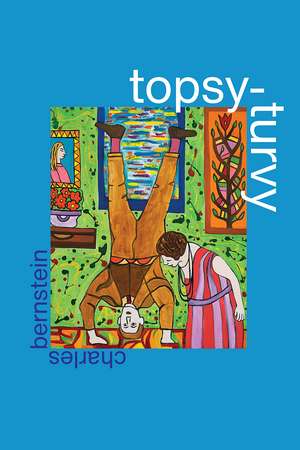
Topsy-Turvy
Autor Charles Bernsteinen Limba Engleză Paperback – 30 apr 2021
Though Bernstein’s poems play with form, they incorporate a melancholy, even tragic, sensibility. This “cognitive dissidence,” as Bernstein calls it, is reflected in a lyrically explosive mix of pathos, comedy, and wit, though the reader is kept guessing which is which at almost every turn. Topsy-Turvy includes an ode to the New York City subway and a memorial for Harpers Ferry hero Shields Green, along with collaborations with artists Amy Sillman and Richard Tuttle. This collection is also full of other voices: Pessoa, Geeshie Wiley, Friedrich Rückert, and Rimbaud; Carlos Drummond, Virgil, and Brian Ferneyhough; and even Caudio Amberian, an imaginary first-century aphorist.
Bernstein didn’t set out to write a book about the pandemic, but these poems, performances, and translations are oddly prescient, marking a path through dark times with a politically engaged form of aesthetic resistance: We must “Continue / on, as / before, as / after.”
The audio version of Topsy-Turvy is performed by the author.
Preț: 220.66 lei
Puncte Express: 331
Carte disponibilă
Livrare economică 05-19 noiembrie
Livrare express 22-28 octombrie pentru 25.35 lei
Livrare prin curier în România Termenul estimat este afișat lângă disponibilitate.
Transport gratuit de la 400.00 lei Plată online sau ramburs, în funcție de opțiunile comenzii.
Retur gratuit în 14 zile Comandă securizată și suport în română.
Specificații
ISBN-13: 9780226783604
ISBN-10: 022678360X
Pagini: 176
Ilustrații: 1 color plate, 1 halftone
Dimensiuni: 152 x 229 x 23 mm
Greutate: 0.31 kg
Ediția:First Edition
Editura: University of Chicago Press
Colecția University of Chicago Press
ISBN-10: 022678360X
Pagini: 176
Ilustrații: 1 color plate, 1 halftone
Dimensiuni: 152 x 229 x 23 mm
Greutate: 0.31 kg
Ediția:First Edition
Editura: University of Chicago Press
Colecția University of Chicago Press
Notă biografică
Charles Bernstein is the author of many books, including the poetry collections Topsy-Turvy and Near/Miss and the critical works The Kinds of Poetry I Want: Essays and Comedies and Pitch of Poetry, which are published by the University of Chicago Press. He won the 2019 Bollingen Prize and the 2025 America Award for lifetime contribution to international writing. Bernstein is distinguished professor emeritus at the State University of New York at Buffalo and the Donald T. Regan Professor of English and Comparative Literature emeritus at University of Pennsylvania. He was elected to the American Academy of Arts and Sciences in 2006.
Cuprins
Book One: Cognitive Dissidence
Book Two: As I Love
Book Three: Locomotion
Book Four: Last Kind Words
Notes and Acknowledgments
Index
Book Two: As I Love
Book Three: Locomotion
Book Four: Last Kind Words
Notes and Acknowledgments
Index
Recenzii
“Bernstein is less the furloughed bohemian imagining that he is writing only for himself—not marooned, disowned, or marginalized. Instead, he is employed, populated, by poetry. He is well-read and plugged in. . . . [His] poetry is indeed topsy-turvy. Is he playing a game with our emotions? That is for the reader to decide.”
"Bernstein’s constant movement between sincerity and irony, melancholy and humor, seems particularly appropriate for the era of the pandemic. . . . Topsy-Turvy leaves us with a syncretic gathering of voices, both ambiguous and obscure, and clear and direct. Confronted with the realities of the pandemic, Bernstein’s poetry provides us with a way of appreciating life, despite its impermanence. He reveals order by resisting order, and gives us the world in a new light by playing brilliantly with the old ways."
"Bernstein is a philosophical poet, but not one who articulates philosophical systems so much as one who enacts philosophy itself. Any lack of obvious pleasures in his poetry — his jarring, gangly meters, his love for le mot injuste — should not be seen merely as a sort of intramural critique of the social operations of language, but rather, in addition, we should view Bernstein’s calls to the virtual as signaling a preoccupation with hope. By this I mean: how do we drag these broken bones, how do we assimilate these failures at transcendence, how do we negotiate this commerce between the 'I' and the 'Thou,' in a world that has closed off true potential in the confines of the merely possible? There must be more, there is more, in Bernstein’s view, even as he’s never so doctrinaire, or willing to compromise his sense of the virtual, of the ever forthcoming that already is, as to provide names or definitions for it."
"Not set out to be a book about the pandemic, this rowdy collection of poems, performances, and translations nevertheless speaks volumes about the upside-down world we have all found ourselves living in."
“As poet, editor, critic, translator, and educator, Bernstein’s decades-long commitment to the community of arts and letters reflects a profound understanding of the importance of language in the business of culture-making. Throughout his career Bernstein has facilitated a vibrant dialogue between lyric and anti-lyric tendencies in the poetic traditions we have inherited; in so doing, he has shaped and questioned, defined and dismantled ideas and assumptions in order to reveal poetry’s widest and most profound capabilities.”