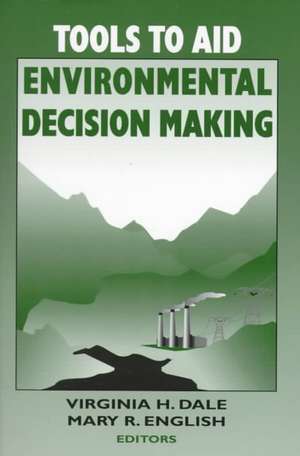
Tools to Aid Environmental Decision Making
Editat de Virginia H. Dale, Mary R. Englishen Limba Engleză Paperback – 21 dec 1998
Preț: 380.12 lei
Puncte Express: 570
Carte tipărită la comandă
Livrare economică 19 noiembrie-03 decembrie
Livrare prin curier în România Termenul estimat este afișat lângă disponibilitate.
Transport gratuit de la 400.00 lei Plată online sau ramburs, în funcție de opțiunile comenzii.
Retur gratuit în 14 zile Comandă securizată și suport în română.
Specificații
ISBN-13: 9780387985565
ISBN-10: 0387985565
Pagini: 360
Ilustrații: XV, 342 p.
Dimensiuni: 155 x 235 x 20 mm
Greutate: 0.55 kg
Ediția:1999
Editura: Springer
Locul publicării:New York, NY, United States
ISBN-10: 0387985565
Pagini: 360
Ilustrații: XV, 342 p.
Dimensiuni: 155 x 235 x 20 mm
Greutate: 0.55 kg
Ediția:1999
Editura: Springer
Locul publicării:New York, NY, United States
V-ar putea interesa
-
 The Evolving Sphere of Food SecurityRosamond L. Naylor-28%Preț: 421.98 lei586.61 lei
 -
 Energy Poverty: Global Challenges and Local SolutionsAntoine Halff-31%Preț: 937.17 lei1363.42 lei
 -
 -13%Preț: 251.65 lei288.48 lei
 -
 Practical Authority: Agency and Institutional Change in Brazilian Water PoliticsRebecca Neaera Abers-11%Preț: 337.28 lei380.43 lei
 -
 Ecological Responses to the 1980 Eruption of Mount St. HelensVirginia H. DalePreț: 446.76 lei
 -
 Applying Ecological Principles to Land ManagementVirginia H. Dale-15%Preț: 673.68 lei792.56 lei
 -
 Watershed Management 2eHeathcote-9%Preț: 975.31 lei1071.77 lei
 -
 Global Energy DilemmasMike BradshawPreț: 175.78 lei
 -
 -31%Preț: 474.44 lei690.05 lei
 -
 Sustainable Surface Water Management - a Handbook For SUDSColin A. Booth-23%Preț: 755.28 lei980.87 lei
 -
 -9%Preț: 866.99 lei952.74 lei
 -
 Energy Security in Japan: Challenges After FukushimaVlado Vivoda-18%Preț: 1253.73 lei1528.95 lei
 -
 For the Love of LandJim HowellPreț: 168.14 lei
 -
 Hypoxia in the Northern Gulf of MexicoVirginia H. Dale-18%Preț: 1186.05 lei1446.40 lei
 -
 Reviews of Environmental Contamination and Toxicology Volume 212David M. Whitacre-15%Preț: 612.18 lei720.20 lei
 -
 Ecological Modeling for Resource ManagementVirginia H. Dale-15%Preț: 676.57 lei795.96 lei
 -
 Application of Threshold Concepts in Natural Resource Decision MakingGlenn R. Guntenspergen-18%Preț: 925.50 lei1128.65 lei
 -
 Reviews of Environmental Contamination and Toxicology Volume 226David M. Whitacre-20%Preț: 594.01 lei742.51 lei
 -
 Reviews of Environmental Contamination and Toxicology Volume 225David M. Whitacre-44%Preț: 539.09 lei970.63 lei
 -
 Reviews of Environmental Contamination and Toxicology Volume 217David M. Whitacre-15%Preț: 612.18 lei720.20 lei
 -
 Reviews of Environmental Contamination and Toxicology Volume 218David M. Whitacre-44%Preț: 540.40 lei970.86 lei
 -
 Disrupted LandscapesStefan Dorondel-23%Preț: 760.83 lei988.09 lei
Public țintă
Professional/practitionerCuprins
1. Overview.- 2. Identifying Environmental Values.- 3. Tools to Characterize the Environmental Setting.- 4. Tools for Understanding the Socioeconomic and Political Settings for Environmental Decision Making.- 5. Characterizing the Regulatory and Judicial Setting.- 6. Integration of Geographic Information.- 7. Forecasting for Environmental Decision Making.- 8. Assessment, Refinement, and Narrowing of Options.- 9. Post-Decision Assessment.- 10. Next Steps for Tools to Aid Environmental Decision Making.- Biographies of Contributing Authors.