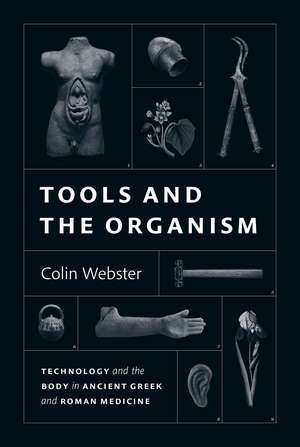
Tools and the Organism: Technology and the Body in Ancient Greek and Roman Medicine
Autor Colin Websteren Limba Engleză Hardback – 24 noi 2023
Notăm cu interes apariția lucrării Tools and the Organism, o analiză fascinantă care propune o perspectivă interdisciplinară riguroasă la intersecția dintre istoria medicinii, filozofia antică și arheologia tehnologică. Remarcăm modul în care Colin Webster deconstruiește viziunea tradițională asupra corpului uman, demonstrând că însăși noțiunea de „organ” a apărut ca urmare a interacțiunii medicilor antici cu uneltele și dispozitivele tehnice ale epocii lor. Autorul susține că medicina nu este doar o aplicație a științei, ci o tehnologie în sine, unde corpul a început să fie conceptualizat ca un „organism” — un ansamblu funcțional în care părțile interne sunt văzute ca unelte (organa) destinate unor sarcini vitale specifice.
Structura cărții urmărește o progresie cronologică și conceptuală clară, pornind de la „interfețele tehnologice” din tratatele hipocratice, unde compoziția corporală era privită fără o segmentare pe organe, și avansând către modelele complexe ale lui Platon și Aristotel. Un aspect distinctiv al lucrării este analiza detaliată a modului în care inovațiile în hidraulică și sistemele pneumatice au redefinit înțelegerea respirației și a sistemului vascular. Comparabil cu Body and Machine in Classical Antiquity de Maria Gerolemou în rigurozitatea cu care tratează interfața dintre biologie și artefact, volumul lui Webster este actualizat pentru noile dezbateri despre cultura materială, oferind o perspectivă mai profundă asupra modului în care analogiile tehnice nu au fost doar metafore, ci modele constitutive ale realității somatice. Deși autorul a explorat anterior teme de impact social, această lucrare reprezintă o rafinare academică a preocupărilor sale pentru modul în care structurile externe modelează experiența umană internă.
Preț: 327.76 lei
Carte disponibilă
Livrare economică 16-30 mai
Livrare express 05-09 mai pentru 42.51 lei
Specificații
ISBN-10: 0226828778
Pagini: 320
Ilustrații: 23 halftones
Dimensiuni: 152 x 229 x 28 mm
Greutate: 0.57 kg
Ediția:First Edition
Editura: University of Chicago Press
Colecția University of Chicago Press
De ce să citești această carte
Credem că această carte este esențială pentru cercetătorii în istoria științei și filozofie clasică. Cititorul va câștiga o înțelegere nouă asupra modului în care tehnologia nu doar asistă medicina, ci fundamentează conceptele noastre despre anatomie. Este o recomandare excelentă pentru cei care doresc să descopere originile materiale ale termenului de „organism” și modul în care ingineria antică a „construit” corpul uman modern prin analogii ingenioase.
Despre autor
Colin Webster este profesor de criminologie la Leeds Metropolitan University, având o activitate academică ce traversează granițele disciplinare. Deși este cunoscut publicului larg pentru lucrări de ficțiune care explorează teme precum supraviețuirea și conflictul în contexte istorice și fantastice — precum Blood and Silver sau Blood and Tequila — în volumul de față, Webster își canalizează expertiza de cercetare către istoria ideilor și a medicinii antice. Abordarea sa în Tools and the Organism reflectă o preocupare constantă pentru modul în care mediul material și instrumentele tehnice influențează structurile de gândire și comportamentul uman, fie ele sociale sau biologice.
Descriere scurtă
Medicine is itself a type of technology, involving therapeutic tools and substances, and so one can write the history of medicine as the application of different technologies to the human body. In Tools and the Organism, Colin Webster argues that, throughout antiquity, these tools were crucial to broader theoretical shifts. Notions changed about what type of object a body is, what substances constitute its essential nature, and how its parts interact. By following these changes and taking the question of technology into the heart of Greek and Roman medicine, Webster reveals how the body was first conceptualized as an “organism”—a functional object whose inner parts were tools, or organa, that each completed certain vital tasks. He also shows how different medical tools created different bodies.
Webster’s approach provides both an overarching survey of the ways that technologies impacted notions of corporeality and corporeal behaviors and, at the same time, stays attentive to the specific material details of ancient tools and how they informed assumptions about somatic structures, substances, and inner processes. For example, by turning to developments in water-delivery technologies and pneumatic tools, we see how these changing material realities altered theories of the vascular system and respiration across Classical antiquity. Tools and the Organism makes the compelling case for why telling the history of ancient Greco-Roman medical theories, from the Hippocratics to Galen, should pay close attention to the question of technology.
Notă biografică
Cuprins
Notes on Translations, Names, Citations, and Editions
Introduction
0.1 Technologies and the Consolidation of the Body
0.2 Teleology, Mechanism, Vitalism, and Technology
0.3 Analogies, Metaphors, and Models
0.4 Chapter Overview
1: Hippocrates and Technological Interfaces
1.0 Introduction
1.1 Corporeal Composition without Organs
1.2 Regimen and the Body
1.3 Hippocrates’s Nature of the Human
1.4 Medical Implements and Hippocrates’s Morb. 4/Genit./Nat. Pue.
1.5 Female Corporeality and Gynecological Technologies
1.6 Conclusion
2: The Origins of the Organism
2.0 Introduction
2.1 Empedocles’s Clepsydra and the Corporeal Interior
2.2 Physikoi on Corporeal Tools
2.3 Plato’s Timaeus and Competing Technological Heuristics
2.4 Respiration, the Clepsydra, and Irrigation Pipes of the Fifth Century BCE
2.5 Irrigation and Water Distribution Technologies
2.6 Conclusion
3: Aristotle and the Emergence of the Organism
3.0 Introduction
3.1 The Soul and the Organism
3.2 The Tools of the Heart
3.3 The Journey of the Blood
3.4 Automata and Animal Motion
3.5 Conclusion
4: The Rise of the Organism in the Hellenistic Period
4.0 Introduction
4.1 The Rise of Anatomy
4.2 Herophilus of Chalcedon and Dissection Practices
4.3. Herophilus’s Bellows
4.4 Erasistratus of Ceos and Pneumatic Pathologies
4.5 Conclusion
5: The Organism and Its Alternatives
5.0 Introduction
5.1 Post-Erasistratean Hellenistic Organa
5.2 The Empiricist Resistance
5.3 The Infrastructure of Roman Power
5.4 Asclepiades of Bithynia
5.5 Asclepiades and Aqueducts
5.6 Methodism and Pneumatism
5.7 Soranus and Female Corporeality in Methodism
5.8 Conclusion
6: Galen and the Technologies of the Vitalist Organism
6.0 Introduction
6.1 The Return of Anatomy
6.2 Galen of Pergamon and On the Function of the Parts
6.3 Technologies and the Natural Faculties
6.4 Vivisection and the Vitalist Body
6.5 Logical and Material Tools of the Lemmatized Body
6.6 The Material Technologies of Vitalism
6.7 Conclusion
Conclusion
Acknowledgments
Bibliography