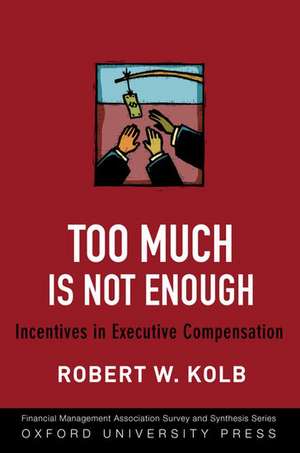
Too Much Is Not Enough: Incentives in Executive Compensation: Financial Management Association Survey and Synthesis Series
Autor Robert W. Kolben Limba Engleză Hardback – 4 oct 2012
Din seria Financial Management Association Survey and Synthesis Series
- 32%
 Preț: 982.15 lei
 - 30%
 Preț: 1142.45 lei
 - 11%
 Preț: 286.06 lei
 - 30%
 Preț: 656.30 lei
 - 20%
 Preț: 360.86 lei
 - 30%
 Preț: 769.83 lei
 - 30%
 Preț: 951.57 lei
 - 21%
 Preț: 390.43 lei
 - 34%
 Preț: 902.16 lei
 - 26%
 Preț: 529.75 lei
 - 24%
 Preț: 201.80 lei
 - 27%
 Preț: 516.27 lei
 - 30%
 Preț: 988.11 lei
 - 31%
 Preț: 808.47 lei
 - 29%
 Preț: 529.33 lei
 - 30%
 Preț: 1025.25 lei
Preț: 360.44 lei
Preț vechi: 501.65 lei
-28%
Puncte Express: 541
Carte tipărită la comandă
Livrare economică 04-15 decembrie
Livrare prin curier în România Termenul estimat este afișat lângă disponibilitate.
Transport gratuit de la 400.00 lei Plată online sau ramburs, în funcție de opțiunile comenzii.
Retur gratuit în 14 zile Comandă securizată și suport în română.
Specificații
ISBN-13: 9780199829583
ISBN-10: 0199829586
Pagini: 232
Ilustrații: 36 b/w line
Dimensiuni: 155 x 236 x 23 mm
Greutate: 0.45 kg
Ediția:New.
Editura: Oxford University Press
Colecția OUP USA
Seria Financial Management Association Survey and Synthesis Series
Locul publicării:New York, United States
ISBN-10: 0199829586
Pagini: 232
Ilustrații: 36 b/w line
Dimensiuni: 155 x 236 x 23 mm
Greutate: 0.45 kg
Ediția:New.
Editura: Oxford University Press
Colecția OUP USA
Seria Financial Management Association Survey and Synthesis Series
Locul publicării:New York, United States
V-ar putea interesa
-
 May Contain LiesAlex EdmansPreț: 84.79 lei
 -
 What's Stopping You?Timothy ArmooPreț: 122.79 lei
 -
 The Winner's CurseRichard H. ThalerPreț: 224.87 lei
 -
 Mixed Signals: How Incentives Really WorkUri GneezyPreț: 116.18 lei
 -
 Uncompete: Rejecting Competition to Unlock SuccessRuchika T. Malhotra-24%Preț: 156.29 lei206.09 lei
 -
 Preț: 525.43 lei
 -
 Encouraging the HeartJames M. KouzesPreț: 127.58 lei
 -
 From Values to ActionHarry M Jansen KraemerPreț: 192.15 lei
 -
 Preț: 137.61 lei
 -
 Preț: 135.43 lei
 -
 -34%Preț: 78.80 lei119.97 lei
 -
 Your Boss EraHeather ElkingtonPreț: 122.83 lei
 -
 The Performance ParadoxEduardo BriceñoPreț: 79.32 lei
 -
 Disrupt EverythingJames PattersonPreț: 122.07 lei
 -
 Don't Be YourselfTomas Chamorro-PremuzicPreț: 176.75 lei
 -
 10 to 25David YeagerPreț: 94.46 lei
 -
 Great by ChoiceJim CollinsPreț: 147.19 lei
 -
 The Winner's CurseRichard H ThalerPreț: 178.78 lei
 -
 Preț: 145.41 lei
 -
 HBR's 10 Must Reads 2026Bent FlyvbjergPreț: 143.29 lei
Recenzii
Assessing the effectiveness of executive pay arrangements in providing desirable incentives presents important questions and has generated a tremendous amount of research. Making this research accessible to a wider audience, and drawing on it to discuss how pay arrangements can be improved, Too Much is Not Enough is a welcome contribution to the ongoing debates on the subject.
Notă biografică
Robert W. Kolb is Professor of Finance and Frank W. Considine Chair of Applied Ethics at Loyola University Chicago. He has been professor of finance at the University of Florida, Emory University, the University of Miami, and the University of Colorado, and has published more than 20 books, including Lessons from the Financial Crisis: Causes, Consequences, and Our Economic Future and Futures, Options, and Swaps.
Cuprins
- Preface
- 1. The Magnitude and Structure of Executive Compensation
- The Magnitude of CEO Compensation
- The Structure of Executive Compensation
- Salary
- Bonuses and Long-Term Incentive Plans
- Restricted Stock Awards
- Executive Stock Option (ESO) Awards
- Other Forms of Compensation
- 2. Corporate Governance, Agency Problems, and Executive Compensation
- Corporate Governance
- Agency Theory and Incentive Alignment
- Corporate Governance, Incentive Alignment, and the Managerial Power Hypothesis
- The Levers of Managerial Power
- Limits to Pay on the Managerial Power Hypothesis
- Assessing the Conceptual Conflict Between the Agency-Theoretic and Managerial Power Views of Executive Compensation
- What about Ethics, Duty, and Justice?
- Fiduciary Duty
- Executive Compensation and Distributive Justice
- 3. The Incentive Structure of Executive Compensation
- The Incentive Revolution and Executive Compensation
- Salary
- Bonuses
- Restricted Stock and Performance Shares
- Executive Stock Options
- Equity Compensation: Retaining the Employees You Have, and Attracting the Ones You Want
- Different Instruments as Tools of Incentive Compensation
- 4. Executive Stock Options and the Incentives They Create
- ESO Incentives, Firm Practices, and the Effect of Accounting Rules
- Option Pricing Models
- Option Valuation Effects of Individual Option Parameters
- The Option Pricing Model and Incentives
- Executive Stock Option Design, Management, and Incentives
- What Exercise Price?
- Repricing and Reloading Executive Stock Options
- The CEO's Utility and the Desire for ESOs
- 5. Executive Stock Option Programs: The Behavior of CEOs, Firms, and Investors
- CEO Wealth, Pay, and Performance
- Exercise of ESOs
- BOX 1: Detecting Abnormal Stock Market Performance
- Unwinding Incentives
- 6. Executive Incentives and Risk-Taking
- Equity Compensation and the CEO's Risk Appetite
- Executive Compensation and the Risk-Taking Behavior of CEOs
- Incentive Compensation, Risk-Taking, and the Financial Crisis of 2007-2009
- 7. Incentive Compensation and the Management of the Firm
- Incentive Compensation and the Firm's Investment Program
- CEO Incentives and the Firm's Financing Decisions
- Compensation Incentives, Dividends, and Share Repurchases,
- Corporate Mergers, Acquisitions, and Liquidations
- Compensation Incentives and Corporate Risk Management
- Compensation Incentives and Corporate Disclosures
- 8. Perverse Incentive Effects: Executives Behaving Badly
- Earnings Management
- Option Games and Exploitation
- Option Games: A Warning About Incentives in Executive Compensation
- 9. Incentives in Executive Compensation: A Final Assessment
- Incentive Compensation and the Level of Executive Pay
- New Legislation and the Shaping of Incentives
- How Dysfunctional is Executive Pay?
- On Balance, Is Incentive Compensation Beneficial?
- To Improve Executive Compensation, Improve Corporate Governance
- Executive Pay, Continuing Inequality, and the Question of Justice
- Appendix: Binomial Valuation Method for Executive Stock Options
- Notes
- References
- Index