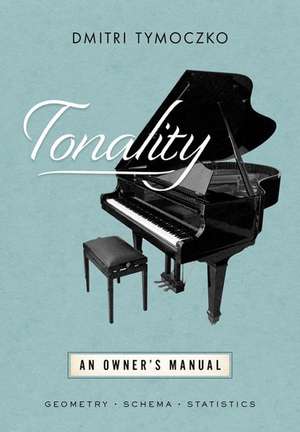
Tonality: An Owner's Manual: OXFORD STUDIES IN MUSIC THEORY
Autor Dmitri Tymoczkoen Limba Engleză Hardback – 14 dec 2023
Preț: 231.39 lei
Preț vechi: 288.20 lei
-20%
Puncte Express: 347
Carte tipărită la comandă
Livrare economică 04-09 decembrie
Livrare express 28 octombrie-03 noiembrie pentru 121.28 lei
Livrare prin curier în România Termenul estimat este afișat lângă disponibilitate.
Transport gratuit de la 400.00 lei Plată online sau ramburs, în funcție de opțiunile comenzii.
Retur gratuit în 14 zile Comandă securizată și suport în română.
Specificații
ISBN-13: 9780197577103
ISBN-10: 0197577105
Pagini: 632
Ilustrații: 698
Dimensiuni: 188 x 244 x 58 mm
Greutate: 1.25 kg
Editura: Oxford University Press
Colecția OUP USA
Seria OXFORD STUDIES IN MUSIC THEORY
Locul publicării:New York, United States
ISBN-10: 0197577105
Pagini: 632
Ilustrații: 698
Dimensiuni: 188 x 244 x 58 mm
Greutate: 1.25 kg
Editura: Oxford University Press
Colecția OUP USA
Seria OXFORD STUDIES IN MUSIC THEORY
Locul publicării:New York, United States
Recenzii
Tonality: An Owner's Manual is Dmitri Tymoczko's dazzling answer to the controversial quest for a transhistorical definition of tonality. By disentangling what composers do from what theorists say, Tymoczko presents a fascinating exposition of common compositional principles that animate Western music from Renaissance polyphony to jazz, rock, and contemporary triadic idioms.
Dmitri Tymoczko is an original musical thinker who combines mathematical skills and good musicianship in search of universal principles of pitch organization. Tonality: An Owner's Manual continues this quest in proposing a geometrical, hierarchical voice-leading theory that has applications across diverse musical styles. It is written with admirable clarity.
This volume is intended for readers with advanced training in music theory. It is in many ways a compendium of thought in the field of "tonal" music theory, that aspect of music theory concerned with musical harmonies as they can be related to each other, often via a central harmony or pitch--a "tonal center." The gathering of recent trends in music theory becomes a launch pad for the author's own astute theoretical projections, many of them informed by his work in the geometry of music theory. The book should be required reading for the specialist music theorist.
Dmitri Tymoczko is an original musical thinker who combines mathematical skills and good musicianship in search of universal principles of pitch organization. Tonality: An Owner's Manual continues this quest in proposing a geometrical, hierarchical voice-leading theory that has applications across diverse musical styles. It is written with admirable clarity.
This volume is intended for readers with advanced training in music theory. It is in many ways a compendium of thought in the field of "tonal" music theory, that aspect of music theory concerned with musical harmonies as they can be related to each other, often via a central harmony or pitch--a "tonal center." The gathering of recent trends in music theory becomes a launch pad for the author's own astute theoretical projections, many of them informed by his work in the geometry of music theory. The book should be required reading for the specialist music theorist.
Notă biografică
Dmitri Tymoczko is a composer and music theorist who teaches at Princeton University. Widely recognized as one of the world's leading music theorists, his music has been performed all over the world.