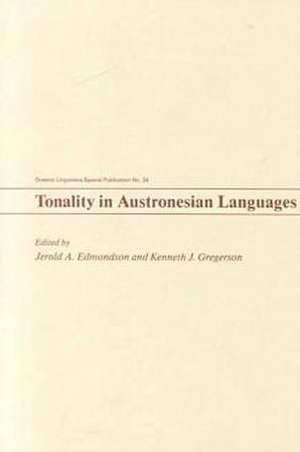
Tonality in Austronesian Languages
Editat de Jerold A Edmondson, Kenneth J Gregersonen Limba Engleză Paperback – mar 1993
Tonogenesis in the North Huon Gulf Chain
Ross, Malcolm D Uses of phonation type in Javanese
Poedjosoedarmo, Gloria R Voicing and vowel height in Madurese: a preliminary report
Cohn, Abigail C Phan Rang Cham and Utsat: Tonogenetic themes and variants
Thurgood, Graham Tone in Utsat
Maddieson, Ian and Keng-Fong Pang Overview of Austronesian and Philippine accent patterns
Zorc, R. David Western Cham as a register language
Edmondson, Jerold A. and Kenneth J. Gregerson Tonogenesis in New Caledonia
Rivierre, Jean-Claude Proto-Austronesian stress
Wolff, John U Proto-Micronesian prosody
Rehg, Kenneth L Austronesian final consonants and the origin of Chinese tones
Sagart, Laurent
Preț: 182.82 lei
Preț vechi: 222.81 lei
-18%
Puncte Express: 274
Preț estimativ în valută:
32.33€ • 37.20$ • 27.92£
32.33€ • 37.20$ • 27.92£
Carte indisponibilă temporar
Doresc să fiu notificat când acest titlu va fi disponibil:
Se trimite...
Specificații
ISBN-13: 9780824815301
ISBN-10: 0824815300
Pagini: 192
Dimensiuni: 147 x 222 x 12 mm
Greutate: 0.26 kg
Ediția:New.
Editura: University of Hawaii Press
ISBN-10: 0824815300
Pagini: 192
Dimensiuni: 147 x 222 x 12 mm
Greutate: 0.26 kg
Ediția:New.
Editura: University of Hawaii Press
Textul de pe ultima copertă
The Tang (618-907) and Sung (960-1279) dynasties were times of great change in China. The economy grew spectacularly, the population doubled, migration brought more and more people to the fertile south, and printing led to a great increase in the availability of books. Buddhism became a fully sinicized religion that penetrated deeply into ordinary life. New cults and sects appeared and flourished. Chan became the dominant force within institutional Buddhism, Celestial Heart and Thunder Rites teachings gained prominence within Taoism, local gods such as Wen-chang came to be worshiped all over the country, and office-holding gods, such as the gods of city walls, became a common feature of the popular pantheon. Even Neo-Confucianism, often thought of simply as an intellectual movement, was in many ways like a new sect, its followers asked to alter fundamentally their patterns of daily life and even to worship at shrines to Confucian heroes. How were changes in the religions of the Chinese people implicated in the momentous social and cultural changes of this period? This volume represents a collaborative effort of nine scholars of Chinese religion, history, and thought to begin addressing this question. Their separate chapters vividly convey the diversity of the Tang and Sung religious world: gods that communicate through spirit writing; scholars who use veneration of maligned officials as subtle forms of political protest; local residents who try to enhance their power by asserting the power of their gods or getting titles for them; officials who seek the most up-to-date techniques to master occult forces. Still the larger goal of the authors is to contribute toward a more integratedunderstanding of Chinese culture and the ways it has changed. Basing themselves on close study of often difficult texts, each author has looked for evidence of interconnections: links between social and religious changes, between political or economic developments and religious ideas or practices, between folk religion and institutional religion, between Confucian philosophy and changes in the social and religious landscape, and between the ways religious and secular groups were organized. Taken together, these nine chapters present a new, fuller, and more nuanced view of the Chinese religions in this period of change.