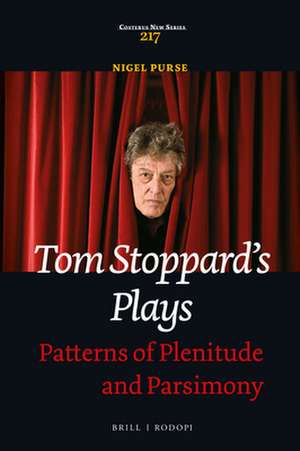
Tom Stoppard's Plays
Autor Nigel Purseen Limba Engleză Hardback – 17 noi 2016
Quoting extensively from all Stoppard’s published works, many of his interviews and also unpublished material Nigel Purse arrives at a comprehensive and unique appraisal of Stoppard’s plays.
Preț: 1045.44 lei
Preț vechi: 1274.93 lei
-18%
Puncte Express: 1568
Preț estimativ în valută:
185.08€ • 215.51$ • 160.78£
185.08€ • 215.51$ • 160.78£
Carte indisponibilă temporar
Doresc să fiu notificat când acest titlu va fi disponibil:
Se trimite...
Preluare comenzi: 021 569.72.76
Specificații
ISBN-13: 9789004318366
ISBN-10: 9004318364
Pagini: 686
Dimensiuni: 160 x 236 x 41 mm
Greutate: 1.11 kg
Editura: Brill
ISBN-10: 9004318364
Pagini: 686
Dimensiuni: 160 x 236 x 41 mm
Greutate: 1.11 kg
Editura: Brill
Cuprins
FOREWORD
PROLOGUE
OCCAM’S RAZOR
THE STOPPARDIAN STAGE DEBATE
THE VEHICLE VERSUS THE IDEA
ETHICS
DUALISM–ILLUSION AND REALITY
STOPPARD’S THEATRICALITY
STOPPARD’S TIME SHIFTS
CODA
APPENDICES
BIBLIOGRAPHY
ACKNOWLEDGEMENTS
INDEX
PROLOGUE
OCCAM’S RAZOR
THE STOPPARDIAN STAGE DEBATE
THE VEHICLE VERSUS THE IDEA
ETHICS
DUALISM–ILLUSION AND REALITY
STOPPARD’S THEATRICALITY
STOPPARD’S TIME SHIFTS
CODA
APPENDICES
BIBLIOGRAPHY
ACKNOWLEDGEMENTS
INDEX
Notă biografică
Nigel Purse has an MA in Modern History from St. Edmund Hall, Oxford and an MBA from Cass (formerly City) University. He has a wide and keen interest in theatre, the arts and history.
Recenzii
“In a nutshell, Nigel Purse has succeeded in his study Tom Stoppard’s Plays: Patterns of Plenitude and Parsimony by application of Occam’s razor – which he identifies as the foundation of Stoppard’s work itself – to identify the central leitmotifs that make up the playwright’s truly entire canon. He does so in a most elaborate and comprehensive way not shying away from any archive or obscure publication of the artist.” - Holger Südkamp, Neuss, in: Symbolism Vol. 17 (2017)