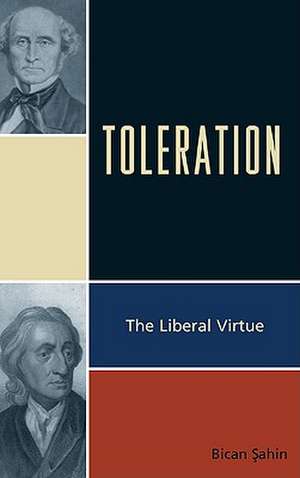
Toleration: The Liberal Virtue
Autor Bican Sahinen Limba Engleză Hardback – 23 iun 2010
Toleration: The Liberal Virtue is a defense of toleration as a remedy to societal conflict caused by differences. It examines four prominent grounds of toleration: skepticism, prudence, autonomy, and conscience which are illustrated through the works of four pioneering liberals, namely, Michel de Montaigne, John Locke, John Stuart Mill, and Pierre Bayle, respectively.
Preț: 567.53 lei
Preț vechi: 862.15 lei
-34%
Puncte Express: 851
Carte tipărită la comandă
Livrare economică 02-16 decembrie
Livrare prin curier în România Termenul estimat este afișat lângă disponibilitate.
Transport gratuit pentru acest produs Plată online sau ramburs, în funcție de opțiunile comenzii.
Retur gratuit în 14 zile Comandă securizată și suport în română.
Specificații
ISBN-13: 9780739147399
ISBN-10: 0739147390
Pagini: 123
Dimensiuni: 162 x 241 x 18 mm
Greutate: 0.36 kg
Editura: Bloomsbury Publishing
Colecția Lexington Books
Locul publicării:New York, United States
ISBN-10: 0739147390
Pagini: 123
Dimensiuni: 162 x 241 x 18 mm
Greutate: 0.36 kg
Editura: Bloomsbury Publishing
Colecția Lexington Books
Locul publicării:New York, United States
Cuprins
1 ACKNOWLEDGMENTS
Chapter 2 1. INTRODUCTION
Chapter 3 2. SKEPTICISM AND TOLERATION: THE CASE OF MICHEL DE MONTAIGNE
Chapter 4 3. PRUDENCE AND TOLERATION: THE CASE OF JOHN LOCKE
Chapter 5 4. AUTONOMY AND TOLERATION: THE CASE OF JOHN STUART MILL
Chapter 6 5. CONSCIENCE AND TOLERATION: THE CASE OF PIERRE BAYLETHE DEFENDER OF CONSCIENCE: PIERRE BAYLE
Chapter 7 6. TWO VERSIONS OF LIBERALISM AND THEIR POSITIONS ON TOLERATION
Chapter 8 7. CONCLUSION
9 BIBLIOGRAPHY
Chapter 2 1. INTRODUCTION
Chapter 3 2. SKEPTICISM AND TOLERATION: THE CASE OF MICHEL DE MONTAIGNE
Chapter 4 3. PRUDENCE AND TOLERATION: THE CASE OF JOHN LOCKE
Chapter 5 4. AUTONOMY AND TOLERATION: THE CASE OF JOHN STUART MILL
Chapter 6 5. CONSCIENCE AND TOLERATION: THE CASE OF PIERRE BAYLETHE DEFENDER OF CONSCIENCE: PIERRE BAYLE
Chapter 7 6. TWO VERSIONS OF LIBERALISM AND THEIR POSITIONS ON TOLERATION
Chapter 8 7. CONCLUSION
9 BIBLIOGRAPHY
Recenzii
In today's globalized world, in which different peoples, states, and religions increasingly interact -and sometimes collide-with one another, few problems are more pressing than the issue of toleration. Sahin probes "the paradox of toleration" by asking the question why should we not persecute that with which we disagree? Using canonical political theorists - Montaigne, Locke, Mill and Bayle - as well as contemporary thinkers such as Kymlicka and Kukathas, Sahin presents an array of answers rooted in four different grounds for toleration: skepticism, prudence, autonomy, and conscience. Sahin's book is a good introduction to an important and timely issue. It is as enlightening as it is useful.
Sahin has done an excellent job of putting the debate about toleration into historical perspective.
Bican Sahin has provided an important study of the development of the Western concept of toleration. His analysis of the early modern thinkers is complemented by his consideration of John Stuart Mill, Will Kymlicka and Chandran Kukathus. The book is written with clarity and authority.
Sahin has done an excellent job of putting the debate about toleration into historical perspective.
Bican Sahin has provided an important study of the development of the Western concept of toleration. His analysis of the early modern thinkers is complemented by his consideration of John Stuart Mill, Will Kymlicka and Chandran Kukathus. The book is written with clarity and authority.