Cantitate/Preț
Produs

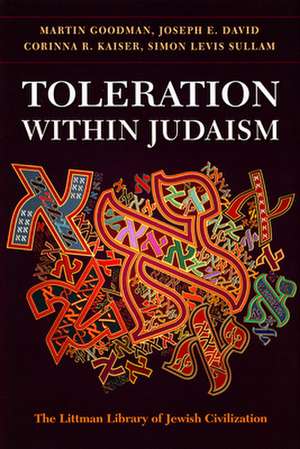
Toleration within Judaism

Autor Martin Goodman, Joseph E. David, Corinna R. Kaiser, Simon Levis Sullam
en Limba Engleză Hardback – 29 mai 2013

Observăm adesea tendința de a privi tradițiile religioase ca pe niște blocuri monolitice, însă Toleration within Judaism ne propune o perspectivă mult mai nuanțată: iudaismul ca o rețea complexă de interacțiuni, marcată de o diversitate internă surprinzătoare. Analiza pornește de la un detaliu fundamental — însăși Biblia numește poporul evreu „o adunare de națiuni” — sugerând că pluralismul nu este un fenomen modern, ci o trăsătură intrinsecă. Găsim în acest volum o investigație riguroasă asupra modului în care diferențele de practică și teologie au fost gestionate, de la toleranța forțată la acceptarea entuziastă.

Structura cărții este remarcabil de coerentă, fiind organizată cronologic pentru a permite cititorului să urmărească evoluția conceptului de „eroare tolerabilă”. După două capitole introductive care stabilesc cadrul teoretic, suntem purtați prin episoade istorice esențiale: rivalitățile dintre casele Hillel și Shammai în Mișna, conviețuirea în ghetoul Veneției sau provocările modernității în comunitățile din Curaçao. Cine a studiat Tolerance and Intolerance in Early Judaism and Christianity de Graham N. Stanton va aprecia aici focalizarea strictă pe dinamica internă a iudaismului, volumul aducând nou o documentare aprofundată a mecanismelor prin care comunitatea s-a autoreglat fără a recurge la excludere.

Credem că forța acestei lucrări rezidă în capacitatea de a demonstra cum pragmatismul și teologia s-au împletit pentru a menține unitatea în diversitate. Nu este doar o istorie a ideilor, ci și una a practicilor sociale, oferind perspective valoroase despre cum pot supraviețui grupuri cu viziuni divergente sub aceeași umbrelă identitară. Este o resursă academică esențială, publicată sub egida prestigioasei LUP – Littman Library, care transformă percepția asupra coeziunii religioase.

Citește tot Restrânge

Preț: 43950 lei

Preț vechi: 57078 lei
-23%

Puncte Express: 659

Carte disponibilă

Livrare economică 14-28 septembrie

Livrare prin curier în România Termenul estimat este afișat lângă disponibilitate.
Transport gratuit pentru acest produs Plată online sau ramburs, în funcție de opțiunile comenzii.
Retur gratuit în 14 zile Comandă securizată și suport în română.

Specificații

ISBN-13: 9781906764173
ISBN-10: 1906764174
Pagini: 246
Dimensiuni: 168 x 238 x 25 mm
Greutate: 0.66 kg
Ediția:1
Editura: LUP – Littman Library

De ce să citești această carte

Recomandăm această carte cercetătorilor și studenților interesați de istoria religiilor și sociologia toleranței. Cititorul câștigă o înțelegere profundă a modului în care iudaismul a supraviețuit prin negocierea diferențelor interne, nu prin eliminarea lor. Este o lectură esențială pentru a înțelege rădăcinile istorice ale pluralismului religios și mecanismele concrete — de la texte talmudice la decizii administrative — care permit coexistența în ciuda dezacordurilor teologice majore.


Despre autor

Martin Goodman este un reputat istoric și profesor de studii iudaice la Universitatea Oxford, specializat în perioada celui de-al Doilea Templu și în istoria evreilor sub stăpânire romană. Alături de el, Joseph E. David, Corinna R. Kaiser și Simon Levis Sullam aduc expertize diverse, de la dreptul evreiesc și filosofie la istoria modernă a comunităților evreiești din Europa și America. Împreună, acești autori reprezintă un colectiv de elită în cadrul cercetării academice contemporane, oferind o viziune multidisciplinară asupra evoluției gândirii iudaice.


Notă biografică

Martin Goodman is Professor of Jewish Studies in the University of Oxford, a Fellow of Wolfson College, and a Fellow of the Oxford Centre for Hebrew and Jewish Studies. Among his books on Jewish history are Rome and Jerusalem (2007) and Judaism in the Roman World: Collected Essays (2007). Joseph E. David is Senior Lecturer in Law and Religion at the Hebrew University of Jerusalem and Sapir Academic College. He has been a visiting professor at Rutgers, the University of Pennsylvania, and New York University, and a faculty member at the University of Oxford. He is the author of The Family and the Political: On Belonging and Responsibility in a Liberal Society (2012) and Between Logos and Nomos: Law and Theology in Medieval Jewish Thought (forthcoming). Corinna R. Kaiser has taught at the universities of Dusseldorf, Giessen, and Rutgers, the Hebrew University of Jerusalem, and the University of Oxford. She recently returned to Dusseldorf as a lecturer. She specializes in the cultural, ritual, and media history of the Jews in the twentieth and twenty-first centuries. Simon Levis Sullam is Assistant Professor of Modern History at Ca' Foscari, University of Venice. He has held visiting positions at Berkeley, at the European University Institute, and at the University of Oxford. His publications on Jewish history include a modern history of the Jews of Venice (Una Comunita Immaginata, 2001) and (as co-editor) the multi-volume Storia della Shoah (2006-10).

Cuprins

Preface Note on Transliteration 1 Introduction: The Study of Toleration 2 Toleration within Judaism from the Second Temple to the Present 3 Sadduccees and Pharisees in the Temple Martin Goodman 4 The Houses of Hillel and Shammai in the Mishnah Martin Goodman 5 The Notion of Tolerable Error from the Mishnah to Maimonides Joseph E. David 6 Talmudic Controversies in Post-Talmudic Eyes Joseph E. David 7 Toleration in the Ghetto of Venice: Evidence from Leon Modena's Historia de' riti Hebraici Simon Levis Sullam 8 Prescribing Toleration in the Paris Sanhedrin (1806 - 1807) Simon Levis Sullam 9 Islets of Toleration among the Jews of Curacao Corinna R. Kaiser 10 Sitting on Fences: The Toleration of Compromise and Mixed Seating in Orthodox Synagogues in the USA Corinna R. Kaiser 11 Conclusion: Causes of Toleration Bibliography Index

Descriere

The Bible itself calls the Jewish people 'a company of nations', suggesting that difference within Judaism is not a new phenomenon. It has continued throughout Jewish history, and this volume investigates how and why such difference has been tolerated. Drawing on examples from different geographical areas and from ancient times to the present, the contributors consider why Jews sometimes attempt to impose constraints on other Jews or relate to them as if they were not Jews at all, but at other times recognize differences of practice and belief and develop ways of handling them. In doing so, they provide an insight into a history of Judaism as a complex web of interactions between groups of Jews despite grounds for mutual antagonism. Substantial introductory chapters lay out the issues and provide an extensive survey of cases of toleration throughout the past two thousand years, outlining possible structural reasons for it. The eight chapters that follow each take a specific case of toleration within Judaism, attempting to explain it in light of the models outlined in the Introduction. Presented in chronological order, the cases have been selected to reflect a spectrum of responses, from grudging forbearance to enthusiastic welcome of difference. Covering both practice and theology, each case is presented in depth, with full documentation. The Conclusion provides an overview of the patterns of tolerance that have emerged and discusses the implications for writing the history of Judaism as a narrative more complex than either the tracing of a linear progression from the Bible to the present, with variations presented as deviations, or as a model of overlapping 'Judaisms'. This innovative volume sheds light on an important and overlooked aspect of the history of Judaism and should have broad appeal, not only for students and scholars of Judaism but for students of religious studies more generally.