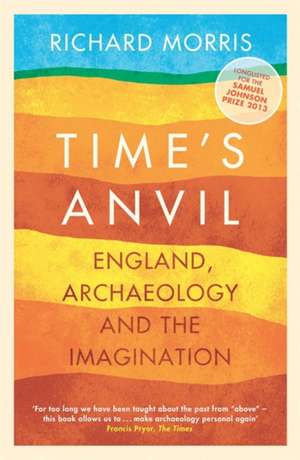
Time's Anvil: England, Archaeology and the Imagination
Autor Richard Morrisen Limba Engleză Paperback – 7 noi 2013
History thrives on stories. TIME'S ANVIL explores archaeology's influence on what such stories say, how they are told, who tells them and how we listen.
In a dazzlingly wide-ranging exploration, Richard Morris casts fresh light on three quarters of a million years of history in the place we now think of as England. Drawing upon genres that are usually pursued in isolation - like biography, poetry, or physics - he finds potent links between things we might imagine to be unrelated. His subjects range from humanity's roots to the destruction of the wildwood, from the first farmers to industrialization, and from Tudor drama to 20th-century conflict. Each topic sits at a different point along the continuum between epoch and the fleeting moment.
In part, this is a history of archaeology; in part, too, it is a personal account of the author's history in archaeology. But mainly it is about how the past is read, and about what we bring to the reading as well as what we find. The result is a book that defies categorisation, but one which will by turns surprise, enthrall and provoke anyone who cares for England, who we are and where we have come from. TIME'S ANVIL was longlisted for the Samuel Johnson Prize for Non-Fiction 2013.
Preț: 79.53 lei
Preț vechi: 107.27 lei
-26%
Puncte Express: 119
Carte disponibilă
Livrare economică 03-17 noiembrie
Livrare express 17-23 octombrie pentru 55.33 lei
Livrare prin curier în România Termenul estimat este afișat lângă disponibilitate.
Transport gratuit de la 400.00 lei Plată online sau ramburs, în funcție de opțiunile comenzii.
Retur gratuit în 14 zile Comandă securizată și suport în română.
Specificații
ISBN-13: 9781780222448
ISBN-10: 1780222440
Pagini: 480
Dimensiuni: 132 x 198 x 36 mm
Greutate: 0.38 kg
Editura: Orion Publishing Group
Colecția W&N
Locul publicării:London, United Kingdom
ISBN-10: 1780222440
Pagini: 480
Dimensiuni: 132 x 198 x 36 mm
Greutate: 0.38 kg
Editura: Orion Publishing Group
Colecția W&N
Locul publicării:London, United Kingdom
V-ar putea interesa
-
 Queen AnneAnne SomersetPreț: 122.11 lei
 -
 Singled OutVirginia NicholsonPreț: 133.11 lei
 -
 -20%Preț: 193.07 lei240.13 lei
 -
 A People of One Book: The Bible and the VictoriansTimothy Larsen-17%Preț: 283.41 lei339.94 lei
 -
 How to be a TudorRuth Goodman-19%Preț: 75.79 lei93.55 lei
 -
 She-WolvesHelen CastorPreț: 95.18 lei
 -
 -26%Preț: 68.90 lei93.62 lei
 -
 Bosworth: The Birth of the TudorsChris Skidmore-26%Preț: 79.62 lei107.14 lei
 -
 Preț: 67.94 lei
 -
 Perilous Question: The Drama of the Great Reform Bill 1832Lady Antonia Fraser-27%Preț: 77.67 lei106.16 lei
 -
 The Balfour Declaration: The Origins of the Arab-Israeli ConflictJonathan Schneer-26%Preț: 91.52 lei123.05 lei
 -
 Folk-Tales of IndiaRichard MorrisPreț: 200.91 lei
 -
 Preț: 183.57 lei
 -
 -25%Preț: 76.51 lei102.02 lei
 -
 Preț: 78.67 lei
 -
 Our Island StoryH.E. Marshall-26%Preț: 79.17 lei107.06 lei
 -
 Wellington: A Journey Through My FamilyLady Jane Wellesley-26%Preț: 79.86 lei107.28 lei
 -
 -18%Preț: 77.24 lei94.42 lei
 -
 Preț: 361.73 lei
Recenzii
The press release for this remarkable book announces that it 'defies categorisation'. It is not wrong. Longlisted for the Samuel Johnson prize, Time's Anvil contemplates what is now England over a span of 750,000 years.
Sometimes we are left with snapshots, including the varying view from Paviland Cave over the last 29,000 years; elsewhere the text lingers, as with the felling of the Old Wood. Along the way we meet eminent practitioners of many disciplines, as archaeology itself emerges and the stories it tells evolve. 'Archaeology', we are told, 'might be seen as but a late ripple in the cult of ancestors'. An acquired taste, perhaps, but presenting archaeology in this way has created an especially thought-provoking read
This is a remarkable, and in many respects a very courageous book - he puts himself on the line
For Morris, this book is an 'expedition' into the past, and as such it is both expansive and singular. But TIME'S ANVIL is also an impassioned history and defence of archeology, a history of humanity in England, and a heartfelt meditation on transience and mortality
[An] undeniably curious book...the story of archeology, mixed with the author's personal and family history, and interspersed with a smattering of scientific discourse, and a fair bit of poetry
I should have told you about this superb piece of work months ago... It is a wonderful reminder of the extent of human knowledge and how little we can know about our own past. It is possible to hold a Saxon's helmet in your hand but you can't hear the man who wore it speak. This is a wise book, worth the investment.
This fascinating book - a combination of the author's autobiography and a biography of the science of archaeology in England since the 17th century - suggests that some historical truths are found and proved, rather than created, by archaeology
Combining literature and myth with science, it explores how the past is read and the relevance and role of archaeology while challenging assumptions about our history
A richly textured, and very moving, hybrid of a book: silted, layered, as studded with jewels as the mud around an Anglo-Saxon tomb. The ground beneath your feet - or the keepsakes cleared from a relative's home - will never feel the same again,
This book allows us to regain possession and to make archeology personal again.
He makes the point that history is always changing, as we find new things, or come to see old things in new ways.
A thoughtful book, intelligent book.
Sometimes we are left with snapshots, including the varying view from Paviland Cave over the last 29,000 years; elsewhere the text lingers, as with the felling of the Old Wood. Along the way we meet eminent practitioners of many disciplines, as archaeology itself emerges and the stories it tells evolve. 'Archaeology', we are told, 'might be seen as but a late ripple in the cult of ancestors'. An acquired taste, perhaps, but presenting archaeology in this way has created an especially thought-provoking read
This is a remarkable, and in many respects a very courageous book - he puts himself on the line
For Morris, this book is an 'expedition' into the past, and as such it is both expansive and singular. But TIME'S ANVIL is also an impassioned history and defence of archeology, a history of humanity in England, and a heartfelt meditation on transience and mortality
[An] undeniably curious book...the story of archeology, mixed with the author's personal and family history, and interspersed with a smattering of scientific discourse, and a fair bit of poetry
I should have told you about this superb piece of work months ago... It is a wonderful reminder of the extent of human knowledge and how little we can know about our own past. It is possible to hold a Saxon's helmet in your hand but you can't hear the man who wore it speak. This is a wise book, worth the investment.
This fascinating book - a combination of the author's autobiography and a biography of the science of archaeology in England since the 17th century - suggests that some historical truths are found and proved, rather than created, by archaeology
Combining literature and myth with science, it explores how the past is read and the relevance and role of archaeology while challenging assumptions about our history
A richly textured, and very moving, hybrid of a book: silted, layered, as studded with jewels as the mud around an Anglo-Saxon tomb. The ground beneath your feet - or the keepsakes cleared from a relative's home - will never feel the same again,
This book allows us to regain possession and to make archeology personal again.
He makes the point that history is always changing, as we find new things, or come to see old things in new ways.
A thoughtful book, intelligent book.