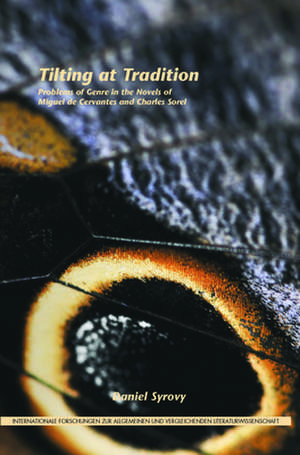
Tilting at Tradition
Autor Daniel Syrovyen Limba Engleză Paperback – 2013
Preț: 691.46 lei
Preț vechi: 776.92 lei
-11%
Puncte Express: 1037
Carte tipărită la comandă
Livrare economică 01-15 decembrie
Livrare prin curier în România Termenul estimat este afișat lângă disponibilitate.
Transport gratuit pentru acest produs Plată online sau ramburs, în funcție de opțiunile comenzii.
Retur gratuit în 14 zile Comandă securizată și suport în română.
Specificații
ISBN-13: 9789042037090
ISBN-10: 9042037091
Pagini: 270
Dimensiuni: 155 x 234 x 15 mm
Greutate: 0.38 kg
Editura: Brill
ISBN-10: 9042037091
Pagini: 270
Dimensiuni: 155 x 234 x 15 mm
Greutate: 0.38 kg
Editura: Brill
V-ar putea interesa
-
 Spies and Spymasters of the Civil WarDonald MarklePreț: 114.35 lei
 -
 Preț: 59.90 lei
 -
 To the Pike's Peak Gold Fields, 1859LeRoy R. HafenPreț: 114.15 lei
 -
 Preț: 133.19 lei
 -
 Specters of the AtlanticIan BaucomPreț: 229.12 lei
 -
 Land and Liberty: Hudson Valley Riots in the Age of RevolutionThomas J. HumphreyPreț: 385.26 lei
 -
 Russia in a Box: Art and Identity in an Age of RevolutionAndrew L. JenksPreț: 376.19 lei
 -
 Preț: 216.01 lei
 -
 The Ottoman Balkans, 1750-1830Frederick F AnscombePreț: 512.28 lei
 -
 Productive Men and Reproductive WomenMarion W. GrayPreț: 269.41 lei
 -
 Preț: 188.92 lei
 -
 An Account of the Life & Death of Mrs. Elizabeth BuryElizabeth BuryPreț: 179.20 lei
 -
 Preț: 152.92 lei
 -
 Mendelssohn to MendelsohnCyril Reade-8%Preț: 599.43 lei651.56 lei
 -
 Politics, Religion and the PressAnthony McNicholas-23%Preț: 597.30 lei775.72 lei
 -
 Herren und LandwirteAndrás VáriPreț: 314.33 lei
 -
 Die Military Revolution und der deutsche TerritorialstaatThomas WollschlägerPreț: 186.15 lei
 -
 -23%Preț: 889.67 lei1155.41 lei
Cuprins
Preface
Part I: Charles Sorel’s Berger extravagant
By way of introduction: An early testimony
A brief word on method
Sorel’s poetics
Utilitas
Berger extravagant and Anti-Roman
The genre of the novel(s)
The structure of the Berger extravagant
The meaning of the Anti-Roman
Charles Sorel, novelist; or, the quest for vraisemblance
Conclusion: Novel or treatise?
Part II: Cervantes’ Don Quijote
Principles of method
First solution: Don Quijote as criticism
Cervantes’ stylistic tradition
Humor and genre
Cervantes and genre
Don Quijote as a chivalric romance
Part III: The Larger Picture
Backgrounds
Cervantes and Avellaneda
Sorel’s Polyandre, a new histoire comique
Conclusion: Genre and ‘Parody’
Appendix: A Problem of Terminology
Bibliography
Index
Part I: Charles Sorel’s Berger extravagant
By way of introduction: An early testimony
A brief word on method
Sorel’s poetics
Utilitas
Berger extravagant and Anti-Roman
The genre of the novel(s)
The structure of the Berger extravagant
The meaning of the Anti-Roman
Charles Sorel, novelist; or, the quest for vraisemblance
Conclusion: Novel or treatise?
Part II: Cervantes’ Don Quijote
Principles of method
First solution: Don Quijote as criticism
Cervantes’ stylistic tradition
Humor and genre
Cervantes and genre
Don Quijote as a chivalric romance
Part III: The Larger Picture
Backgrounds
Cervantes and Avellaneda
Sorel’s Polyandre, a new histoire comique
Conclusion: Genre and ‘Parody’
Appendix: A Problem of Terminology
Bibliography
Index
Recenzii
“Syrovy gelingt es, erhellende Schlaglichter zu werfen in jene Auseinandersetzungen in der ersten Hälfte des 17. Jh.s, in denen dem Roman seine Unwahrscheinlichkeit vorgeworfen wurde, in dem er moralisch zu sein hatte, in dem sich die Frage nach der imitatio noch im engen aristotelischen Sinne stellte und die erzählerische Konvention verschrien war. Syrovy stellt sich dabei der Bedingtheit einer nationalgeschichtlich angelegten Quellenforschung ebenso wie dem Problem, warum ausgerechnet ein experimenteller Autor wie Sorel sich für eine Literaturdidaxe stark machen konnte, die neben der moralischen Nützlichkeit der Romangattung ein rigoroses Zensursystem des Literaturbetriebs vorsah.”
– Frank Estelmann (Universität Mainz), in Literaturkritik.de (2014)
Full text available: http://www.literaturkritik.de/public/rezension.php?rez_id=19087
– Frank Estelmann (Universität Mainz), in Literaturkritik.de (2014)
Full text available: http://www.literaturkritik.de/public/rezension.php?rez_id=19087