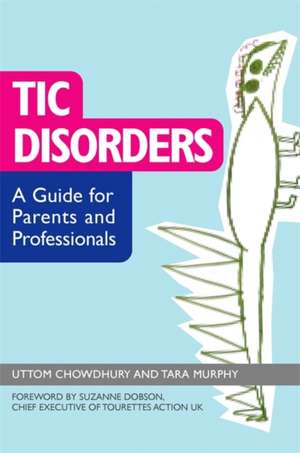
Tic Disorders: A Guide for Parents and Professionals
Autor Uttom Chowdhury, Tara Murphy Cuvânt înainte de Suzanne Dobsonen Limba Engleză Paperback – 21 sep 2016
Drawing on current research and their own clinical experience, the authors provide up-to-date information on tic disorders and review the psychological, medical and alternative methods of managing symptoms. Written in clear, accessible language and with practical advice on how to support children with tics at home and in school, the book also includes essential information on the common co-occurring conditions and difficulties, such as ADHD, anxiety, OCD, autism, self-esteem issues and behavioural difficulties.
Preț: 114.31 lei
Preț vechi: 144.07 lei
-21%
Puncte Express: 171
Carte disponibilă
Livrare economică 30 octombrie-13 noiembrie
Livrare express 15-21 octombrie pentru 48.94 lei
Livrare prin curier în România Termenul estimat este afișat lângă disponibilitate.
Transport gratuit de la 400.00 lei Plată online sau ramburs, în funcție de opțiunile comenzii.
Retur gratuit în 14 zile Comandă securizată și suport în română.
Specificații
ISBN-13: 9781849050616
ISBN-10: 1849050619
Pagini: 192
Ilustrații: 18 b&w diagrams and illustrations
Dimensiuni: 140 x 214 x 18 mm
Greutate: 0.2 kg
Editura: JESSICA KINGSLEY PUBLISHERS
Colecția Jessica Kingsley Publishers
Locul publicării:London, United Kingdom
ISBN-10: 1849050619
Pagini: 192
Ilustrații: 18 b&w diagrams and illustrations
Dimensiuni: 140 x 214 x 18 mm
Greutate: 0.2 kg
Editura: JESSICA KINGSLEY PUBLISHERS
Colecția Jessica Kingsley Publishers
Locul publicării:London, United Kingdom
V-ar putea interesa
-
 The Case of the Corner Shop RobbersAllen J. WoppertPreț: 79.23 lei
 -
 Preț: 95.19 lei
 -
 When I Was Five I Killed MyselfErnst KemmerPreț: 47.82 lei
 -
 Monsieur Ibrahim et les fleurs du CoranEric-Emmanuel SchmittPreț: 42.39 lei
 -
 A Kiss Before DyingIra LevinPreț: 98.21 lei
 -
 Lernen geht andersRemo H. LargoPreț: 85.07 lei
 -
 Die Verwandlung. Mit MaterialienFranz KafkaPreț: 54.69 lei
 -
 Der goldene Topf. Text und KommentarErnst Theodor Amadeus HoffmannPreț: 58.39 lei
 -
 Preț: 136.20 lei
 -
 Die Jungfrau von OrleansFriedrich von SchillerPreț: 31.81 lei
Recenzii
Here, in one volume, written in an accessible manner by people who have spent a huge amount of their professional lives working with those living with Tourette syndrome, is everything you need to know to gain a good working knowledge and understanding of TS. I am so pleased that such a volume exists and hope it will soon be on not only every worried parent's reading list, but also those of GPs and those charged with supporting someone with TS.
It is not always easy to understand what it is like to live with Tourette syndrome. Comprehensive and accessible, this book sheds light on the key clinical features, management strategies and implications to day-to-day life. The authors have done a great job in putting together a highly useful resource for patients and their families, as well as professionals and teachers dealing with this condition in the school setting.
Uttom Chowdhury and Tara Murphy have been committed for years to the care of children and families affected by Tourette syndrome and have trained many other clinicians. This book combines the medical literature with their experience of the condition, its challenges and its treatment, including in the home and classroom. It will be a valuable resource for both parents and professionals.
This accessible book from experienced clinicians helps families live with and accept tics. At the same time it provides guidance to enable parents to make the best use of professional advice and expect a high standard of assessment and treatment for their child. It acknowledges and explains the neurological basis of tics and Tourette's but avoids excessive preoccupation with the unusual symptoms. It also gently dismisses the myth that doctors have a full answer to tics and Tourette's. Instead the emphasis is on families learning to identify and access the help they need. Part of this process is realising that their child's difficulties may not be the tics themselves, but a related problem such as anxiety or learning difficulties. There are practical tips for families throughout - with the repeated message that 'knowledge is power'.
It is not always easy to understand what it is like to live with Tourette syndrome. Comprehensive and accessible, this book sheds light on the key clinical features, management strategies and implications to day-to-day life. The authors have done a great job in putting together a highly useful resource for patients and their families, as well as professionals and teachers dealing with this condition in the school setting.
Uttom Chowdhury and Tara Murphy have been committed for years to the care of children and families affected by Tourette syndrome and have trained many other clinicians. This book combines the medical literature with their experience of the condition, its challenges and its treatment, including in the home and classroom. It will be a valuable resource for both parents and professionals.
This accessible book from experienced clinicians helps families live with and accept tics. At the same time it provides guidance to enable parents to make the best use of professional advice and expect a high standard of assessment and treatment for their child. It acknowledges and explains the neurological basis of tics and Tourette's but avoids excessive preoccupation with the unusual symptoms. It also gently dismisses the myth that doctors have a full answer to tics and Tourette's. Instead the emphasis is on families learning to identify and access the help they need. Part of this process is realising that their child's difficulties may not be the tics themselves, but a related problem such as anxiety or learning difficulties. There are practical tips for families throughout - with the repeated message that 'knowledge is power'.
Cuprins
Foreword by Suzanne Dobson, Chief Executive of Tourette Action, UK. Part 1. Tics and Tourette Syndrome. 1.1. What are Tic Disorders? 1.2. Signs and Symptoms. 1.3. Causes of Tic Disorders. Part 2. Management. 2.1. Working with Schools. 2.2. Psychological Management. 2.3. Medication. 2.4. Neurosurgery. 2.5. Less Well Validated Treatments. Part 3. Co-occurring Features and Conditions. 3.1. ADHD. 3.2. OCD. 3.3. Depression. 3.4. Anxiety. 3.5. ASD. 3.6. Specific Learning Difficulties. 3.7. Sleep. 3.8. Anger. Part 4. Parenting and Family Life. 4.1. Adjusting to the Diagnosis. 4.2. Dealing with Behavioural Problems. 4.3. Improving your Child's Self Esteem. Appendix I. Glossary. Appendix II. Useful resources and websites. References. Index.