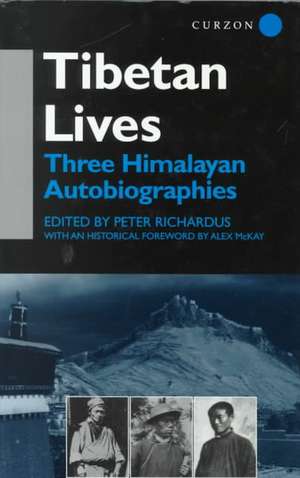
Tibetan Lives: Three Himalayan Autobiographies
Autor Peter Richardusen Limba Engleză Hardback – 19 mai 1998
It was left to a Dutchman, Johan van Manen, and hence an outside observer of the British imperial system, to preserve the impressions of three who served on the periphery of the imperial system. The three autobiographies that make up this book, crowded with ethnographical, sociological and historico-religious data, offer a unique insight into the world of the intermediary class. In addition to being interesting and entertaining, they are an important contribution to our understanding of the history of Tibet and its opening up to cultures beyond its own.
Preț: 1473.59 lei
Preț vechi: 1797.07 lei
-18%
Puncte Express: 2210
Carte tipărită la comandă
Livrare economică 02-16 decembrie
Livrare prin curier în România Termenul estimat este afișat lângă disponibilitate.
Transport gratuit pentru acest produs Plată online sau ramburs, în funcție de opțiunile comenzii.
Retur gratuit în 14 zile Comandă securizată și suport în română.
Specificații
ISBN-13: 9780700710232
ISBN-10: 070071023X
Pagini: 252
Dimensiuni: 156 x 234 x 16 mm
Greutate: 0.63 kg
Ediția:1
Editura: Taylor & Francis
Colecția Routledge
Locul publicării:Oxford, United Kingdom
ISBN-10: 070071023X
Pagini: 252
Dimensiuni: 156 x 234 x 16 mm
Greutate: 0.63 kg
Ediția:1
Editura: Taylor & Francis
Colecția Routledge
Locul publicării:Oxford, United Kingdom
V-ar putea interesa
-
 Upon This RockSamuel G. FreedmanPreț: 106.92 lei
 -
 A Century of British OrientalistsBosworth-55%Preț: 414.87 lei926.55 lei
 -
 Preț: 405.27 lei
 -
 A Thematic Dictionary of Modern PersianColin Turner-15%Preț: 542.56 lei638.31 lei
 -
 Preț: 472.22 lei
 -
 The Philosophy of Desire in the Buddhist Pali CanonDavid WebsterPreț: 483.41 lei
 -
 -18%Preț: 1257.26 lei1533.24 lei
 -
 Preț: 255.98 lei
 -
 El laberinto de la soledad by Octavio PazAnthony StantonPreț: 166.90 lei
 -
 Obama and the Biracial Factor: The Battle for a New American MajorityAndrew J. JolivéttePreț: 267.79 lei
 -
 Standing on Both Feet: Voices of Older Mixed-Race AmericansCathy J Tashiro-18%Preț: 1148.05 lei1400.07 lei
 -
 Preț: 167.44 lei
 -
 -21%Preț: 273.89 lei345.27 lei
 -
 Call Me OkaasanSuzanne KamataPreț: 91.24 lei
Recenzii
'These three autobiographies have been edited (and condensed?) with great skill by Peter Richardus from Leiden All three autobiographies abound with details illuminating daily life in the Tibetan world and its interactions with the British and Chinese imperial apparatus, and for this reason alone they make intriguing reading. This is, in its way, a delightful book; and it is further garnished by photographs.' - Alastair Lamb, Bulletin of SOAS
Cuprins
Part I The Autobiography of Phun-tshogs Lung-rtogsPart II The Autobiography of sKar-ma Sum-dhon PaulPart III The Autobiography of Ts’an-chih Chen;
Descriere
Including ethnographical, sociological and historico-religious data, the three autobiographies which make up this text provide a unique insight into the fight for control over Tibet at the start of the twentieth-century and the country's intermediary class.