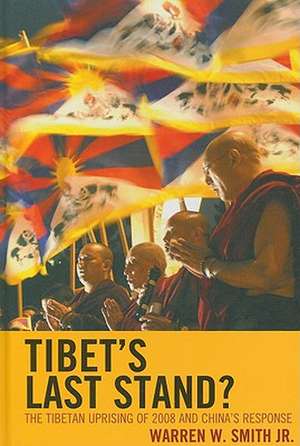
Tibet's Last Stand?: The Tibetan Uprising of 2008 and China's Response
Autor Warren W. Smith Jr.en Limba Engleză Hardback – 16 dec 2009
Preț: 351.46 lei
Preț vechi: 510.48 lei
-31%
Puncte Express: 527
Carte tipărită la comandă
Livrare economică 16-30 noiembrie
Livrare prin curier în România Termenul estimat este afișat lângă disponibilitate.
Transport gratuit de la 400.00 lei Plată online sau ramburs, în funcție de opțiunile comenzii.
Retur gratuit în 14 zile Comandă securizată și suport în română.
Specificații
ISBN-13: 9780742566859
ISBN-10: 0742566854
Pagini: 299
Dimensiuni: 162 x 238 x 26 mm
Greutate: 0.66 kg
Editura: Bloomsbury Publishing
Colecția Rowman & Littlefield
Locul publicării:New York, United States
ISBN-10: 0742566854
Pagini: 299
Dimensiuni: 162 x 238 x 26 mm
Greutate: 0.66 kg
Editura: Bloomsbury Publishing
Colecția Rowman & Littlefield
Locul publicării:New York, United States
V-ar putea interesa
-
 China's War with Japan, 1937-1945Rana Mitter-28%Preț: 88.32 lei122.34 lei
 -
 Preț: 173.29 lei
 -
 Tibet in the Western ImaginationT. NeuhausPreț: 395.83 lei
 -
 Women and Gender in Twentieth-Century ChinaPaul J. Bailey-24%Preț: 242.12 lei316.72 lei
 -
 Zen at WarBrian Daizen Victoria-21%Preț: 308.59 lei390.15 lei
 -
 -27%Preț: 827.47 lei1133.52 lei
 -
 Spying for the PeopleMichael SchoenhalsPreț: 214.56 lei
 -
 A Concise History of Modern IndiaBarbara MetcalfPreț: 186.18 lei
 -
 Pre-Modern East AsiaAnne Walthall-26%Preț: 563.82 lei764.62 lei
 -
 The Parchment of KashmirN. KhanPreț: 383.60 lei
 -
 Preț: 392.00 lei
Descriere
This book offers a definitive account of the origins and events of the 2008 Tibetan uprising, which began with peaceful demonstrations by monks of Lhasa's great monasteries on the anniversary of the 1959 revolt. Noted expert Warren W. Smith Jr. argues that the uprising was a widespread response to the conditions of Chinese rule over Tibet, which revealed much about Tibetan nationalism and even more about Chinese nationalism. Interpreting the Tibetan uprising as an attempt to spoil the Beijing Olympics, China's hard-line response was repression, "patriotic education," and propaganda blaming the disturbances on the "Dalai clique" and "hostile Western forces."
Smith contends that China's offensive is based upon a belief that China now has sufficient economic and political influence to make the world "thoroughly revise its mistaken knowledge" about the Tibet issue. He convincingly shows that far from becoming more lenient in response to Tibetan discontent, China has determined to eradicate Tibetan opposition internally and coerce the international community to conform to China's version of Tibetan history and reality.
Smith contends that China's offensive is based upon a belief that China now has sufficient economic and political influence to make the world "thoroughly revise its mistaken knowledge" about the Tibet issue. He convincingly shows that far from becoming more lenient in response to Tibetan discontent, China has determined to eradicate Tibetan opposition internally and coerce the international community to conform to China's version of Tibetan history and reality.
Cuprins
Introduction
Chapter 1: Chronology of Revolt
Chapter 2: China's Response: Repression
Chapter 3: China's Response: Propaganda
Chapter 4: Tibet and the Olympics
Chapter 5: One State, Two Nations
Chapter 1: Chronology of Revolt
Chapter 2: China's Response: Repression
Chapter 3: China's Response: Propaganda
Chapter 4: Tibet and the Olympics
Chapter 5: One State, Two Nations
Recenzii
The most informative and fair account available of China's occupation of Tibet and its consequences. . . . Open-minded readers of whatever opinion about China and Tibet will find much to learn from Tibet's Last Stand? and may even change their minds. . . . This is a revealing and honest book. . . . Tibetans are unlikely ever to achieve their independence, Dr. Smith concludes, 'but they retain the right to write their own history.' This he says-and he is a great champion-must be the role of Tibetans in exile and their friends. . . . I believe that will be the judgment of many attentive readers of this invaluable book.
A useful, detailed account of the 2008 demonstrations, the official response, and surrounding events. . . . Readers will gain a clear idea of the Chinese position on Tibet and of Beijing's strategy in the region: a combination of Han immigration, economic development, assimilation, repression, and waiting for the Dalai Lama to die.
Recommended.
An invaluable compendium of data on what Smith convincingly argues was a watershed moment not just for Sino-Tibetan relations, but also for China's relationship with the rest of the world. . . . Smith provides readers with an admirably comprehensive review of the events, players, and discourses of the Tibetan unrest.
A lucid, comprehensive, and insightful account of the 2008 uprising in Tibet. Smith's impressive analysis of the causes of the uprising is surpassed only by his detailed examination of the consequences of that eruption: the resurgence of Tibetan nationalism, the brutal Chinese crackdown and the collapse of the Dalai Lama's negotiation attempts with Beijing. It is a must read for those concerned about the fate of Tibet. The book takes on special significance in the wake of the similar conflict in Xinjiang in 2009, providing useful insight into the future of China's colonial empire.
Tibet's Last Stand? is the first book-length discussion of the 150 or so protests that took place in Tibet in 2008. Using clear, accessible language, Warren Smith offers a detailed summary of the protests that took place and especially of the responses of the security forces and politicians to unrest, together with extensive ethical and political commentaries by the author.
Warren W. Smith Jr. has emerged as the preeminent writer on Tibetan history and Sino-Tibetan relations. His newest work solidifies that position by offering the most comprehensive account available of Tibet's resistance during the buildup to the Beijing Olympics-an uprising that challenged China's claim that it has a legitimate right to colonize and suppress the Tibetan people. Smith relates Beijing's paranoid reaction to the uprising in fascinating detail. Anyone who is interested in the Tibetan issue or the nature of modern Chinese nationalism must read Tibet's Last Stand?, a seminal and mesmerizing book.
A useful, detailed account of the 2008 demonstrations, the official response, and surrounding events. . . . Readers will gain a clear idea of the Chinese position on Tibet and of Beijing's strategy in the region: a combination of Han immigration, economic development, assimilation, repression, and waiting for the Dalai Lama to die.
Recommended.
An invaluable compendium of data on what Smith convincingly argues was a watershed moment not just for Sino-Tibetan relations, but also for China's relationship with the rest of the world. . . . Smith provides readers with an admirably comprehensive review of the events, players, and discourses of the Tibetan unrest.
A lucid, comprehensive, and insightful account of the 2008 uprising in Tibet. Smith's impressive analysis of the causes of the uprising is surpassed only by his detailed examination of the consequences of that eruption: the resurgence of Tibetan nationalism, the brutal Chinese crackdown and the collapse of the Dalai Lama's negotiation attempts with Beijing. It is a must read for those concerned about the fate of Tibet. The book takes on special significance in the wake of the similar conflict in Xinjiang in 2009, providing useful insight into the future of China's colonial empire.
Tibet's Last Stand? is the first book-length discussion of the 150 or so protests that took place in Tibet in 2008. Using clear, accessible language, Warren Smith offers a detailed summary of the protests that took place and especially of the responses of the security forces and politicians to unrest, together with extensive ethical and political commentaries by the author.
Warren W. Smith Jr. has emerged as the preeminent writer on Tibetan history and Sino-Tibetan relations. His newest work solidifies that position by offering the most comprehensive account available of Tibet's resistance during the buildup to the Beijing Olympics-an uprising that challenged China's claim that it has a legitimate right to colonize and suppress the Tibetan people. Smith relates Beijing's paranoid reaction to the uprising in fascinating detail. Anyone who is interested in the Tibetan issue or the nature of modern Chinese nationalism must read Tibet's Last Stand?, a seminal and mesmerizing book.
Notă biografică
Warren W. Smith Jr. received his PhD in international relations from Tufts University.