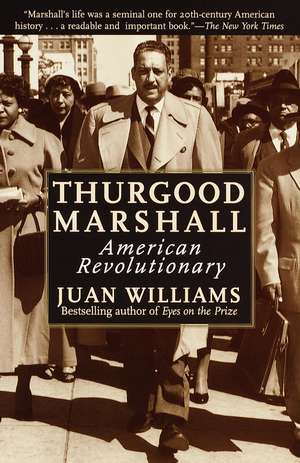
Thurgood Marshall
Autor Juan Williamsen Limba Engleză Paperback – feb 2000
Printr-o dramatizare a bătăliilor juridice care au fracturat și apoi au reconstruit fundamentul social american, Juan Williams ne introduce în culisele unei vieți dedicate egalității. Imaginează-ți un avocat singuratic înfruntând prejudecățile unui întreg sistem în sălile de judecată ostile din sudul segregaționist. Considerăm că această lucrare depășește granițele unei simple biografii, fiind o investigație jurnalistică riguroasă asupra curajului individual și a mecanismelor puterii. Merită menționat că autorul reușește să capteze esența lui Thurgood Marshall, primul judecător afro-american la Curtea Supremă, printr-o narațiune fluidă susținută de 37 de fotografii de arhivă. În aceeași familie cu Showdown de Wil Haygood, volumul adaugă o analiză panoramică a întregii cariere a lui Marshall, de la activistul din tribunale la magistratul care a modelat constituția. Reținem modul în care autorul ancorează această lucrare în contextul operei sale, fiind o continuare naturală a temelor abordate în Eyes on the Prize. Dacă Making Constitutional Law se concentrează strict pe jurisprudență, Juan Williams ne oferă acces la omul din spatele deciziilor istorice. Această biografie completează viziunea autorului despre lupta pentru demnitate, temă centrală și în lucrările sale mai recente, precum What the Hell Do You Have to Lose?.
Preț: 117.88 lei
Carte disponibilă
Livrare economică 09-23 noiembrie
Specificații
ISBN-10: 0812932994
Pagini: 512
Ilustrații: 37 B&W PHOTOS;1 16P B&W INSERT
Dimensiuni: 133 x 205 x 27 mm
Greutate: 0.41 kg
Ediția:Pbk.
Editura: Crown Publishing Group (NY)
V-ar putea interesa
-
 The Boundless DeepRichard HolmesPreț: 194.51 lei
 -
 EntitledAndrew LowniePreț: 162.66 lei
 -
 Preț: 59.86 lei
 -
 KetanjiKekla MagoonPreț: 108.37 lei
 -
 Only God Can Judge MeJeff PearlmanPreț: 204.55 lei
 -
 To Kill a MockingbirdHarper Lee-19%Preț: 52.34 lei64.56 lei
 -
 Mark TwainRon Chernow-16%Preț: 272.47 lei322.82 leiRecomandat
 -
 John HancockWillard Sterne RandallPreț: 201.98 lei
 -
 FramedJohn GrishamPreț: 72.53 lei
 -
 Justice Brennan: Liberal ChampionSeth SternPreț: 376.50 lei
 -
 A Picture Book of Thurgood MarshallDavid A AdlerPreț: 42.90 lei
 -
 My Own WordsRuth Bader Ginsburg-18%Preț: 77.62 lei94.43 lei
 -
 CitizenPresident Bill ClintonPreț: 227.95 lei
 -
 The Land of Sweet ForeverHarper LeePreț: 157.03 leiRecomandat
 -
 Carter, G: When the Going Was GoodGraydon CarterPreț: 122.79 lei
 -
 Look CloserRobert Douglas-FairhurstPreț: 144.73 lei
 -
 Aaron JudgeCharlie Beattie-5%Preț: 87.67 lei92.06 lei
De ce să citești această carte
Recomandăm această biografie cititorilor interesați de intersecția dintre lege, politică și drepturile omului. Veți descoperi parcursul fascinant al unui lider care a dărâmat barierele segregației prin forța argumentului juridic. Este o resursă valoroasă pentru a înțelege evoluția democrației americane, oferind o perspectivă onestă asupra sacrificiilor necesare pentru a obține dreptatea socială într-o perioadă de schimbări radicale.
Despre autor
Juan Williams este un distins jurnalist american, analist politic și fost corespondent senior la NPR. Cu o experiență de 23 de ani la Washington Post ca editorialist și corespondent la Casa Albă, Williams s-a impus ca o autoritate în documentarea mișcărilor pentru drepturi civile. Este autorul celebrului volum Eyes on the Prize, lucrare ce a însoțit seria documentară PBS, pentru care a câștigat un premiu Emmy. Absolvent al Haverford College, Williams a contribuit cu analize în publicații prestigioase precum Fortune, The Atlantic și GQ, consolidându-și reputația de fin observator al dinamicii sociale și politice din Statele Unite.
Notă biografică
Extras
Rumors flew that night. Supreme Court Justice Tom Clark had resigned a few hours earlier. By that Monday evening, Solicitor General Thurgood Marshall and his wife, Cissy, heard that the president was set to name Clark's replacement the very next morning. At the Marshalls' small green town house on G Street in Southwest Washington, D.C., the phone was ringing. Friends, family, and even politicians were calling to see if Thurgood had heard anything about his chances for the job. But all the Marshalls could say was that they had heard rumors.
As Marshall dressed for Clark's retirement party on that muggy Washington night of June 12, 1967, he looked at his reflection in the mirror. Years ago some of his militant critics had called him "half-white" for his straight hair, pointed nose, and light tan skin. Now, at fifty-eight, his face had grown heavy, with sagging jowls and dark bags under his eyes. His once black hair, even his mustache, was now mostly a steely gray. And he looked worried. He did have on a good dark blue suit, the uniform of a Washington power player. But the conservative suit looked old and out of place in an era of Afros and dashikis. And even the best suit might not be strong enough armor for the high-stakes political fight he was preparing for tonight. At this moment the six-foot-two-inch Marshall, who weighed well over two hundred pounds, felt powerless. He was fearful that he was about to lose his only chance to become a Supreme Court justice.
Staring in the mirror as if it were a crystal ball, Marshall could see clearly only that he would have one last chance to convince the president he was the right man. That chance would come tonight at Justice Clark's retirement party.
In his two years as solicitor general there had been constant rumors floating around the capital about Marshall being positioned by the president to become the first black man on the high court. However, with one exception, no one at the White House had ever spoken to him about the job. That exception was President Lyndon Johnson. Whenever Johnson talked about the Supreme Court in front of him, the tall, intense Texan made a point of turning to Marshall, thrusting a finger in his face, and reminding him there was no promise that he would ever have a job on the high court.
But Johnson was privately talking about putting Marshall on the Supreme Court. For a southern politician, Johnson had a strong sense of racial justice. As a skinny twenty-year-old, he had taught school to poor Hispanic children in south Texas and seen firsthand the disadvantages they faced. Now Johnson's fabled political instincts had drawn him to the idea that he would be hailed by history as the president who put the first black on the Supreme Court. The president had set the wheels in motion by making Marshall the nation's first black solicitor general. And he had confided to his wife, Lady Bird, that he wanted to appoint Marshall to the Supreme Court. But the president had been having second thoughts about Marshall. Was he really a good lawyer? And what about talk that Marshall was lazy? Was it realistic to think he could win enough votes to get by white racists in the Senate and be confirmed?
As he finished getting ready for the party, Marshall replayed all the rumors he had heard about why the president was reluctant to appoint him to the high court. Thinking about it, Marshall got grumpy, then angry. His chance to be in the history books as the first black man on the Supreme Court was fading, and he felt abandoned. The word around the capital was that the nomination would be announced tomorrow. Marshall had heard nothing from the White House.
Descriere scurtă
From the bestselling author of Eyes on the Prize, here is the definitive biography of the great lawyer and Supreme Court justice.
Recenzii
"This is a must-read for all Americans concerned with the struggle for civil and individual rights."--Booklist (Editors' Choice, 1998)
"Engaging--remarkable in its vivid and detailed account of its subject."--The Washington Post Book World
"Magisterial." --Time magazine