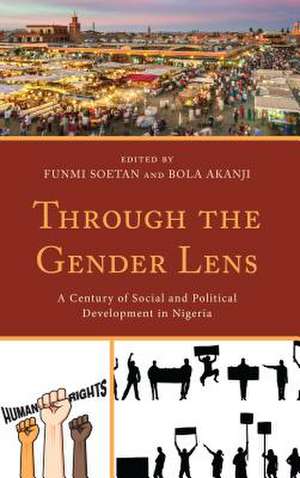
Through the Gender Lens: A Century of Social and Political Development in Nigeria: Gender and Sexuality in Africa and the Diaspora
Editat de Funmi Soetan, Bola Akanji Contribuţii de Helen O. Aderemi, Yinka Adesina, Michael Akanji, Mary S. Modupe Kolawole, Kolade Odekunle, Isaac Olawale Albert, Kehinde Olayode, I.O. Olomola, Kehinda Oluponna, Tope Osanyintuyi, Funmi Para-Malam, Irene Pogosson, Bola Lukman Solanke, Dixon Torimiro, Christian Ubanien Limba Engleză Hardback – 12 dec 2018
Din seria Gender and Sexuality in Africa and the Diaspora
- 30%
 Preț: 533.74 lei
 - 33%
 Preț: 583.16 lei
 - 33%
 Preț: 550.70 lei
 - 32%
 Preț: 585.71 lei
 - 36%
 Preț: 523.84 lei
 - 32%
 Preț: 490.85 lei
 - 32%
 Preț: 664.78 lei
 - 32%
 Preț: 552.03 lei
 - 32%
 Preț: 565.15 lei
 - 28%
 Preț: 219.35 lei
 - 34%
 Preț: 699.20 lei
 - 37%
 Preț: 664.73 lei
 - 28%
 Preț: 221.53 lei
 - 33%
 Preț: 559.24 lei
 - 32%
 Preț: 594.97 lei
Preț: 703.13 lei
Preț vechi: 1053.36 lei
-33%
Puncte Express: 1055
Carte tipărită la comandă
Livrare economică 04-18 decembrie
Livrare prin curier în România Termenul estimat este afișat lângă disponibilitate.
Transport gratuit pentru acest produs Plată online sau ramburs, în funcție de opțiunile comenzii.
Retur gratuit în 14 zile Comandă securizată și suport în română.
Specificații
ISBN-13: 9781498564724
ISBN-10: 1498564720
Pagini: 366
Ilustrații: 13 tables; 15 graphs; 4 textboxes;
Dimensiuni: 153 x 236 x 25 mm
Greutate: 0.52 kg
Editura: Bloomsbury Publishing
Colecția Lexington Books
Seria Gender and Sexuality in Africa and the Diaspora
Locul publicării:New York, United States
ISBN-10: 1498564720
Pagini: 366
Ilustrații: 13 tables; 15 graphs; 4 textboxes;
Dimensiuni: 153 x 236 x 25 mm
Greutate: 0.52 kg
Editura: Bloomsbury Publishing
Colecția Lexington Books
Seria Gender and Sexuality in Africa and the Diaspora
Locul publicării:New York, United States
Cuprins
Chapter One: Gender Inequality in Socio-Political Development of the Nigerian Nation-State: An Empirical Glimpse
Bola Akanji and Funmi Soetan
Chapter Two: Gender and State Formation: A Comparative Study of Latin America and Africa
Bola Akanji, Tope Osanyintuyi, Michael Akanji and Christian Ubani
Chapter Three: Gender-Based Power Differentials and Sexual and Reproductive Health in Nigeria
Funmi Soetan and Bola Lukman Solanke
Chapter Four: Re-Thinking Gender Roles towards Promotion of Socio-Economic Advancement: Evolution of Entrepreneurship in Nigeria
Helen Aderemi
Chapter Five: Analysis of Gender-inclusiveness of Education Policies and Practices in Nigeria: Colonialism as Cause and Effect
Bola Akanji and Kolade Odekunle
Chapter Six: Environmental Change, Gender and Sustainable Development in Nigeria
Yinka Adesina and Theophilus Odekunle
Chapter Seven: Gender, Youth and Agricultural Development: Reflecting on the Centenarian Status of the Nigerian State
Dixon Torimiro
Chapter Eight: Gender, Citizenship and Democratic Governance in Nigeria
Funmi Para-Malam
Chapter Nine: Do we Understand the Value of Women in Political Leadership in Nigeria's History?
Irene Pogoson
Chapter Ten: Gender, Culture and Development Debates in Nigeria.
Funmi Soetan, I.O. Olomola, Modupe Kolawole
Chapter Eleven: Women's Activism for Gender Equality and Social Justice in Nigeria (1900-2015)
Kehinde Olayode
Chapter Twelve: Resisting Structural Violence: Continuity and Change in Women's Street Protests in Nigeria
Isaac Olawale Albert
Bola Akanji and Funmi Soetan
Chapter Two: Gender and State Formation: A Comparative Study of Latin America and Africa
Bola Akanji, Tope Osanyintuyi, Michael Akanji and Christian Ubani
Chapter Three: Gender-Based Power Differentials and Sexual and Reproductive Health in Nigeria
Funmi Soetan and Bola Lukman Solanke
Chapter Four: Re-Thinking Gender Roles towards Promotion of Socio-Economic Advancement: Evolution of Entrepreneurship in Nigeria
Helen Aderemi
Chapter Five: Analysis of Gender-inclusiveness of Education Policies and Practices in Nigeria: Colonialism as Cause and Effect
Bola Akanji and Kolade Odekunle
Chapter Six: Environmental Change, Gender and Sustainable Development in Nigeria
Yinka Adesina and Theophilus Odekunle
Chapter Seven: Gender, Youth and Agricultural Development: Reflecting on the Centenarian Status of the Nigerian State
Dixon Torimiro
Chapter Eight: Gender, Citizenship and Democratic Governance in Nigeria
Funmi Para-Malam
Chapter Nine: Do we Understand the Value of Women in Political Leadership in Nigeria's History?
Irene Pogoson
Chapter Ten: Gender, Culture and Development Debates in Nigeria.
Funmi Soetan, I.O. Olomola, Modupe Kolawole
Chapter Eleven: Women's Activism for Gender Equality and Social Justice in Nigeria (1900-2015)
Kehinde Olayode
Chapter Twelve: Resisting Structural Violence: Continuity and Change in Women's Street Protests in Nigeria
Isaac Olawale Albert
Recenzii
[T]he book presents an in-depth analytical exploration of one hundred years of gender relations in a developing society. Furthermore, it virtually touches the social and political structure of Nigeria through the employment of historical and multidisciplinary approaches with massive statistical and theoretical frameworks. Therefore, I highly recommend Through the Gender Lens to scholars of gender studies, social and political historians, as well as everyone interested in grasping a better understanding of how gender relations are skewed so as to be able to address such anomalies.
Based on careful intellectual inquiry, rigorous methodological approaches, insightful theoretical perspectives, and compelling discussions of extensive scholarly works, Soetan, Akanji, and their colleagues have made a landmark contribution to the scholarship on women and gender studies in Nigeria.
The editors began by presenting a well-detailed empirical analysis of gender inequality in the sociopolitical development of Nigeria. Very importantly, their positions are critical to the understanding of women's disadvantaged lived experiences in both colonial and post-colonial Nigeria. I highly recommend Through the Gender Lens to scholars of gender studies, social and political historians, as well as everyone interested in grasping a better understanding of how gender relations are skewed so as to be able to address such anomalies.
Based on careful intellectual inquiry, rigorous methodological approaches, insightful theoretical perspectives, and compelling discussions of extensive scholarly works, Soetan, Akanji, and their colleagues have made a landmark contribution to the scholarship on women and gender studies in Nigeria.
The editors began by presenting a well-detailed empirical analysis of gender inequality in the sociopolitical development of Nigeria. Very importantly, their positions are critical to the understanding of women's disadvantaged lived experiences in both colonial and post-colonial Nigeria. I highly recommend Through the Gender Lens to scholars of gender studies, social and political historians, as well as everyone interested in grasping a better understanding of how gender relations are skewed so as to be able to address such anomalies.