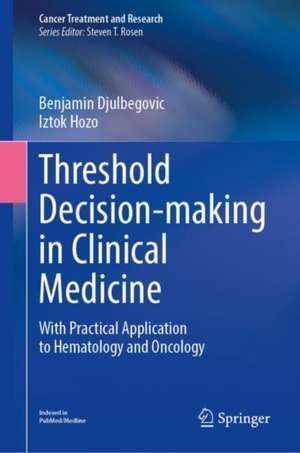
Threshold Decision-making in Clinical Medicine: Cancer Treatment and Research, cartea 189
Autor Benjamin Djulbegovic, Iztok Hozoen Limba Engleză Hardback – 5 oct 2023
Observăm în Threshold Decision-making in Clinical Medicine o abordare clinică riguroasă a unei probleme fundamentale: eroarea de judecată ca factor de risc major în mortalitatea contemporană. Publicată în prestigioasa serie Cancer Treatment and Research de la Springer, această primă ediție din 2023 este structurată într-un format de tip manual academic (Hardback, 164 pagini), fiind organizată progresiv pentru a ghida medicul de la fundamentele medicinei bazate pe dovezi către modele matematice complexe. Apreciem organizarea logică a cuprinsului, care separă deciziile luate în condiții de certitudine diagnostică de cele marcate de incertitudine, oferind soluții specifice pentru fiecare scenariu prin modele hibride și euristici de tip „fast-and-frugal tree”. Pe linia clinică a lucrării Medical Decision Making de Stefan Felder, acest volum se distinge prin accentul pus pe „modelele de prag” (threshold models), instrumente care permit medicului să determine momentul optim pentru a trece de la observație la intervenție terapeutică sau de la diagnostic la testare suplimentară. Găsim în această carte nu doar teorie pură, ci o aplicabilitate imediată în hematologie și oncologie, unde riscurile tratamentului trebuie echilibrate constant cu beneficiile potențiale. Autorii, Benjamin Djulbegovic și Iztok Hozo, integrează perspective moderne precum Teoria Regretului și Teoria Procesării Duale, oferind un fundament științific proceselor intuitive pe care medicii le folosesc adesea inconștient. Relevanța pentru practica actuală este subliniată în secțiunile finale, unde se analizează impactul inteligenței artificiale asupra teoriilor decizionale standard, pregătind cititorul pentru viitorul medicinei digitalizate.
Din seria Cancer Treatment and Research
- 5%
 Preț: 1138.53 lei
 - 5%
 Preț: 725.60 lei
 - 5%
 Preț: 764.83 lei
 - 5%
 Preț: 1006.97 lei
 - 5%
 Preț: 997.21 lei
 - 5%
 Preț: 1006.43 lei
 - 5%
 Preț: 885.78 lei
 - 5%
 Preț: 920.67 lei
 - 5%
 Preț: 1049.33 lei
 - 5%
 Preț: 1053.68 lei
 - 5%
 Preț: 693.36 lei
 - 5%
 Preț: 359.27 lei
 - 5%
 Preț: 1352.40 lei
 - 5%
 Preț: 1362.05 lei
 - 5%
 Preț: 1056.88 lei
 - 5%
 Preț: 694.80 lei
 - 5%
 Preț: 1053.70 lei
 - 5%
 Preț: 1051.96 lei
 - 5%
 Preț: 1053.89 lei
 - 5%
 Preț: 702.84 lei
 - 5%
 Preț: 1352.40 lei
 - 5%
 Preț: 1056.52 lei
 - 5%
 Preț: 1055.49 lei
 - 5%
 Preț: 1049.83 lei
 - 5%
 Preț: 1056.88 lei
 - 5%
 Preț: 1055.64 lei
 - 5%
 Preț: 1054.24 lei
 - 5%
 Preț: 356.17 lei
 - 5%
 Preț: 1360.84 lei
 - 5%
 Preț: 1047.20 lei
 - 5%
 Preț: 1057.04 lei
 - 5%
 Preț: 721.61 lei
 - 5%
 Preț: 1054.94 lei
 - 5%
 Preț: 1364.48 lei
 - 5%
 Preț: 352.29 lei
 - 5%
 Preț: 1707.68 lei
 - 5%
 Preț: 746.77 lei
 - 5%
 Preț: 1245.59 lei
 - 5%
 Preț: 1479.19 lei
 - 5%
 Preț: 748.40 lei
 - 5%
 Preț: 1154.98 lei
 - 5%
 Preț: 1042.02 lei
 - 5%
 Preț: 735.53 lei
Preț: 691.97 lei
Preț vechi: 728.39 lei
-5%
Carte disponibilă
Livrare economică 31 octombrie-14 noiembrie
Specificații
ISBN-10: 3031379926
Pagini: 164
Ilustrații: XXIII, 138 p. 29 illus., 16 illus. in color.
Dimensiuni: 160 x 241 x 15 mm
Greutate: 0.45 kg
Ediția:1st ed. 2023
Editura: Springer
Colecția Cancer Treatment and Research
Seria Cancer Treatment and Research
Locul publicării:Cham, Switzerland
V-ar putea interesa
-
 On the EdgeNate SilverPreț: 107.37 lei
 -
 The Winner's CurseRichard H. ThalerPreț: 224.87 lei
 -
 Decision Making in Medicine: An Algorithmic ApproachStuart B. Mushlin-5%Preț: 772.18 lei812.82 lei
 -
 -5%Preț: 549.78 lei578.72 lei
 -
 Oh's Intensive Care ManualJonathan M. Handy-29%Preț: 688.26 lei970.31 leiRecomandat
 -
 Sabiston Textbook of Surgery: The Biological Basis of Modern Surgical PracticeDouglas Scott Tyler-29%Preț: 1167.99 lei1644.95 leiRecomandat
 -
 -29%Preț: 286.36 lei406.15 lei
 -
 Kumar and Clark's Clinical MedicineDavid Randall-26%Preț: 489.85 lei660.08 leiRecomandat
 -
 Medical Decision MakingAlan Schwartz-5%Preț: 637.01 lei670.53 lei
 -
 How Doctors ThinkJerome Groopman-5%Preț: 106.79 lei112.41 lei
 -
 Learning Clinical ReasoningJerome P. Kassirer MD-28%Preț: 368.00 lei507.88 lei
 -
 The Elements of ChoiceEric J. JohnsonPreț: 93.25 lei
 -
 Medical Decision MakingHarold C Sox-5%Preț: 387.83 lei408.25 lei
 -
 -5%Preț: 1507.84 lei1587.20 leiRecomandat
 -
 CURRENT Medical Diagnosis & Treatment 2026Maxine A. Papadakis-24%Preț: 478.55 lei633.64 lei
 -
 How to Read a PaperTrisha M Greenhalgh-5%Preț: 324.81 lei341.90 lei
 -
 Preț: 129.64 lei
 -
 -27%Preț: 175.18 lei238.55 lei
 -
 Running the RiskDavid Burrett ReidPreț: 140.40 lei
 -
 Pocket MedicineMARC SABATINE-22%Preț: 372.72 lei476.67 lei
De ce să citești această carte
Această lucrare este esențială pentru oncologi, hematologi și rezidenți care doresc să își rafineze procesul decizional dincolo de intuiție. Cititorul câștigă acces la modele matematice de prag care reduc incertitudinea în alegerea tratamentelor complexe. Este un instrument de management al riscului clinic care transformă dovezile statistice în decizii concrete la patul pacientului, fiind util în orice specialitate medicală unde balanța risc-beneficiu este critică.
Despre autor
Benjamin Djulbegovic este un cercetător și clinician recunoscut la nivel internațional pentru contribuțiile sale în domeniul medicinei bazate pe dovezi și al teoriei decizionale, având o vastă experiență în hematologie și oncologie. Iztok Hozo este profesor de matematică, specializat în modelarea matematică a deciziilor medicale. Împreună, cei doi autori combină rigoarea statistică cu experiența clinică, oferind o perspectivă interdisciplinară unică asupra modului în care medicii pot optimiza rezultatele tratamentelor prin utilizarea corectă a datelor și a modelelor de probabilitate.
Descriere scurtă
Poor decision-making is considered a leading cause of death in contemporary medicine. Decisions, however, have to be made - at a given threshold of risk and unfortunately physicians are not trained on how to make decisions. This book provides help to all those who want to improve their decision-making for a better patient outcome. With its examples from hematology and oncology the book will not only benefit haematologists and oncologists but physicians from all disciplines, hence the threshold model is applicable to all fields in medicine. This book will be useful to experienced physicians as well as trainees alike.
Cuprins
Notă biografică
In addition to receiving several Indiana University awards for excellence in research, Dr. Hozo won prestigious teaching awards in recognition of his expertise in the classroom and curriculum development.
He is a mathematician capable of translating real scientific and medical problems into mathematical language. His mathematical acumen has enabled him to tackle the vast array of diverse medical problems. Over the years he has made contribution to statistical analysis of clinical data and improvement in techniques of meta-analysis, tackled the issues of diagnostic tests using information theory approach, recast the issue of clinical trials from game theory point of view, developed new methods for decision-making, including a novel method based on mathematical modelling of regret, and helped develop the first mathematical model of decision-making that is based on dual processing theory and developed a new theory called acceptable regret, which could explain many phenomena in the diagnostic and treatment decisions in medicine.
According to Google Scholar, his current h-index is 25. One of his published articles has over 4200 citations (written jointly with Dr. Djulbegovic and Mrs. Pudar-Hozo).
Caracteristici
Descriere
This book aims to provide threshold models to help physicians to make optimal diagnostic, therapeutic and predictive decisions. Decisions, however, have to be made - at a given threshold of risk and unfortunately physicians are not trained on how to make decisions.