Cantitate/Preț
Produs

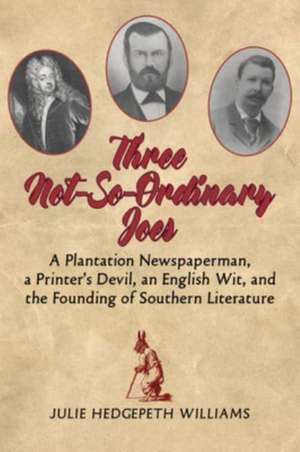
Three Not-So-Ordinary Joes

Autor Julie Hedgepeth Williams
en Limba Engleză Paperback – iun 2018

Autoarea Julie Hedgepeth Williams, profesor asistent la Samford University și expertă în istoria jurnalismului, fundamentează această lucrare pe o cercetare minuțioasă a arhivelor presei sudiste și a biografiilor literare. Reținem din paginile volumului o perspectivă inedită asupra originilor literaturii americane, concentrată pe figura excentrică a lui Joseph Addison Turner. Acesta, un proprietar de plantație din Georgia cu ambiții literare, a reușit să creeze „The Countryman”, singura publicație periodică editată pe o plantație în timpul Războiului Civil, modelată după stilul clasic al lui Joseph Addison. Descoperim aici cum eșecurile repetate ale lui Turner au pavat, paradoxal, drumul către succesul ucenicului său, tânărul Joel Chandler Harris. Cartea funcționează ca o alternativă istorică și critică la edițiile clasice din Uncle Remus pentru cursurile de istoria literaturii sau jurnalism, cu avantajul că explică mecanismele uceniciei și influența directă a tradiției britanice din secolul al XVIII-lea asupra folclorului sudist. Remarcăm modul în care Williams documentează tranziția de la poveștile auzite de Harris în colibele sclavilor la fenomenul literar care a reconciliat simbolic Nordul și Sudul. Față de antologii precum Southern Frontier Humor, care se axează pe analize tematice, lucrarea de față oferă o narațiune biografică strânsă, demonstrând cum Turner a influențat indirect coloși precum Mark Twain sau Beatrix Potter prin formarea lui Harris. În contextul operei autoarei, care a explorat anterior reziliența umană în Rare Titanic Family sau inovația tehnologică în Wings of Opportunity, acest volum continuă preocuparea pentru momentele de cotitură ale istoriei americane, văzute prin prisma unor destine individuale remarcabile.

Citește tot Restrânge

Preț: 13152 lei

Puncte Express: 197

Carte disponibilă

Livrare economică 14-28 mai


Specificații

ISBN-13: 9781588383235
ISBN-10: 1588383237
Pagini: 216
Dimensiuni: 152 x 211 x 18 mm
Greutate: 0.41 kg
Editura: University of Georgia Press

De ce să citești această carte

Această carte este esențială pentru pasionații de istoria presei și a literaturii americane. Cititorul descoperă cum un ziar de plantație a devenit laboratorul de scriere pentru Joel Chandler Harris, creatorul unora dintre cele mai influente povești din Sud. Este o lecție fascinantă despre mentorat, ambiție literară și modul în care cultura se naște adesea în locuri neașteptate, transformând eșecul personal într-un succes național durabil.


Despre autor

Julie Hedgepeth Williams este profesor asistent la Samford University în Birmingham, Alabama, unde predă istoria jurnalismului și scriere media. Expertiza sa academică se concentrează pe intersecția dintre evenimentele istorice majore și experiențele umane documentate prin presă. Printre lucrările sale anterioare se numără Rare Titanic Family, o cronică a supraviețuirii familiei Caldwell pe Titanic, și Wings of Opportunity, despre prima școală civilă de aviație a fraților Wright. În prezentul volum, ea își folosește rigoarea de cercetător pentru a recupera moștenirea lui Joseph Addison Turner, legând istoria presei de evoluția literaturii sudiste.


Notă biografică

Julie Hedgepeth Williams is a media historian who always favored the media of America's colonial era ... until she stumbled across issues of The Countryman in the Samford University archives. The newspaper offered such an entertaining look at the Confederacy that she thought maybe she should study the Civil War. She was smitten when The Countryman announced it was a reincarnation of the famous colonial-era newspaper, The Spectator. What more could a colonial news aficionado want? Thus began the research that led to the writing of Three Not-So-Ordinary Joes. Williams is the author of two other books, the award-winning A Rare Titanic Family, about her great-uncle who survived the famous shipwreck, and Wings of Opportunity, about the founding of our country's first civilian flying school in Montgomery, Alabama, by the Wright Brothers, both published by NewSouth Books. Williams has published many academic works on the colonial American press. Williams lives in Birmingham and teaches journalism at Samford University. She is a past president of the American Journalism Historians Association.

Descriere scurtă

One of the more eccentric figures in the antebellum South was Joseph Addison Turner, born to the plantation and trained to run one. All he really wanted to do, though, was be a famous writer-and to be the founder of Southern literature. He tried and failed and tried and failed at publishing magazines, poems, books, articles, journals, all while halfheartedly running a plantation. When the Civil War broke out, he no longer had access to New York publishers, and in his frustration it dawned on him that he could throw a newspaper press into an outbuilding on his Georgia plantation. Furthermore, his newspaper would be modeled on The Spectator, the literary newspaper of the early 1700s by Joseph Addison, for whom Turner was named. The Spectator in its day, and 150 years later in Turner's day, was considered high literature. Turner carefully copied Addison's style and philosophy-and it worked! His newspaper, The Countryman-the only newspaper ever published on a plantation-was one of the most widely read in the Confederacy. Following Addison's lead, Turner suggested that slaves should be treated well, lauded the contributions of women, and featured humorous copy. And, of course, his paper celebrated Southern culture and creativity. As Turner urged in The Countryman, the South could never be a great nation if all it did was fight. It needed art-it needed literature! And he, J. A. Turner himself, would lead the way. The Civil War, however, didn't go as Turner had hoped. Sherman's army marched through and took Turner's world with it. His newspaper collapsed. He died a few years after the war ended, thinking he had failed to start Southern literature. However, he was wrong. The Countryman's teenage printer's devil was Joel Chandler Harris, who grew up to write the first wildly popular Southern literature, the Uncle Remus tales. Turner had taken in the illegitimate, ill-educated Harris and had turned him into a writer. And while Harris worked for the plantation newspaper, he joined Turner's children at dusk in the slave cabins, listening to the fantastical animal stories the Negroes told. Young Harris recognized the tales' subversive theme of the downtrodden outwitting the powerful. Years later as a newspaperman, he was asked to write a column in the Negro dialect, and he reached back to his days at The Countryman for the slaves' narratives. The stories enthralled readers in the South-but also in the North, particularly Theodore Roosevelt. The Uncle Remus stories were hailed as the reconciler between North and South, and they directly influenced Mark Twain, Rudyard Kipling, and Beatrix Potter. Most importantly, Uncle Remus knocked New England off its perch as the focus of American belles-lettres and made Southern literature the primary national focus. So, ultimately, Joseph Addison Turner really did found Southern literature-with the help of two other not-so-ordinary Joes, Joseph Addison and Joel Chandler Harris. Julie Hedgepeth Williams tells their story.