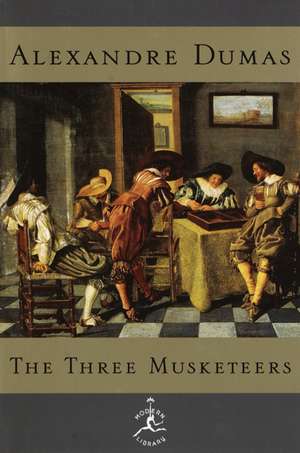
Three Musketeers (Modern Library)
Autor Alexandre Dumas Traducere de Jacques Le Clercqen Limba Engleză Hardback – 18 noi 1999
Ce rămâne dintr-un om atunci când onoarea este singura monedă de schimb într-o lume guvernată de trădare și ambiție politică? Suntem de părere că forța acestui roman, dincolo de faima sa universală, rezidă în capacitatea lui Alexandre Dumas de a transforma istoria Franței într-un mecanism narativ vibrant, unde fiecare duel și fiecare ambuscadă capătă o dimensiune aproape mitică. În această ediție Modern Library, povestea tânărului D'Artagnan, care sosește la Paris în 1625 cu speranța de a se alătura gărzilor regelui Ludovic al XIII-lea, este redată cu o prospețime care justifică de ce, după aproape două secole, rămâne un punct de referință în literatura de aventură. Notăm cu interes modul în care autorul echilibrează dinamismul acțiunii cu portretele psihologice ale celor trei camarazi: melancolicul Athos, exuberantul Porthos și enigmaticul Aramis. Cititorul care a apreciat tema dreptății și a răbdării strategice din The Count of Monte Cristo va găsi aici un spirit similar de reziliență — dar într-un context diferit, mult mai exuberant și axat pe fraternitate militară. Dacă în alte lucrări, precum Ten Years Later, Dumas explorează amurgul eroismului și greutatea trecerii timpului, în Three Musketeers (Modern Library) asistăm la apogeul vitalității. Stilul este unul alert, marcat de o succesiune de evenimente care nu lasă răgaz reflecției statice, ci invită la o trăire nemijlocită a comploturilor orchestrate de Cardinalul Richelieu și de fatala Milady. Putem afirma că romanul nu este doar o cronică a duelurilor, ci o explorare a loialității absolute, scrisă cu o plăcere evidentă a povestirii care se transmite intactă cititorului modern.
Preț: 159.37 lei
Carte disponibilă
Livrare economică 10-24 noiembrie
Specificații
ISBN-10: 0679603328
Pagini: 624
Dimensiuni: 147 x 214 x 34 mm
Greutate: 0.67 kg
Ediția:Modern Library edition
Editura: Random House
V-ar putea interesa
-
 Dominoes: Level 2:: The Three MusketeersAlexandre DumasPreț: 88.49 lei
 -
 Preț: 70.54 lei
 -
 La Reine MargotAlexandre DumasPreț: 68.00 lei
 -
 Louise de la VallièreAlexandre DumasPreț: 68.81 lei
 -
 The Vicomte de BragelonneAlexandre DumasPreț: 64.04 lei
 -
 La Dame aux CaméliasAlexandre DumasPreț: 58.13 lei
 -
 Preț: 49.59 lei
 -
 The Three Musketeers: In Easy-To-Read-TypeAlexandre DumasPreț: 26.15 lei
 -
 The Three MusketeersRebecca LevenePreț: 47.84 lei
 -
 The Three MusketeersMonsieur Alexandre DumasPreț: 151.98 lei
 -
 The Three MusketeersAlexandre DumasPreț: 58.40 lei
 -
 Classic Starts®: The Three MusketeersAlexandre Dumas-28%Preț: 40.04 lei55.66 lei
 -
 The Three MusketeersAlexandre Dumas-32%Preț: 59.42 lei87.61 lei
 -
 Dumas, A: The Count of Monte CristoAlexandre DumasPreț: 69.57 lei
 -
 Twenty Years AfterAlexandre DumasPreț: 40.49 lei
 -
 Man in the Iron MaskAlexandre DumasPreț: 40.65 lei
 -
 Three MusketeersAlexandre DumasPreț: 39.62 lei
 -
 Preț: 52.98 lei
 -
 Preț: 146.10 lei
De ce să citești această carte
Recomandăm această ediție celor care doresc să descopere sau să reviziteze fundamentul romanului de capă și spadă într-o formă neprescurtată. Cititorul câștigă acces la o lume a eleganței primejdioase, unde prietenia este singura ancoră în fața corupției politice. Este o lectură esențială pentru oricine apreciază construcția personajelor arhetipale care au modelat cultura europeană, oferind un amestec rar de rigoare istorică și divertisment pur.
Despre autor
Alexandre Dumas (1802–1870), cunoscut și ca Dumas père pentru a se distinge de fiul său, a fost unul dintre cei mai prolifici și citiți scriitori francezi. Cu o moștenire multiculturală — bunicul său fiind nobil francez, iar bunica sclavă africană din Saint-Domingue — Dumas a reușit să cucerească scena literară pariziană, începând cu piese de teatru și culminând cu romane foileton care au definit epoca. Opera sa monumentală, ce însumează peste 100.000 de pagini, include titluri legendare precum The Count of Monte Cristo și seria muschetarilor, fiind adaptată în sute de producții cinematografice datorită geniului său în a combina faptele istorice cu intriga de aventură.
Descriere scurtă
creating D'Artagnan's troubles and triumphs flashes out of these pages. . . . Dumas rampaged through the history of France, inventing, changing, distorting--doing whatever was needed to produce a tale to hold the reader breathless."
Notă biografică
Dumas achieved instant fame on February 11, 1829, with the triumphant opening of Henri III et sa cour (Henry III and His Court). An innovative and influential play generally regarded as the first French drama of the Romantic movement, it broke with the staid precepts of Neoclassicism that had been imposed on the Paris stage for more than a century. Briefly involved as a republican partisan in the July Revolution of 1830, Dumas soon resumed playwriting and over the next decade turned out a number of historical melodramas that electrified audiences. Two of these works—Antony (1831) and La Tour de Nesle (The Tower of Nesle, 1832)—stand out as milestones in the history of nineteenth-century French theater. In disfavor with the new monarch, Louis-Philippe, because of his republican sympathies, Dumas left France for a time. In 1832 he set out on a tour of Switzerland, chronicling his adventures in Impressions de voyage: En Suisse ( Travels in Switzerland, 1834-1837); over the years he produced many travelogues about subsequent journeys through France, Italy, Russia, and other countries.
Around 1840 Dumas embarked upon a series of historical romances inspired by both his love of French history and the novels of Sir Walter Scott. In collaboration with Auguste Maquet, he serialized Le Chevalier d'Harmental in the newspaper Le Siècle in 1842. Part history, intrigue, adventure, and romance, it is widely regarded as the first of Dumas's great novels. The two subsequently worked together on a steady stream of books, most of which were published serially in Parisian tabloids and eagerly read by the public. He is best known for the celebrated d'Artagnan trilogy—Les trois mousquetaires ( The Three Musketeers, 1844), Vingt ans après (Twenty Years After, 1845) and Dix ans plus tarde ou le Vicomte de Bragelonne ( Ten Years Later; or The Viscount of Bragelonne, 1848-1850)—and the so-called Valois romances—La Reine Margot (Queen Margot, 1845), La Dame de Monsoreau ( The Lady of Monsoreau, 1846), and Les Quarante-cinc ( The Forty-Five Guardsmen, 1848). Yet perhaps his greatest success was Le Comte de Monte Cristo ( The Count of Monte Cristo), which appeared in installments in Le Journal des debats from 1844 to 1845. A final tetralogy marked the end of their partnership: Mmoires d'un medecin: Joseph Balsamo ( Memoirs of a Physician, 1846-1848), Le Collier de la reine ( The Queen's Necklace, 1849-1850), Ange Pitou ( Taking the Bastille, 1853), and La Comtesse de Charny ( The Countess de Charny, 1852-1855).
In 1847, at the height of his fame, Dumas assumed the role of impresario. Hoping to reap huge profits, he inaugurated the new Theatre Historique as a vehicle for staging dramatizations of his historical novels. The same year he completed construction of a lavish residence in the quiet hamlet of Marly-le-Roi. Called Le Château de Monte Cristo, it was home to a menagerie of exotic pets and a parade of freeloaders until 1850, when Dumas's theater failed and he faced bankruptcy. Fleeing temporarily to Belgium in order to avoid creditors, Dumas returned to Paris in 1853, shortly after the appearance of the initial volumes of Mes Memoires ( My Memoirs, 1852). Over the next years he founded the newspaper Le Mousquetaire, for which he wrote much of the copy, as well as the literary weekly Le Monte Cristo, but his finances never recovered. In 1858 he traveled to Russia, eventually publishing two new episodes of Impressions de voyage: Le Caucase (Adventures in the Caucasus, 1859) and En Russie (Travels in Russia, 1865).
The final decade of Dumas's life began with customary high adventure. In 1860 he met Garibaldi and was swept up into the cause of Italian independence. After four years in Naples publishing the bilingual paper L'Independant/L'Indipendente, Dumas returned to Paris in 1864. In 1867 he began a flamboyant liaison with Ada Menken, a young American actress who dubbed him 'the king of romance.' The same year marked the appearance of a last novel, La Terreur Prussiene (The Prussian Terror). Dumas's final play, Les Blancs et les Bleus (The Whites and the Blues), opened in Paris in 1869.
Alexandre Dumas died penniless but cheerful on December 5, 1870, saying of death: 'I shall tell her a story, and she will be kind to me.' One hundred years later his biographer Andre Maurois paid him this tribute: 'Dumas was a hero out of Dumas. As strong as Porthos, as adroit as d'Artagnan, as generous as Edmond Dantes, this superb giant strode across the nineteenth century breaking down doors with his shoulder, sweeping women away in his arms, and earning fortunes only to squander them promptly in dissipation. For forty years he filled the newspapers with his prose, the stage with his dramas, the world with his clamor. Never did he know a moment of doubt or an instant of despair. He turned his own existence into the finest of his novels.'