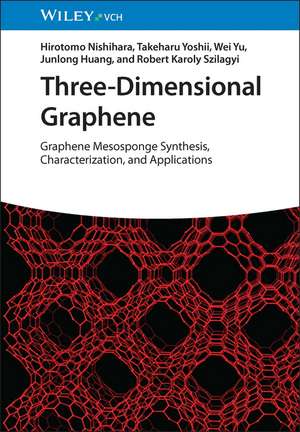
Three-Dimensional Graphene
Autor Hirotomo Nishihara, Takeharu Yoshii, Wei Yu, Junlong Huang, Robert Karoly Szilagyien Limba Engleză Hardback – 21 oct 2026
Three-dimensional graphene-based materials offer high porosity, large specific surface area, and unique electrochemical performance for energy conversion, storage, and environmental applications. Three-Dimensional Graphene: Graphene Mesosponge Synthesis, Characterization, and Applications, written by a team of materials scientists at Tohoku University, provides a systematic treatment spanning fundamental graphene science through the synthesis, properties, structural controllability, and applications of graphene mesosponge.
The book traces the development history and unique synthesis mechanism of graphene mesosponge, detailing its structural variety and controllability. Advanced characterization techniques for carbon-related materials and nanocarbons receive thorough coverage. Battery-related case studies draw on first-hand commercialization data from the authors' own startup, 3DC, and the text explores pathways toward three-dimensional graphene structures with structural regularity.
Readers will also find:
- Detailed coverage progressing from general graphene-based materials to the latest three-dimensional carbon material, graphene mesosponge
- Instructions on advanced characterization techniques applicable to research on carbon-related materials and nanocarbon structures
- Case studies on battery-related applications informed by direct commercialization experience and experimental data from industry
- Analysis of graphene mesosponge properties including high porosity, low density, large specific surface area, and electrochemical performance
- Discussion of future synthesis pathways aimed at creating three-dimensional graphene architectures with controlled structural regularity
Preț: 800.85 lei
Preț vechi: 880.06 lei
-9% Precomandă
Carte nepublicată încă
Specificații
ISBN-10: 352735459X
Pagini: 240
Ilustrații: 1 schwarz-weiße und 10 farbige Abbildungen
Dimensiuni: 170 x 244 mm
Greutate: 0.59 kg
Editura: Wiley-VCH GmbH
Notă biografică
Hirotomo Nishihara, PhD, is a Full Professor at WPI-AIMR and IMRAM, Tohoku University, and Chief Science Officer at 3DC, a startup he founded in 2022 to commercialize graphene mesosponge. He received the JSPS Prize in 2020.
Takeharu Yoshii, PhD, is an Associate Professor at IMRAM, Tohoku University. His research focuses on nanostructured heterogeneous catalysts and carbon materials. He received the Chemical Society of Japan Award for Young Chemists in 2025.
Wei Yu, PhD, is a tenure-track assistant professor at Tohoku University. He holds a PhD from Tsinghua University and has authored over 25 peer-reviewed publications and three international patents on carbon and energy materials.
Junlong Huang, PhD, is an Assistant Professor at WPI-AIMR, Tohoku University. His research focuses on the design and preparation of functional porous polymers and carbon materials for energy storage devices.
Robert Karoly Szilagyi, PhD, MSc, is an Associate Professor and Department Head of Chemistry at the University of British Columbia, Okanagan. His research integrates quantum chemical methods with synchrotron spectroscopy across bioinorganic systems and materials science.
Cuprins
Author Biography ix
Preface xi
Acknowledgments xiii
1 General Background of Carbon Materials 1
1.1 Carbon Allotrope 1
1.2 Synthesis of sp2-Based Carbon Allotropes 7
2 Graphene and Related Materials 15
2.1 Graphene 15
2.2 Synthesis of Graphene-Based Materials 24
2.3 Commercial Graphene Products 29
2.4 Application of Graphene-Based Materials 31
2.5 Limitations of 2D Graphene and the Need for 3D Architectures 34
3 3D Carbon Materials 39
3.1 Geometric Considerations Toward 3D Graphene Materials 39
3.2 Plausible Advantages of 3D Graphene 42
3.3 Synthetic Strategies Toward 3D Graphene Materials 46
3.4 Templated Synthesis 60
3.5 Remaining Challenges and Outlook 76
4 Structural Evaluation of Graphene-Based 3D Materials 93
4.1 Defects 94
4.2 Edge Site Analysis by HT-TPD 94
4.3 Domain Size 97
4.4 Stacking Number 99
4.5 Topological Defect Analysis 101
5 Graphene Mesosponge - A Genuine 3D Graphene 103
5.1 Definition 103
5.2 Development History 105
5.3 Synthesis 108
5.4 Structure 122
5.5 Intermediates 136
5.6 Comprehensive Discussion of GMS Properties 139
5.7 Summary and Outlook 157
6 Applications 167
6.1 Catalyst Supports 167
6.2 Supercapacitors 171
6.3 Li-S Batteries 180
6.4 Li-O
6.5 Fuel Cells 194
6.6 Li-Ion Batteries 197
6.7 New Type of Heat Pumps 199
6.8 Biosensors 203
6.9 Summary and Perspective 204
References 205
7 Conclusive Remarks and Perspective 213
Index 217