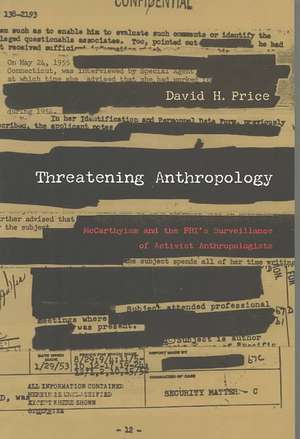
Threatening Anthropology
Autor David H Priceen Limba Engleză Paperback – 20 apr 2004
Recomandăm Threatening Anthropology ca o lucrare de referință pentru nivelul de licență și master în istoria științelor sociale și științe politice. David H Price oferă o reconstrucție metodică a modului în care supravegherea statului american în timpul Războiului Rece a deformat parcursul antropologiei ca disciplină. Spre deosebire de alte lucrări care se concentrează strict pe ideologie, Price demonstrează că nu apartenența la partide de stânga a declanșat cele mai dure persecuții, ci implicarea cercetătorilor în lupta pentru drepturi civile și egalitate rasială. Structura cărții este organizată cronologic și tematic, începând cu primele semne ale Războiului Rece și continuând cu analize de caz detaliate ale unor figuri precum Melville Jacobs sau Gene Weltfish. Descoperim aici o perspectivă critică asupra instituțiilor academice, autorul dedicând capitole întregi „tăcerii conspirative” și reticenței American Anthropological Association de a proteja libertatea academică. Volumul acoperă o arie similară cu Anthropology At the Dawn of the Cold War de Dustin M. Wax, însă abordarea lui Price este mult mai ancorată în dovezi primare, utilizând peste 30.000 de pagini de documente FBI declasificate. În contextul operei sale, această lucrare face tranziția de la studiul utilizării antropologilor în scopuri militare, analizat în Anthropological Intelligence, către mecanismele interne de control și cenzură. Stilul este precis și documentat, evitând speculațiile în favoarea faptelor extrase din audieri judiciare și corespondență privată. Rezultatul este o cronică despre cum frica și monitorizarea guvernamentală au limitat orizontul de cercetare, transformând disciplinele academice în instrumente mai puțin critice la adresa status quo-ului.
Preț: 296.25 lei
Carte tipărită la comandă
Livrare economică 20 noiembrie-04 decembrie
Specificații
ISBN-10: 0822333384
Pagini: 448
Dimensiuni: 152 x 236 x 27 mm
Greutate: 0.63 kg
Ediția:New.
Editura: Duke University Press
Locul publicării:United States
V-ar putea interesa
-
 ColossusNiall Ferguson-30%Preț: 66.36 lei94.21 lei
 -
 Lyndon B. JohnsonRobert DallekPreț: 122.49 lei
 -
 The Oxford Companion to United States HistoryPaul S. Boyer-18%Preț: 433.99 lei526.52 lei
 -
 -13%Preț: 155.16 lei177.68 lei
 -
 Once They Moved Like The Wind 49David RobertsPreț: 143.32 lei
 -
 Benjamin Franklin: An American LifeWalter Isaacson-21%Preț: 90.45 lei114.16 lei
 -
 The AmericasFelipe Fernandez-Armesto-28%Preț: 65.71 lei90.90 lei
 -
 Bury My Heart at Wounded KneeDee BrownPreț: 143.63 lei
 -
 Alternative OklahomaDavis D. JoycePreț: 124.60 lei
 -
 The 9/11 ReportSid JacobsonPreț: 114.34 lei
 -
 Unspeakable ViolenceNicole M Guidotti-HernándezPreț: 292.09 lei
 -
 Stories of Faith and Courage from the Civil WarTerry R TuleyPreț: 107.70 lei
 -
 Lincoln's SwordDouglas L. WilsonPreț: 119.39 lei
 -
 The Politically Incorrect Guide to the SouthClint JohnsonPreț: 126.33 lei
De ce să citești această carte
Această carte este esențială pentru cercetătorii interesați de libertatea academică și de intersecția dintre politică și știință. Cititorul va înțelege mecanismele subtile prin care supravegherea statului poate duce la autocenzură în mediul universitar. Este o recomandare solidă pentru cei care doresc să vadă dincolo de mitul neutralității științifice, oferind un studiu de caz istoric despre riscurile activismului social în perioade de tensiune politică.
Despre autor
David H Price este un cercetător recunoscut pentru investigațiile sale asupra relației dintre comunitatea academică și serviciile de informații americane. Lucrările sale sunt fundamentate pe o utilizare riguroasă a legii privind liberul acces la informații (FOIA), prin care a reușit să scoată la lumină documente clasificate timp de decenii. În timp ce în lucrări precum In the Beginning Was the Image a explorat istoria artei și a Reformei, proiectul său de anvergură rămâne analiza modului în care antropologia a fost modelată de interesele strategice și de supravegherea FBI în secolul XX.
Descriere scurtă
Cuprins
> 1 A Running Start at the Cold War: Time, Place, and Outcomes 1
2 Melville Jacobs, Albert Canwell, and the University of Washington Regents: A Message Sent 34
3 Syncopated Incompetence: The American Anthropological Association’s Reluctance to Protect Academic Freedom 50
4 Hoover’s Informer 70
5 Lessons Learned: Jacobs’s Fallout and Swadesh’s Troubles 90
6 Public Show Trials: Gene Weltfish and a Conspiracy of Silence 109
7 Bernhard Stern: “A Sense of Atrophy among Those Who Fear: 136
8 Persecuting Equality: The Travails of Jack Harris and Mary Shepardson 154
9 Estimating the FBI’s Means and Methods 169
10 Known Shades of Red: Marxist Anthropologists Who Escaped Public Show Trials 195
11 Red Diaper Babies, Suspect Agnates, Cognates, and Affines 225
12 Culture, Equality, Poverty, and Paranoia: The FBI, Oscar Lewis, and Margaret Mead 237
13 Crusading Liberals Advocating for Racial Justice: Philleo Nash and Ashley Montagu 263
14 The Suspicions of Internationalists 284
15 A Glimpse of Post-McCarthyism: FBI Surveillance and Consequences for Activism 306
16 Through a Fog Darkly: The Cold War’s Impact on Free Inquiry 341
Appendix: On Using the Freedom of Information Act 355
Notes 363
Bibliography 383
Index 405
Recenzii
"A bold piece of scholarship that breaks the silence on many issues that have changed only a bit since the Cold War and might still come to the foreground in such a way as to make the McCarthy era look like a play." Laura Nader, University of California, Berkeley "An enthralling expedition into the heart of academic darkness. David H. Price brilliantly confirms that there are no depths to which policemen and professors will not sink."--Alexander Cockburn, coeditor of CounterPunch and columnist for The Nation "Threatening Anthropology is a bold piece of scholarship, one that breaks the silence on many issues in the American trajectory that have changed only a bit since the Cold War and--given recent indications--might still come to the foreground in such a way as to make the McCarthy era look like play."--Laura Nader, University of California, Berkeley "David H. Price's painstaking account of political repression in anthropology after the Second World War is a unique contribution to the history of the field. More than that, it may foreshadow what some today may entertain. Let us hope not, but let us not be naive."--Dell Hymes, editor of Reinventing Anthropology "a story that is historically needed and industriously researched..." The Seattle Times, Bruce Ramsey "...is an opinionated, audacious, and welcome piece of scholarship." Barbara McMichael of The Olympian "David Price has produced an extremely important book. 'Threatening Anthropology' illuminates both the history of Anthropology and the political history of the USA from the late 1930's to the present."--CAMBRIDGE ANTHROPOLOGY, 25:1, 2005