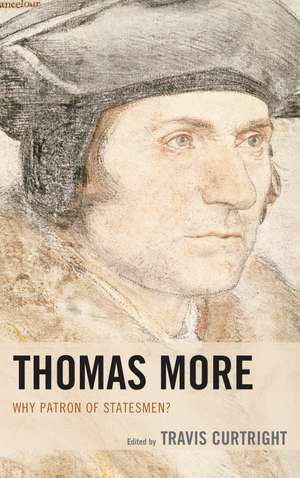
Thomas More: Why Patron of Statesmen?
Editat de Travis Curtright Contribuţii de J. Brian Benestad, Samuel Gregg, Carson Holloway, Louis Karlin, Jeffrey S. Lehman, James V. Schall, Stephen W. Smith, James R. Stoner Jr., Gerard B. Wegemeren Limba Engleză Paperback – 24 iul 2017
Preț: 328.98 lei
Preț vechi: 426.17 lei
-23%
Puncte Express: 493
Carte tipărită la comandă
Livrare economică 28 noiembrie-12 decembrie
Livrare prin curier în România Termenul estimat este afișat lângă disponibilitate.
Transport gratuit de la 400.00 lei Plată online sau ramburs, în funcție de opțiunile comenzii.
Retur gratuit în 14 zile Comandă securizată și suport în română.
Specificații
ISBN-13: 9781498522281
ISBN-10: 1498522289
Pagini: 244
Dimensiuni: 151 x 228 x 17 mm
Greutate: 0.34 kg
Editura: Bloomsbury Publishing
Colecția Lexington Books
Locul publicării:New York, United States
ISBN-10: 1498522289
Pagini: 244
Dimensiuni: 151 x 228 x 17 mm
Greutate: 0.34 kg
Editura: Bloomsbury Publishing
Colecția Lexington Books
Locul publicării:New York, United States
Cuprins
Acknowledgements
List of Contributors
Introduction: Why Patron of Statesmen (Travis Curtright)
Chapter 1: Thomas More on Liberty, Law, and Good Rule (Gerard Wegemer)
Chapter 2: Statesmanship, Tyranny, and Piety: Thomas More's Response to Lucian's
The Tyrannicide (Carson Holloway)
Chapter 3: Utopia's Images of the Statesman (James R. Stoner, Jr.)
Chapter 4: Passing Strange, Yet Wholly True: On the Political Tales of Plato's Critias
and More's Hythlodaeus (Jeffrey S. Lehman)
Chapter 5: Thomas More's Utopia and Catholic Social Doctrine (J. Brian Benestad)
Chapter 6: Faith, Reason, and Order: Thomas More and Natural Law (Samuel Gregg)
Chapter 7: Sir Thomas More and his Opposition to Henry VIII in 1533 (Travis Curtright)
Chapter 8: Thomas More: Patron Saint of Leading Citizens (Stephen W. Smith)
Chapter 9: What Bolt Got Right and What Mantel Got Wrong (Louis Karlin)
Chapter 10: The Place of Sir Thomas More in Political Philosophy: A Reflection on "A
Man for All Seasons." (James V. Schall, S. J.)
Appendix: Apostolic Letter, Issued Motu Proprio, Proclaiming Saint Thomas More
Patron of Statesmen and Politicians. (Pope John Paul II.)
Bibliography
Index
About the contributors
List of Contributors
Introduction: Why Patron of Statesmen (Travis Curtright)
Chapter 1: Thomas More on Liberty, Law, and Good Rule (Gerard Wegemer)
Chapter 2: Statesmanship, Tyranny, and Piety: Thomas More's Response to Lucian's
The Tyrannicide (Carson Holloway)
Chapter 3: Utopia's Images of the Statesman (James R. Stoner, Jr.)
Chapter 4: Passing Strange, Yet Wholly True: On the Political Tales of Plato's Critias
and More's Hythlodaeus (Jeffrey S. Lehman)
Chapter 5: Thomas More's Utopia and Catholic Social Doctrine (J. Brian Benestad)
Chapter 6: Faith, Reason, and Order: Thomas More and Natural Law (Samuel Gregg)
Chapter 7: Sir Thomas More and his Opposition to Henry VIII in 1533 (Travis Curtright)
Chapter 8: Thomas More: Patron Saint of Leading Citizens (Stephen W. Smith)
Chapter 9: What Bolt Got Right and What Mantel Got Wrong (Louis Karlin)
Chapter 10: The Place of Sir Thomas More in Political Philosophy: A Reflection on "A
Man for All Seasons." (James V. Schall, S. J.)
Appendix: Apostolic Letter, Issued Motu Proprio, Proclaiming Saint Thomas More
Patron of Statesmen and Politicians. (Pope John Paul II.)
Bibliography
Index
About the contributors
Recenzii
I appreciate the strengths of a fine volume that will benefit many different audiences. . . .The volume's illumination of More's life, writings, and historical reception deserves the attention of all scholars and teachers--Catholic and non-Catholic alike. . . .The book successfully addresses these many audiences by having a wide variety of fine essays.
In 2000 Pope John Paul II proclaimed St. Thomas More to be the patron of statesmen and people in public life. And yet scholarly investigations of More's principles of statesmanship are still relatively few. In commissioning and editing this often stimulating collection of essays, Travis Curtwright seeks to fill the gap. He and his fellow contributors, several connected to the Center for Thomas More Studies at the University of Dallas, aim to revive interest in More by distilling from his writings and life experiences the very essence of this subtle, steely individual who began as a commercial lawyer and moral philosopher and ended up as Henry VIII's only honest councilor. It is an approach that in the wrong hands could become clumsily instrumentalist and teleological. Fortunately, these contributors know the pitfalls and largely avoid them.. By writing Utopia, More created an entirely new literary genre, one that has continued to rekindle the perennially central issues of social and political thinking ever since. And for that, his statesmanship should be honored.
This excellent book dives deep into the mystery of Thomas More (1478-1535), lawyer, scholar, saint. It was published to commemorate Pope John Paul's naming More the Patron of Statesmen, and examines, in particular, the grounds for that honorific. The authors included in this volume read like a who's who of More scholarship. Their carefully crafted essays are worthy of close study and will repay the efforts of serious students as well as interested amateurs. The essays are variously focused but, taken as a whole, admirably comprehensive in exploring the words and deeds of their famous subject. What follows is but one reflection born of this magisterial work.
One of the contributors to this book has written that "admiration draws the soul toward an example of human excellence; it is felt as a desire to be like the person admired". This remarkable collection of essays offers a convincing and multifaceted view of Thomas More as the ideal Christian statesman. Through the study of both More's writings and two famous works of fiction, A Man for All Seasons and Wolf Hall, this scholarly enterprise gives flesh to the gubernator in Thomas More, and validates his election as Patron of Statesmen.
In 2000 Pope John Paul II proclaimed St. Thomas More to be the patron of statesmen and people in public life. And yet scholarly investigations of More's principles of statesmanship are still relatively few. In commissioning and editing this often stimulating collection of essays, Travis Curtwright seeks to fill the gap. He and his fellow contributors, several connected to the Center for Thomas More Studies at the University of Dallas, aim to revive interest in More by distilling from his writings and life experiences the very essence of this subtle, steely individual who began as a commercial lawyer and moral philosopher and ended up as Henry VIII's only honest councilor. It is an approach that in the wrong hands could become clumsily instrumentalist and teleological. Fortunately, these contributors know the pitfalls and largely avoid them.. By writing Utopia, More created an entirely new literary genre, one that has continued to rekindle the perennially central issues of social and political thinking ever since. And for that, his statesmanship should be honored.
This excellent book dives deep into the mystery of Thomas More (1478-1535), lawyer, scholar, saint. It was published to commemorate Pope John Paul's naming More the Patron of Statesmen, and examines, in particular, the grounds for that honorific. The authors included in this volume read like a who's who of More scholarship. Their carefully crafted essays are worthy of close study and will repay the efforts of serious students as well as interested amateurs. The essays are variously focused but, taken as a whole, admirably comprehensive in exploring the words and deeds of their famous subject. What follows is but one reflection born of this magisterial work.
One of the contributors to this book has written that "admiration draws the soul toward an example of human excellence; it is felt as a desire to be like the person admired". This remarkable collection of essays offers a convincing and multifaceted view of Thomas More as the ideal Christian statesman. Through the study of both More's writings and two famous works of fiction, A Man for All Seasons and Wolf Hall, this scholarly enterprise gives flesh to the gubernator in Thomas More, and validates his election as Patron of Statesmen.