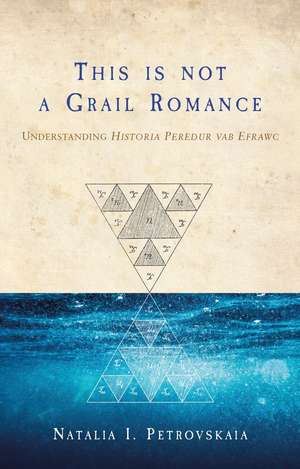
This is Not a Grail Romance
Autor Natalia I. Petrovskaiaen Limba Engleză Paperback – 15 iul 2023
This book presents a fresh analysis of the medieval Welsh Arthurian tale, Historia Peredur vab Efrawc (Story of Peredur son of Efrawc). It explains the text’s structure and provides new insights into its connection with its medieval Welsh cultural and political context, casting light on the relationship between this narrative and the broader European tradition of Grail romances.
Preț: 213.89 lei
Puncte Express: 321
Carte disponibilă
Livrare economică 02-16 noiembrie
Livrare express 16-22 octombrie pentru 22.74 lei
Livrare prin curier în România Termenul estimat este afișat lângă disponibilitate.
Transport gratuit de la 400.00 lei Plată online sau ramburs, în funcție de opțiunile comenzii.
Retur gratuit în 14 zile Comandă securizată și suport în română.
Specificații
ISBN-13: 9781837720361
ISBN-10: 1837720363
Pagini: 228
Dimensiuni: 138 x 216 x 12 mm
Greutate: 0.26 kg
Editura: University of Wales Press - IPSUK
ISBN-10: 1837720363
Pagini: 228
Dimensiuni: 138 x 216 x 12 mm
Greutate: 0.26 kg
Editura: University of Wales Press - IPSUK
V-ar putea interesa
-
 Edge of Irony: Modernism in the Shadow of the Habsburg EmpireProfessor Marjorie PerloffPreț: 198.67 lei
 -
 La Letteratura Italiana Nel Secolo XIXFrancesco De SanctisPreț: 112.39 lei
 -
 El Pensamiento de La Liberacion y La Novela Hispanoamericana de Tematica IndigenaJavier Valiente N. EzPreț: 94.28 lei
 -
 Su L'Aminta Di T. TassoGiosue CarducciPreț: 53.02 lei
 -
 Sonatine BizzarreAntonio FogazzaroPreț: 51.68 lei
 -
 Il TesorettoBrunetto LatiniPreț: 53.42 lei
 -
 Hermann Hesses "Siddhartha"Eberhard OstermannPreț: 82.23 lei
 -
 Il Libro Di Don ChisciotteEdoardo ScarfoglioPreț: 74.73 lei
 -
 La Lectura NovelescaGonzalo Diaz MigoyoPreț: 85.60 lei
 -
 Oedipus, Isaac, and the Noblest RomanLeonard GinsbergPreț: 44.72 lei
 -
 The General Prologue by Geoffrey ChaucerRay Moore M. a.Preț: 71.66 lei
 -
 Always Only AlmostD. E. LucasPreț: 86.94 lei
 -
 Sea of SorrowsDennis E. AdonisPreț: 36.71 lei
 -
 The Holy Buy BullBenn PerryPreț: 128.82 lei
 -
 Kritische Abhandlung Von Dem Wunderbaren in Der PoesieJohann Jacob BodmerPreț: 84.95 lei
 -
 TheaterkritikenLudwig BornePreț: 67.24 lei
 -
 LiteraturkritikenLudwig BornePreț: 60.15 lei
 -
 Essays Und AutobiographischesIda Boy EdPreț: 66.23 lei
 -
 Etwas Uber William Shakespeares SchauspieleUlrich BrakerPreț: 54.46 lei
 -
 Deutsche Geschichte Von 1815-1870Luise BuchnerPreț: 173.63 lei
Notă biografică
Natalia I. Petrovskaia is assistant professor in Celtic at Utrecht University.
Cuprins
List of Tables and Figures
Acknowledgments
Introduction
Chapter 1: The Structure of the Narrative
Chapter 2: The Geography and Landscapes of Peredur
Chapter 3: Historical Context and the Empress
Chapter 4: Literary Context. Peredur and Some Lost Tales
Chapter 5: Peredur and Welsh Law
Chapter 6: The Witches of Gloucester and other Problematic Characters
Conclusion
Abbreviations
Bibliography
Index
Acknowledgments
Introduction
Chapter 1: The Structure of the Narrative
Chapter 2: The Geography and Landscapes of Peredur
Chapter 3: Historical Context and the Empress
Chapter 4: Literary Context. Peredur and Some Lost Tales
Chapter 5: Peredur and Welsh Law
Chapter 6: The Witches of Gloucester and other Problematic Characters
Conclusion
Abbreviations
Bibliography
Index
Recenzii
‘Natalia Petrovskaia’s thought-provoking and closely-argued monograph will dramatically change how we think about the medieval Welsh Peredur and about the vexed issue of its relation to Chrétien’s Perceval. It provides convincing and innovative analyses of its narrative structure, and of its indebtedness to Welsh literary, legal and cultural traditions.’