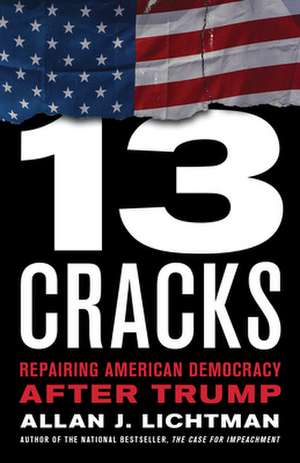
Thirteen Cracks: Repairing American Democracy after Trump
Autor Allan J. Lichtmanen Limba Engleză Hardback – 8 noi 2021
America's founders feared a president like Donald Trump. Through the Constitution and the Bill of Rights, they erected a fortified but constrained government to secure the benchmarks of our democracy and established the guardrails designed to protect it. But Trump pushed almost every one of the Framers' safeguards to its limit-most held, but some broke under the weight of presidential abuses even the Framers did not foresee.
Thirteen Cracks will be the first book to expose the most vulnerable areas in our democracy, explain in historical context how President Trump uniquely and outrageously exploited these weak spots, and propose a fix for each challenge. Historian Allan J. Lichtman argues that Trump has put us at a pivot point in our history, where the survival of American democracy is at stake. But this is also an historic opportunity to shore up the vulnerabilities and to strengthen our democracy.
Preț: 120.31 lei
Preț vechi: 144.60 lei
-17%
Puncte Express: 180
Preț estimativ în valută:
21.29€ • 24.88$ • 18.49£
21.29€ • 24.88$ • 18.49£
Carte disponibilă
Livrare economică 29 ianuarie-12 februarie
Preluare comenzi: 021 569.72.76
Specificații
ISBN-13: 9781538156513
ISBN-10: 1538156512
Pagini: 224
Dimensiuni: 144 x 218 x 26 mm
Greutate: 0.44 kg
Editura: Bloomsbury Publishing
Colecția Rowman & Littlefield Publishers
Locul publicării:New York, United States
ISBN-10: 1538156512
Pagini: 224
Dimensiuni: 144 x 218 x 26 mm
Greutate: 0.44 kg
Editura: Bloomsbury Publishing
Colecția Rowman & Littlefield Publishers
Locul publicării:New York, United States
Cuprins
Contents
Introduction
Chapter 1: Doing Whatever I Want: Controlling Autocracy
Chapter 2: Congress Be Damned: Restoring Accountability
Chapter 3. Russia is Listening: Defending America's Sovereignty
Chapter 4. A Presidency Built On Lies: Reclaiming Truth
Chapter 5. Corrupt Justice: Redeeming Law Enforcement
Chapter 6. Enemies of the People: Protecting a Free Press
Chapter 7. Profits Above Patriotism: Policing Conflicts of Interest
Chapter 8. Political Cleansing: Stopping Favoritism, Cronyism and Nepotism
Chapter 9. Governing in the Dark: Expanding Transparency
Chapter 10. A Militarized Nation: Separating The Military From Politics
Chapter 11. Voter Suppression: Restoring the Franchise
Chapter 12: Post-Election Obstruction: Reforming Presidential Transitions
Chapter 13. Rigged if I Lose, Fair if I Win: Protecting Election Results
Chapter 14: Conclusion: Promoting Civic Virtue and Healing a Divided America
Introduction
Chapter 1: Doing Whatever I Want: Controlling Autocracy
Chapter 2: Congress Be Damned: Restoring Accountability
Chapter 3. Russia is Listening: Defending America's Sovereignty
Chapter 4. A Presidency Built On Lies: Reclaiming Truth
Chapter 5. Corrupt Justice: Redeeming Law Enforcement
Chapter 6. Enemies of the People: Protecting a Free Press
Chapter 7. Profits Above Patriotism: Policing Conflicts of Interest
Chapter 8. Political Cleansing: Stopping Favoritism, Cronyism and Nepotism
Chapter 9. Governing in the Dark: Expanding Transparency
Chapter 10. A Militarized Nation: Separating The Military From Politics
Chapter 11. Voter Suppression: Restoring the Franchise
Chapter 12: Post-Election Obstruction: Reforming Presidential Transitions
Chapter 13. Rigged if I Lose, Fair if I Win: Protecting Election Results
Chapter 14: Conclusion: Promoting Civic Virtue and Healing a Divided America
Recenzii
In his sobering and deeply researched new book. renowned historian Professor Allan J. Lichtman recounts how Trump exploited the most vulnerable weaknesses of our democracy. As he details Trump's many abuses, he also provides detailed historical context on challenges to democracy from other American leaders. Professor Lichtman shares his profound concern for the fate of our democracy.
[E]nlightening are Lichtman's discussions of the ways in which previous presidents laid the groundwork for Trump's more flagrant violations of democratic norms.
As America moves into a new era, pundits and scholars are asking how badly American democracy and its institutions have been damaged by Trump and his followers. The answer is: it's serious. Lichtman looks at 13 aspects of American democracy, analyzes how they have been damaged, and then offers reasonable, intelligent advice on how to repair or ameliorate the damage. These subjects include reclaiming truth, policing conflicts of interest, expanding transparency, and stopping cronyism and nepotism. Also, while the focus is primarily on former President Trump, Lichtman takes a historian's long view, noting that many of these corrupt practices date back to George Washington's presidency. This additional historical perspective shows that the American ideal has been a constant work in progress, giving hope that our current dilemma might be resolved to positive effect. Lichtman's proffered solutions, however reasonable they may be, however, depend on one of two things happening: either Democrats must remain the majority party, or the Trumpist Republicans have to abandon their obstructionist ways. For Lichtman, hope springs eternal.
For the four years of its existence and in the months following it, Donald Trump's presidential administration provided myriad examples of breaking American law and general norms of government. As Allan Lichtman demonstrates in his valuable Thirteen Cracks, that administration's crimes highlighted places where the US system needs reform or enforcement so that such offenses never happen again.
Lichtman takes a welcome nonpartisan, straightforward approach to laying out Donald Trump's repeated violations. Along with diagnosing those problems, the book recommends reasonable cures, like specific actions that Congress or other entities could take. This work is organized into thirteen categories that focus on the types of violations that most harm democracy, like the politicization of the military, the widespread nepotism and cronyism, and the use of pardons for profit and to reward criminal action on the president's behalf. It avoids the distractions of Twitter debates or discussions of the former president's tone to instead tie together the serious ways in which he tried to dismantle
American democracy.
Thirteen Cracks includes examples of actions by past presidents of all parties that fall into similar categories. In each case, it demonstrates that the problems go beyond the forty-fifth president and need to be addressed after him, while still highlighting how much his actions exceeded those of even his unsavory predecessors, and how no past administration broke such a range of laws. The book stresses how the founding fathers argued against, and took steps to prevent, many of those very actions. It's packed with important context, and the inclusion of practical cures along with the diagnosis of the disease makes it more than just a recitation of corruption.
Thirteen Cracks is a thorough roundup on the threats to democracy that America faced in the past few years-and a useful road map for moving forward.
Lichtman's book reads like an exercise in Trump detox. In 13 concise chapters, he offers to patch the cracks he identifies with various forms of-well, pick whatever metaphor might fit-caulking, dry wall, bricks and mortar, or something stronger still. The fact that he advertises his remedies as "simple, quick, and practical" would appear to suggest caulking.... The list of fixes is long-there are so many cracks to be filled, from barring nepotism to protecting inspectors general. But it eventually dawns on any attentive reader of this catalogue of Trumpian malfeasance that the trail of misdeeds did not begin with him and that cracks have characterized the history of the republic from the very beginning.
What sets Thirteen Cracks apart from the slew of books chronicling the abuses of the Trump administration is that Lichtman does not just identify those abuses, he provides solutions designed to prevent future presidents from following Trump's example. Lichtman's sentences, which are packed with quotes from everyone from Hannah Arendt and Jeremy Benthem to Walter Cronkite and the punk band Lard, convey a sense of urgency that keeps the reader engaged, and the writing throughout is impassioned and incisive. Ultimately the success of Thirteen Cracks rests on the specific and actionable solutions Lichtman offers for each of the weaknesses he identifies.
With fresh, inventive, and sound ideas--what he calls a "blueprint" for reform in the early post-Trump months--Allan Lichtman, one of the most widely knowledgeable historians of the American past, provides a set of robust proposals for essential changes in American government to prevent the further erosion of federal institutions, practices, and norms. It should be read widely in Congress and by everyone concerned with the perilous state of American government and politics.
The question of whether our constitutional democracy will survive the next decade has become the most urgent problem of American politics. In his newest book, Allan Lichtman offers an acute diagnosis of thirteen of the most troubling ailments vexing our political system and prescribes an ingenious remedy for each. Writing with an almost Madisonian concision, Lichtman makes an essential contribution to the growing literature on the danger of democratic decline.
[E]nlightening are Lichtman's discussions of the ways in which previous presidents laid the groundwork for Trump's more flagrant violations of democratic norms.
As America moves into a new era, pundits and scholars are asking how badly American democracy and its institutions have been damaged by Trump and his followers. The answer is: it's serious. Lichtman looks at 13 aspects of American democracy, analyzes how they have been damaged, and then offers reasonable, intelligent advice on how to repair or ameliorate the damage. These subjects include reclaiming truth, policing conflicts of interest, expanding transparency, and stopping cronyism and nepotism. Also, while the focus is primarily on former President Trump, Lichtman takes a historian's long view, noting that many of these corrupt practices date back to George Washington's presidency. This additional historical perspective shows that the American ideal has been a constant work in progress, giving hope that our current dilemma might be resolved to positive effect. Lichtman's proffered solutions, however reasonable they may be, however, depend on one of two things happening: either Democrats must remain the majority party, or the Trumpist Republicans have to abandon their obstructionist ways. For Lichtman, hope springs eternal.
For the four years of its existence and in the months following it, Donald Trump's presidential administration provided myriad examples of breaking American law and general norms of government. As Allan Lichtman demonstrates in his valuable Thirteen Cracks, that administration's crimes highlighted places where the US system needs reform or enforcement so that such offenses never happen again.
Lichtman takes a welcome nonpartisan, straightforward approach to laying out Donald Trump's repeated violations. Along with diagnosing those problems, the book recommends reasonable cures, like specific actions that Congress or other entities could take. This work is organized into thirteen categories that focus on the types of violations that most harm democracy, like the politicization of the military, the widespread nepotism and cronyism, and the use of pardons for profit and to reward criminal action on the president's behalf. It avoids the distractions of Twitter debates or discussions of the former president's tone to instead tie together the serious ways in which he tried to dismantle
American democracy.
Thirteen Cracks includes examples of actions by past presidents of all parties that fall into similar categories. In each case, it demonstrates that the problems go beyond the forty-fifth president and need to be addressed after him, while still highlighting how much his actions exceeded those of even his unsavory predecessors, and how no past administration broke such a range of laws. The book stresses how the founding fathers argued against, and took steps to prevent, many of those very actions. It's packed with important context, and the inclusion of practical cures along with the diagnosis of the disease makes it more than just a recitation of corruption.
Thirteen Cracks is a thorough roundup on the threats to democracy that America faced in the past few years-and a useful road map for moving forward.
Lichtman's book reads like an exercise in Trump detox. In 13 concise chapters, he offers to patch the cracks he identifies with various forms of-well, pick whatever metaphor might fit-caulking, dry wall, bricks and mortar, or something stronger still. The fact that he advertises his remedies as "simple, quick, and practical" would appear to suggest caulking.... The list of fixes is long-there are so many cracks to be filled, from barring nepotism to protecting inspectors general. But it eventually dawns on any attentive reader of this catalogue of Trumpian malfeasance that the trail of misdeeds did not begin with him and that cracks have characterized the history of the republic from the very beginning.
What sets Thirteen Cracks apart from the slew of books chronicling the abuses of the Trump administration is that Lichtman does not just identify those abuses, he provides solutions designed to prevent future presidents from following Trump's example. Lichtman's sentences, which are packed with quotes from everyone from Hannah Arendt and Jeremy Benthem to Walter Cronkite and the punk band Lard, convey a sense of urgency that keeps the reader engaged, and the writing throughout is impassioned and incisive. Ultimately the success of Thirteen Cracks rests on the specific and actionable solutions Lichtman offers for each of the weaknesses he identifies.
With fresh, inventive, and sound ideas--what he calls a "blueprint" for reform in the early post-Trump months--Allan Lichtman, one of the most widely knowledgeable historians of the American past, provides a set of robust proposals for essential changes in American government to prevent the further erosion of federal institutions, practices, and norms. It should be read widely in Congress and by everyone concerned with the perilous state of American government and politics.
The question of whether our constitutional democracy will survive the next decade has become the most urgent problem of American politics. In his newest book, Allan Lichtman offers an acute diagnosis of thirteen of the most troubling ailments vexing our political system and prescribes an ingenious remedy for each. Writing with an almost Madisonian concision, Lichtman makes an essential contribution to the growing literature on the danger of democratic decline.