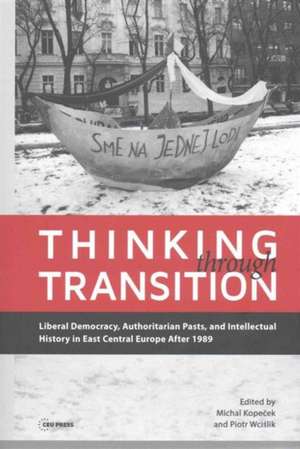
Thinking through Transition: Liberal Democracy, Authoritarian Pasts, and Intellectual History in East Central Europe After 1989
Editat de Michal Kopeček, Piotr Wciśliken Limba Engleză Hardback – oct 2015
Preț: 1045.12 lei
Preț vechi: 1148.48 lei
-9%
Puncte Express: 1568
Carte disponibilă
Livrare economică 02-16 noiembrie
Livrare prin curier în România Termenul estimat este afișat lângă disponibilitate.
Transport gratuit pentru acest produs Plată online sau ramburs, în funcție de opțiunile comenzii.
Retur gratuit în 14 zile Comandă securizată și suport în română.
Specificații
ISBN-13: 9789633860854
ISBN-10: 9633860857
Pagini: 608
Dimensiuni: 152 x 229 x 37 mm
Greutate: 1.28 kg
Ediția:1
Editura: Amsterdam University Press
Colecția Central European University Press
Locul publicării:Oxford, United Kingdom
ISBN-10: 9633860857
Pagini: 608
Dimensiuni: 152 x 229 x 37 mm
Greutate: 1.28 kg
Ediția:1
Editura: Amsterdam University Press
Colecția Central European University Press
Locul publicării:Oxford, United Kingdom
V-ar putea interesa
-
 The Sewing Circles of HeratChristina LambPreț: 116.51 lei
 -
 Forgotten Voices Of The Second World WarMax Arthur-28%Preț: 87.50 lei120.75 lei
 -
 The Argumentative IndianAmartya Sen-30%Preț: 65.82 lei94.04 lei
 -
 Cuba ConfidentialAnn Louise BardachPreț: 117.90 lei
 -
 Another Day of LifeRyszard Kapuscinski-27%Preț: 56.90 lei77.92 lei
 -
 The FixerJoe Sacco-18%Preț: 100.71 lei123.31 lei
 -
 After HeavenRobert WuthnowPreț: 252.03 lei
 -
 Bringing the War HomeJeremy Peter VaronPreț: 282.94 lei
 -
 The American EraRobert J. LieberPreț: 224.14 lei
 -
 Satchmo Blows Up the World – Jazz Ambassadors Play the Cold WarPenny M Von EschenPreț: 236.76 lei
 -
 Inside the Kremlin¿s Cold War - From Stalin to KhrushchevConstantine PleshakovPreț: 252.09 lei
 -
 Afghanistan, Where God Only Comes To WeepSiba ShakibPreț: 120.90 lei
 -
 An Ordinary Man: The True Story Behind Hotel RwandaPaul Rusesabagina-28%Preț: 74.44 lei102.92 lei
 -
 First They Killed My FatherLoung Ung-19%Preț: 68.39 lei84.80 lei
 -
 Conspiracy to MurderLinda MelvernPreț: 210.97 lei
 -
 -9%Preț: 1044.24 lei1147.52 lei
Public țintă
AcademicNotă biografică
Michal Kopecek is Research Fellow at the Institute of Contemporary History, Prague.
Piotr Wcislik is PhD candidate at the Central European University, Budapest, and currently affiliated with the Digital Humanities Center at IBL PAN, Warsaw.
Piotr Wcislik is PhD candidate at the Central European University, Budapest, and currently affiliated with the Digital Humanities Center at IBL PAN, Warsaw.
Cuprins
Introduction Michal Kopecek (ICH, Prague), Piotr Wcislik (CEU, Budapest): Towards Intellectual History of Post-Socialism Liberalism: Dissident Illusions and Disillusions Ferenc Laczó (Imre Kertész Kolleg, Jena): Five Faces of Post-Dissident Hungarian Liberalism: A Study in Agendas, Concepts and Ambiguities Piotr Wcislik (CEU, Budapest): Totalitarianism and The Limits of the Political Thought of Polish Dissidents: Late Socialism and After. Milan Znoj (Charles University, Prague): Václav Havel, His Idea of Civil Society and the Czech Liberal Tradition Paul Blokker (University of Trento): The (Re-)Emergence of Constitutionalism in East-Central Europe Conservatism: A Counter-Revolution? Petr Roubal (ICH, Prague): The Conservative Counter-Revolution: Post-Dissident Neoconservatives in Post-communist Transformation. Rafal Matyja (WSB-NLU, Nowy Sacz): Polish Conservatism after Communism: Tradition of Sovereignty and Sovereignty of Tradition Zoltán Gábor Szucs (Hungarian Academy of Science, Budapest): The Abortion of a 'Conservative’ Constitution-Making: A Discourse Analysis of the 1994-1998 Failed Hungarian Constitution-Making Enterprise Populism: Endemic Pasts and Global Effects Camil Alexandru Parvu (University of Bucharest): Populism and Democratic Malaise in Post-Communist Romania András Bozóki (CEU, Budapest): Configurations of Populism in Hungary Juraj Buzalka (Comenius University, Bratislava): The Political Lives of Dead Populists in Post-Socialist Slovakia The Left: Between Communist Legacy and Neoliberal Challenge Agnes Gagyi (Moholy-Nagy University of Arts, Budapest): Non-Post-Communist Left in Hungary after 1989: Diverging Paths of Leftist Criticism, Civil Activism and Radicalizing Constituency Maciej Gdula (University of Warsaw): The Architecture of Revival: Left-Wing Ideas and Politics in Poland after 2002 Stanislav Holubec (Imre Kertész Kolleg Jena): Czech Post-Communist Intellectual Left. Twenty Years of Seeking Own Identity Zsófia Lóránd (CEU, Budapest): Feminist Criticism of the “New Democracies” in Serbia and Croatia in the early 1990s Politics of History: Nations, Wars, Revolutions James Mark (University of Exeter), Muriel Blaive (Ludwig Boltzmann Institute, Vienna), Adam Hudek (Historical Institute SAV, Bratislava), Anna Saunder, Stanislaw Tyszka: Remembering the End of Communism in East-Central Europe Gábor Egry (Institute of Political History, Budapest): A Fate for a Nation. Concepts of History and the Nation in the Hungarian Politics, 1989-2010 Stevo Ðuraškovic (University of Zagreb): From “Husakism” to “Meciarism”: The National Identity-Building Discourse of the Slovak left-wing Intellectuals in the 1990s Slovakia Zoltán Dujisin (CEU, Budapest): Post-Communist Europe: On the Path to Regional Regime of Remembrance?
Descriere
First effort to explore East Central European post-communist intellectual history. Grounded in empirical research sensitive to local contexts, the book proposes a history of adaptations, entanglements, and unintended consequences, structured around major domains of political thought including both generic categories (liberalism, conservatism, the Left) and those deemed typical for post-socialism (populism and politics of history), demonstrating how the generic often depends heavily on immediate settings while the typical resonates with broader, non-vernacular processes.