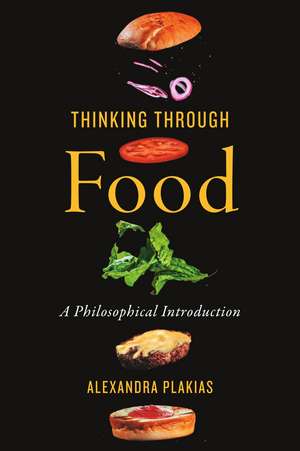
Thinking Through Food: A Philosophical Introduction
Autor Alexandra Plakiasen Limba Engleză Paperback – 31 ian 2019
Preț: 208.16 lei
Puncte Express: 312
Carte disponibilă
Livrare economică 01-15 septembrie
Livrare prin curier în România Termenul estimat este afișat lângă disponibilitate.
Transport gratuit de la 400.00 lei Plată online sau ramburs, în funcție de opțiunile comenzii.
Retur gratuit în 14 zile Comandă securizată și suport în română.
Specificații
ISBN-13: 9781554814312
ISBN-10: 1554814316
Pagini: 216
Dimensiuni: 152 x 229 x 9 mm
Greutate: 0.29 kg
Editura: BROADVIEW PR
Colecția Broadview Press
Locul publicării:Peterborough, Canada
ISBN-10: 1554814316
Pagini: 216
Dimensiuni: 152 x 229 x 9 mm
Greutate: 0.29 kg
Editura: BROADVIEW PR
Colecția Broadview Press
Locul publicării:Peterborough, Canada
Recenzii
This book offers a wide-ranging yet concise introduction to the many philosophical issues surrounding food production and consumption. It begins with discussions of the metaphysics, epistemology, and aesthetics of food, then moves on to debates about the ethics of eating animals, the environmental impacts of food production, and the role of technology in our food supply, before concluding with discussions of food access, health, and justice. Throughout, the author draws on cross-disciplinary research to engage with historical debates and current events.
“Thinking Through Food is a wonderful introduction to the philosophical issues surrounding food. In fact, I think it may be the best book on the market for courses that deal with such issues. The text is comprehensive, covering not only food justice and ethics but also the metaphysics and epistemology of food, the aesthetics of food, food technology, and environmental problems connected to the food system. It is written in a lively, engaging style that will be accessible to the philosophical novice yet also interesting to those who are more philosophically astute. I highly recommend Thinking Through Food for any philosophy course that deals with food.” — Jill M. Dieterle, Eastern Michigan University
“Thinking Through Food is a good book for those looking for an interesting slant on teaching an ‘Introduction to Philosophy’ course. Clear and approachable writing introduces readers to central concepts and theories in metaphysics, epistemology, ethics, political philosophy, and aesthetics, using food as a topic that helps readers find their footing. For those teaching classes on food and philosophy, this text covers a range of important topics. In addition, the author makes a case for how approaching philosophy through the topic of food can create a change in perspective that results in endorsing broad views of knowledge and aesthetics, as well as a kind of value pluralism.” — Erin McKenna, University of Oregon
“Thinking Through Food is a wonderful introduction to the philosophical issues surrounding food. In fact, I think it may be the best book on the market for courses that deal with such issues. The text is comprehensive, covering not only food justice and ethics but also the metaphysics and epistemology of food, the aesthetics of food, food technology, and environmental problems connected to the food system. It is written in a lively, engaging style that will be accessible to the philosophical novice yet also interesting to those who are more philosophically astute. I highly recommend Thinking Through Food for any philosophy course that deals with food.” — Jill M. Dieterle, Eastern Michigan University
“Thinking Through Food is a good book for those looking for an interesting slant on teaching an ‘Introduction to Philosophy’ course. Clear and approachable writing introduces readers to central concepts and theories in metaphysics, epistemology, ethics, political philosophy, and aesthetics, using food as a topic that helps readers find their footing. For those teaching classes on food and philosophy, this text covers a range of important topics. In addition, the author makes a case for how approaching philosophy through the topic of food can create a change in perspective that results in endorsing broad views of knowledge and aesthetics, as well as a kind of value pluralism.” — Erin McKenna, University of Oregon
Cuprins
ACKNOWLEDGMENTSINTRODUCTION
CHAPTER ONE: THE METAPHYSICS OF FOOD
CHAPTER ONE: THE METAPHYSICS OF FOOD
- Introduction
- 1. What Is Food?
- 1.1 Food as a Natural Kind?
- 1.2 Food as a Functional Kind?
- 1.3 Food as Nutrition: Why Not Eat Pets?
- 1.4 Socially Constructed Kinds
- 1.5 Social Construction and Normativity
- 1.6 Social Construction and Subjectivity
- 2. What Is Flavor?
- 2.1 Flavor and Taste: Some Background
- 2.2 What Is Flavor? The Case of Chloe
- 2.3 Flavor as a Secondary Quality
- Conclusion: Taste, Flavor, and Objectivity
- Introduction
- 1. Epistemology and Food
- 2. Empiricist vs. Rationalist Approaches to Knowledge
- 3. Knowledge of Taste and Subjective Experience
- 4. Taste and Testimony
- 4.1 Knowledge, Justification, and Testimony
- 4.2 Testimony and Food
- 4.3 Testimony, Vulnerability, and Epistemic Justice
- 4.4 Testimony and Trust
- 5. Labels, Lies, and Bullshit
- 6. Knowing Food: Knowing That or Knowing How?
- 7. Skill, Virtue, and Food Choice
- Conclusion
- Introduction
- 1. Taste and Philosophy: A Tendentious Relationship?
- 2. The Nature of Aesthetic Experience
- 3. Hume and the Standard of Taste
- 4. Food as Aesthetic Experience
- 5. Defining Art
- 5.1 Traditional Characteristics of Art: Form, Expression, Representation
- Form
- Expression
- Representation
- 5.2 Institutional/Conventional Definitions of Art
- 5.3 Aesthetic Definitions
- 5.1 Traditional Characteristics of Art: Form, Expression, Representation
- 6. Food as Art: Objections
- 7. Food: The Art and the Artwork
- 8. Food as Art, Recipes as Property?
- 9. Cuisine and Cultural Appropriation
- Conclusion: Food as Art, and as Cultural Artifact
- Introduction
- 1. Eating Animals: The Problem of Suffering
- 2. Utilitarianism
- 2.1 Factory Farming: Some Facts and Figures
- 2.2 Animal Suffering and the Causal Impotence Objection
- 2.3 Critiques of the Argument from Suffering: Happy Meat, Engineered Animals?
- 3. Deontological Objections to Eating Animals
- 3.1 Animal Rights
- 3.2 Contractarianism and the Moral Status of Animals
- 4. The Moral Status of Animals
- 4.1 Animal Equality and the Argument from Marginal Cases
- 4.2 Speciesism
- 5. Value Pluralism
- 6. Feminist and Care Ethics
- 6.1 Feminist Critiques of Traditional Discourse
- 6.2 Feminism and the Ethics of Care
- 7. Practical Implications: Ought We Eat Animals?
- Conclusion
- Introduction
- 1. Environmental Impacts of Food Production: Some Facts and Figures
- 1.1 Pesticides and Pollutants
- 1.2 From Land to Sea
- 1.3 The Problem of Waste
- 2. Environmental Ethics: Anthropocentric vs. Ecocentric Approaches
- 2.1 Ecocentrism: Arguments and Interpretations
- 2.2 Ecocentrism and the Last Person Argument
- 2.3 Ecocentrism and Holistic Ethics
- Deep Ecology
- The Land Ethic
- 2.4 Ecofeminism
- 3. Environmental Ethics, Agricultural Ethics
- 3.1 Stewardship: Towards an Agricultural Ethic?
- 3.2 Stewardship and Future Generations
- 4. Environmental Ethics through Traditional Approaches
- 4.1 Utilitarianism and Environmental Ethics
- 4.2 Deontological Approaches
- 4.3 Virtue Ethics and Agrarian Ethics
Conclusion: Reconciling the Views—Pluralism Again?
- Introduction
- 1. The Green Revolution
- 2. The Debate over GM Foods
- 3. GM Crops: Background and Uses
- 4. GM Crops: Objections
- 4.1 Extrinsic Objections to GM Foods
- Objection 1: GM Is Bad for the Environment
- Objection 2: GMOs Threaten Biodiversity
- Objection 3: GMOs Perpetuate Social Injustice
- Objection 4: Safety, Risk, and Precaution
- 4.2 Intrinsic Objections to GM
- Objection 1: GM Food Is Unnatural
- Objection 2: GM and the Yuck Factor
- 4.1 Extrinsic Objections to GM Foods
- 5. Disgust and Technology
- 5.1 Disgust, Rationality, and Labeling
- Conclusion: An Irreconcilable Moral Disagreement?
- Introduction
- 1. Liberty and Liberalism: The Harm Principle
- 1.1 Deontological and Rights-Based Defenses of Liberalism
- 1.2 Consequentialist Defenses of Liberalism
- 2. Liberty: Positive and Negative Conceptions
- 3. Food, Freedom, and Failures of Will
- 4. Paternalism: What and Why
- 5. Cognitive Biases, Weakness of Will, and Paternalism
- 5.1 Akrasia and Weakness of Will
- 5.2 Libertarian Paternalism and Weakness of Will
- 6. Food Environments and Freedom
- 7. Paternalism Revisited
- 7.1 Coercive Paternalism
- 7.2 Objection: Whose Values?
- 8. Stigmatization, Moral Panic, and the Social Policing of Bodies
- 9. Health and Food: Whose Responsibility?
- 10. Advertising, Autonomy, and Trust
- Conclusion
- Introduction
- 1. Global Hunger and Malnutrition
- 2. The Utilitarian Argument for an Obligation to Aid
- Objection 1: Demandingness
- Objection 2: Unrealistic Psychological Demands?
- Objection 3: A Right Not to Aid?
- 3. The Lifeboat Objection—An Argument against Aid
- 4. Food: A Basic Right?
- 5. Hunger: Beyond Scarcity
- 5.1 Sen’s Entitlements Theory
- 5.2 When Enough Isn’t Enough: Food Sovereignty Movements
- 6. Food Access, Food Production, and Distributive Justice
- 6.1 Distributive Food Justice
- 6.2 Food Justice as Social Justice: Critiques of the Distributive Paradigm
- 6.3 Food Justice as Participatory Justice
- 6.4 Food Justice and Environmental Costs
- 6.5 Labor and Food Justice
- 7. Food “Deserts” and Food Access
- Conclusion