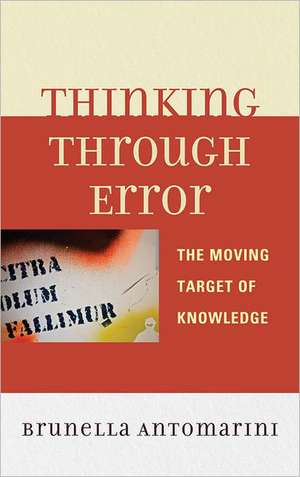
Thinking through Error: The Moving Target of Knowledge
Autor Brunella Antomarinien Limba Engleză Hardback – 14 iun 2012
Preț: 567.98 lei
Preț vechi: 862.43 lei
-34%
Puncte Express: 852
Carte tipărită la comandă
Livrare economică 07-21 decembrie
Livrare prin curier în România Termenul estimat este afișat lângă disponibilitate.
Transport gratuit pentru acest produs Plată online sau ramburs, în funcție de opțiunile comenzii.
Retur gratuit în 14 zile Comandă securizată și suport în română.
Specificații
ISBN-13: 9780739167168
ISBN-10: 0739167162
Pagini: 142
Dimensiuni: 160 x 236 x 15 mm
Greutate: 0.39 kg
Editura: Bloomsbury Publishing
Colecția Lexington Books
Locul publicării:New York, United States
ISBN-10: 0739167162
Pagini: 142
Dimensiuni: 160 x 236 x 15 mm
Greutate: 0.39 kg
Editura: Bloomsbury Publishing
Colecția Lexington Books
Locul publicării:New York, United States
Cuprins
Chapter 1: The Forms and Their Errors
Chapter 2: The Non-Linear Adventures of the Theories of Color
Chapter 3: The Uselessness of Totality or a Short Survey in a Parallel Philosophical Tradition
Chapter 4: How We Guess
Interlude: The Wrong Decision
Chapter 5: A Defense of Insecurity
Chapter 6: Parallel Universes
Conclusion
Chapter 2: The Non-Linear Adventures of the Theories of Color
Chapter 3: The Uselessness of Totality or a Short Survey in a Parallel Philosophical Tradition
Chapter 4: How We Guess
Interlude: The Wrong Decision
Chapter 5: A Defense of Insecurity
Chapter 6: Parallel Universes
Conclusion
Recenzii
In Thinking Through Error, Professor Antomarini seeks to free our thought from self-pre-empting truths: truths that depend upon our making invidious comparisons with error. Antomarini redefines error as a mental act that is pre-requisite to our engaging experience as a compelling voyage of discovery. She makes a convincing case for claiming that the knowledge we gain by risking knowledge of the truth re-invigorates philosophical inquiry in general. Her 'risky' speculations enhance the prospects for human creativity both within and without the realm of the aesthetic. This is a book with broad interdisciplinary appeal for anyone who has contemplated the possibility that error might be a pathway to knowledge rather than an impediment to knowledge.
Thinking Through Error is a vital and original work. Studying our gestures of knowing, and exploring how we can observe patterns emergent in irregular phenomena, Brunella Antomarini reveals the many ways error is a stimulus to thought. Her case studies range from Catherine of Siena's theological politics to recent developments in chaos theory. Error is central, Antomarini shows, to "the enormous wealth of information," both visible and invisible, observable and intuited, that we bring to the everyday world. In the end she indicates how that world is "made for us and not in spite of us."
Thinking Through Error is a vital and original work. Studying our gestures of knowing, and exploring how we can observe patterns emergent in irregular phenomena, Brunella Antomarini reveals the many ways error is a stimulus to thought. Her case studies range from Catherine of Siena's theological politics to recent developments in chaos theory. Error is central, Antomarini shows, to "the enormous wealth of information," both visible and invisible, observable and intuited, that we bring to the everyday world. In the end she indicates how that world is "made for us and not in spite of us."