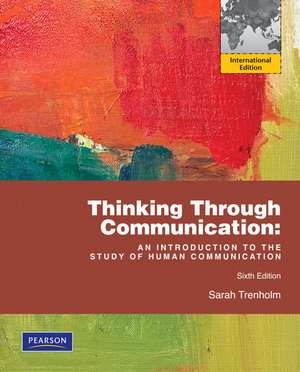
Thinking Through Communication: International Edition
Autor Sarah Trenholmen Limba Engleză Paperback – 14 ian 2010
In an organized and coherent manner, Thinking Through Communication covers a full range of topics–from the history of communication study to the methods used by current communication scholars to understand human interaction. The book explores face-to-face communication in a variety of traditional contexts: interpersonal, group, organizational, public, intercultural, computer-mediated communication and the mass media
Written in a clear, lively style, Trenholm's overall approach—including her use of examples and interesting illustrations—helps develop a better understanding of communication as a field of study and an appreciation for ways in which communication impacts our daily lives.
Preț: 539.27 lei
Preț vechi: 634.44 lei
-15%
Puncte Express: 809
Carte indisponibilă temporar
Doresc să fiu notificat când acest titlu va fi disponibil:
Se trimite...
Specificații
ISBN-13: 9780205786848
ISBN-10: 0205786847
Pagini: 432
Dimensiuni: 187 x 232 mm
Greutate: 0.68 kg
Ediția:6Nouă
Editura: Pearson Education
Colecția Pearson Education
Locul publicării:Upper Saddle River, United States
ISBN-10: 0205786847
Pagini: 432
Dimensiuni: 187 x 232 mm
Greutate: 0.68 kg
Ediția:6Nouă
Editura: Pearson Education
Colecția Pearson Education
Locul publicării:Upper Saddle River, United States
V-ar putea interesa
-
 Organizational Communication: A Lifespan ApproachMichael Kramer-8%Preț: 527.44 lei573.30 lei
 -
 Effective Organisational CommunicationRichard Blundel-15%Preț: 652.37 lei767.50 lei
 -
 Communication in Our LivesJulia Wood-22%Preț: 541.77 lei695.36 lei
 -
 Communicate!Kathleen Verderber-26%Preț: 562.64 lei759.28 lei
 -
 Stories in Health CommunicationGjyn O'Toole-33%Preț: 251.89 lei374.56 lei
 -
 Thinking Through CommunicationAdam RothPreț: 404.41 lei
 -
 -22%Preț: 1033.67 lei1325.22 lei
 -
 Business Communication: 2025 Release ISEKitty Locker-4%Preț: 386.99 lei403.12 lei
 -
 -4%Preț: 363.44 lei378.58 lei
 -
 -4%Preț: 359.91 lei374.90 lei
 -
 A First Look at Communication Theory ISEEm Griffin-8%Preț: 480.25 lei522.01 lei
 -
 Communicating in Groups: Applications and Skills: 2025 Release ISECarrisa Hoelscher-4%Preț: 354.17 lei368.92 lei
 -
 Intercultural CommunicationLarry Samovar-19%Preț: 484.38 lei598.00 lei
 -
 -13%Preț: 573.94 lei659.70 lei
 -
 Communication MosaicsJulia Wood-23%Preț: 1502.42 lei1951.19 lei
 -
 Communicate!Kathleen S. Verderber-15%Preț: 548.84 lei645.70 lei
 -
 Preț: 139.01 lei
 -
 Preț: 139.01 lei
 -
 Using Communication TheoryBenno Signitzer-8%Preț: 453.48 lei492.92 lei
Cuprins
I. INTRODUCTION TO COMMUNICATION
1. The Communication Tradition
A Brief History of Communication Study
Communication Today: Contemporary Departments of Rhetoric and Communication Theory
2. Definitions, Models, and Perspectives
Defining Communication
How Models Help Us Understand Communication
It All Depends on Your Point of View: Four Perspectives
What to Look for When You Look at Communication
II. LISTENING AND LANGUAGE
3. Decoding Messages: Listening and Perception
What Is Listening?
The Listening Process
Designing Messages That Are Easy to Listen to
4. Encoding Messages: Spoken Language
What is Language
The Subsystems of Language
Pragmatic Styles and Structures
Language and Social Identity
Language Choices and Pragmatic Effects
5. Encoding Messages: Nonverbal Communication
What Is Nonverbal Communication?
The Nonverbal Codes
Increasing Nonverbal Skills
III. COMMUNICATION CONTEXTS
6. Interpersonal Communication
What Is Interpersonal Communication?
Managing Interpersonal Communication
Relational Development: Stages in Intimate Dyads
Increasing Relational Skills
Understanding Mediated Relationships
Becoming a More Responsible Communicator
7. Group Communication
What Is a Group?
Managing Group Communication
Group Development: Phases in Problem-Solving Groups
Strengthening Group Discussion Skills
Communicating in Virtual Groups
Becoming a More Responsible Communicator
8. Organizational Communication
What is an Organization?
Managing Organizational Communication
Increasing Organizational Skills
Using Organizational Technology
Becoming a More Responsible Communicator
9. Public Communication
What Is Public Communication?
Why is Public Communication Important?
Evaluating Public Communication
Strengthening Critical Reception Skills
Becoming a More Responsible Communicator
10. Preparing and Presenting Public Speeches
What is a Public Speech?
Planning the Public Speech
Managing Delivery
Increasing Public Speaking Skills
Becoming a More Responsible Communicator
11. Communication and the Mass Media
The Traditional Mass Media
New Media: Going Global and Mobile
Convergence: the Intersection of New Media and Old
Becoming a More Responsible Communicator
12. Intercultural Communication
What Is Culture?
Barriers to Intercultural Communication
Adapting to New Cultures
Becoming a More Open Communicator
13. Methods of Discovery
How Is Communication Research Done?
Five Popular Research Methods
Learning More about Communication
1. The Communication Tradition
A Brief History of Communication Study
Communication Today: Contemporary Departments of Rhetoric and Communication Theory
2. Definitions, Models, and Perspectives
Defining Communication
How Models Help Us Understand Communication
It All Depends on Your Point of View: Four Perspectives
What to Look for When You Look at Communication
II. LISTENING AND LANGUAGE
3. Decoding Messages: Listening and Perception
What Is Listening?
The Listening Process
Designing Messages That Are Easy to Listen to
4. Encoding Messages: Spoken Language
What is Language
The Subsystems of Language
Pragmatic Styles and Structures
Language and Social Identity
Language Choices and Pragmatic Effects
5. Encoding Messages: Nonverbal Communication
What Is Nonverbal Communication?
The Nonverbal Codes
Increasing Nonverbal Skills
III. COMMUNICATION CONTEXTS
6. Interpersonal Communication
What Is Interpersonal Communication?
Managing Interpersonal Communication
Relational Development: Stages in Intimate Dyads
Increasing Relational Skills
Understanding Mediated Relationships
Becoming a More Responsible Communicator
7. Group Communication
What Is a Group?
Managing Group Communication
Group Development: Phases in Problem-Solving Groups
Strengthening Group Discussion Skills
Communicating in Virtual Groups
Becoming a More Responsible Communicator
8. Organizational Communication
What is an Organization?
Managing Organizational Communication
Increasing Organizational Skills
Using Organizational Technology
Becoming a More Responsible Communicator
9. Public Communication
What Is Public Communication?
Why is Public Communication Important?
Evaluating Public Communication
Strengthening Critical Reception Skills
Becoming a More Responsible Communicator
10. Preparing and Presenting Public Speeches
What is a Public Speech?
Planning the Public Speech
Managing Delivery
Increasing Public Speaking Skills
Becoming a More Responsible Communicator
11. Communication and the Mass Media
The Traditional Mass Media
New Media: Going Global and Mobile
Convergence: the Intersection of New Media and Old
Becoming a More Responsible Communicator
12. Intercultural Communication
What Is Culture?
Barriers to Intercultural Communication
Adapting to New Cultures
Becoming a More Open Communicator
13. Methods of Discovery
How Is Communication Research Done?
Five Popular Research Methods
Learning More about Communication
Caracteristici
Features:
- Comprehensive coverage of basic theories and principles in important communication contexts provides students with a thorough introduction to the field and an understanding of the role of communication in their lives.
- Clear organization and a straightforward approach make this text very easy for the classroom teacher to build on basics by adding his/her own material.
- Chapter 1, “The Communication Tradition,” clarifies the nature of the field and emphasizes its rich traditions and history.
- The use of many cross-cultural examples throughout the book, as well as an entire chapter on intercultural communication (Ch. 12), emphasize the global nature of communication.
- Materials on emerging communication technologies appear throughout the text, showing students how new media affect interpersonal, group, organization, and public contexts, and offering suggestions on how to use technology effectively.
- “Methods of Discovery,” featured in Chapter 13, introduces students to research methods in a clear and engaging manner.
- Discussion of the research on gender and communication helps students avoid stereotypes and think critically about language and gender.
Caracteristici noi
New to this Edition:
- Research on communication technologies has been updated throughout the text as well as in Chapter Eleven which focuses in detail both on the convergence of traditional and new media and on the collaborative mediated technologies collectively known a Web 2.0. Topics include use of social networking sites, online impression formation, characteristics of leaders in virtual groups, the impact of groupware on group deliberations, the formation of online trust, e-fatigue, hype stages, and the social effects of our newfound ability to produce as well as consume media products.
- New research on interpersonal and group communication has been added and both chapters have been reorganized. Chapter Six now includes a discussion of relational maintenance strategies and ways to satisfy face needs, while Chapter Seven contains material on transactive memory, group trust, collaborative information sharing, and structural diversity in social and work groups, as well as sections on group identity and inter-group conflict.
- The text, especially in Chapters Six through Eight, has been carefully edited and streamlined for greater clarity and readability. Material considered redundant or outdated has been eliminated.
- New research abstracts have been added to Chapter 13. Topics have been chosen both to suggest the breadth of communication researchers’ interests and to motivate and interest students. Topics include communication in Chicago street gangs, human-robot interaction, reasons viewers watch reality TV, rhetorical strategies in the fight for women’s rights, and the creation of a performance piece about Hurricane Katrina.
- The suggested readings sections at the end of each chapter have been updated to provide recent titles of interest. Students can use the readings as jumping points to delve deeper into the different sections of communication.
- A new text bank has been created to eliminate questions on material that has been replaced and to cover new topics.
- The Instructor’s Manual contains new features, including answers to all student review questions, a copy of the new glossary, and questions for in-class discussion. Chapter outlines, and exercises and assignments remain useful parts of the IM.
- Online student resources in MyCommunicationKit now include a glossary of all key terms in the text, chapter outlines, andreview questions.
Notă biografică
Sarah Trenholm is Emerita Professor in the Department of Communication Studies at Ithaca College, New York, USA.