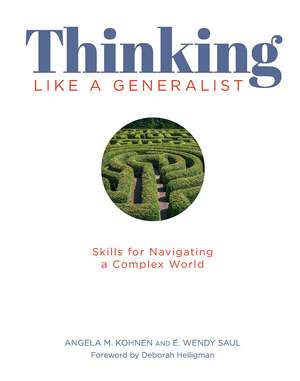
Thinking Like a Generalist: Skills for Navigating a Complex World
Autor Angela Kohnen, Wendy Saulen Limba Engleză Paperback – 28 sep 2020
- A thorough introduction to what it means to be a generalist, and how to develop the practices and tools that help generalists navigate the world we live in
- A focus on the teacher becoming a generalist and tips for modeling those practices in the classroom
- Detailed instructions on how to write a unit of study that emphasizes generalist literacy skills and includes an overview and examples of five different units
- How to use the authors' read-aloud-think-aloud strategy to orient students to generalist tools and practices
Preț: 281.22 lei
Puncte Express: 422
Carte disponibilă
Livrare economică 02-16 noiembrie
Livrare prin curier în România Termenul estimat este afișat lângă disponibilitate.
Transport gratuit de la 400.00 lei Plată online sau ramburs, în funcție de opțiunile comenzii.
Retur gratuit în 14 zile Comandă securizată și suport în română.
Specificații
ISBN-13: 9781625311061
ISBN-10: 1625311060
Pagini: 200
Dimensiuni: 187 x 235 mm
Greutate: 0.42 kg
Ediția:1
Editura: Taylor & Francis
Colecția Routledge
Locul publicării:Oxford, United Kingdom
ISBN-10: 1625311060
Pagini: 200
Dimensiuni: 187 x 235 mm
Greutate: 0.42 kg
Ediția:1
Editura: Taylor & Francis
Colecția Routledge
Locul publicării:Oxford, United Kingdom
Public țintă
Professional Practice & DevelopmentNotă biografică
Angela M. Kohnen is an Assistant Professor of Literacy Education at the University of Florida. Prior to earning her doctorate at the University of Missouri-St. Louis, she taught English Language Arts in the St. Louis area. She loves working with students at all levels to explore questions of genuine curiosity.
Wendy Saul, formerly the Allen B. and Helen S. Shopmaker Chair of Education and International Studies at the University of Missouri-St Louis – is now retired but still spends countless hours thinking with her former students and colleagues about generalist literacy; connections between science, reading and writing; and active learning and critical thinking in under-resourced settings, both here and abroad.
Wendy Saul, formerly the Allen B. and Helen S. Shopmaker Chair of Education and International Studies at the University of Missouri-St Louis – is now retired but still spends countless hours thinking with her former students and colleagues about generalist literacy; connections between science, reading and writing; and active learning and critical thinking in under-resourced settings, both here and abroad.
Recenzii
"With Thinking Like a Generalist, you will help your students understand and become lifelong learners—the greatest gift of all."
—Deborah Heiligman
—Deborah Heiligman
Cuprins
Part I: The Case For Generalist Literacy; Chapter 1: Meet the Generalist; Chapter 2: Promoting a Generalist Identity; Chapter 3: Doing what Generalists do; Part II: A Self-Guided Course; Chapter 4: Getting Started; Chapter 5: Meet the Generalist; Chapter 6: Evaluating Sources; Chapter 7: Navigating the Landscape; Chapter 8: Powering Through to the End; Chapter 9: Self-Guided Course: A Final Word; Part III: Examples from the Classroom; Chapter 10: Planning Units of Study
Descriere
What can we teach kids today that will have utility ten or fifteen years from now? Angela Kohnen and Wendy Saul propose an approach to information literacy that goes beyond the teaching of discreet, easily outdated skills.