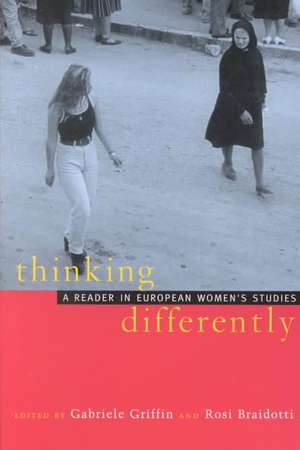
Thinking Differently: A Reader in European Women's Studies
Editat de Gabrielle Griffin, Professor Rosi Braidottien Limba Engleză Paperback – oct 2002
Reading feminism from a European perspective will enable readers to reflect upon the ways in which changes in political, social and cultural positions and practices over the past century in Europe have impacted on feminist thinking and theorizing. The volume raises important issues about the transfer of feminist concepts across cultures and languages. And to English-speaking audiences the volume also offers fresh viewpoints on some of the key debates in Women's Studies.
Preț: 265.97 lei
Preț vechi: 312.91 lei
-15%
Puncte Express: 399
Carte tipărită la comandă
Livrare economică 19 noiembrie-03 decembrie
Livrare prin curier în România Termenul estimat este afișat lângă disponibilitate.
Transport gratuit de la 400.00 lei Plată online sau ramburs, în funcție de opțiunile comenzii.
Retur gratuit în 14 zile Comandă securizată și suport în română.
Specificații
ISBN-13: 9781842770030
ISBN-10: 1842770039
Pagini: 416
Dimensiuni: 156 x 234 x 25 mm
Greutate: 0.59 kg
Editura: Bloomsbury Publishing
Colecția Zed Books
Locul publicării:London, United Kingdom
ISBN-10: 1842770039
Pagini: 416
Dimensiuni: 156 x 234 x 25 mm
Greutate: 0.59 kg
Editura: Bloomsbury Publishing
Colecția Zed Books
Locul publicării:London, United Kingdom
V-ar putea interesa
-
 Sophia: Princess, Suffragette, RevolutionaryAnita Anand-26%Preț: 80.55 lei108.65 lei
 -
 Valerie SolanasBreanne FahsPreț: 130.25 lei
 -
 The Vagina: A Literary and Cultural HistorySenior Lecturer Emma L. E. Rees-19%Preț: 164.15 lei202.01 lei
 -
 -12%Preț: 158.43 lei180.02 lei
 -
 -16%Preț: 195.12 lei232.40 lei
 -
 Reclaiming the F Word: Feminism TodayDoctor Kristin Aune-22%Preț: 86.38 lei110.96 lei
 -
 Women's Oppression TodayMichele BarrettPreț: 211.47 lei
 -
 Woman's Consciousness, Man's WorldSheila RowbothamPreț: 111.77 lei
Cuprins
Introduction: Configuring European Women's Studies - Gabriele Griffin, with Rosi Braidotti
Part I: Women as Social and Political Entities
1. Feminist Perspectives on the European Welfare State - Harriet Silius
2. Single Women - Tuula Gordon
3. Women's Human Rights, Equal Opportunities and Biopolitics in Europe - Marina Calloni
Part II: Culture and Signification
4. Space and Women's Culture - Liana Borghi
5. European Feminine Identity and the Idea of Passion in Politics - Elena Pulcini and Luisa Passerini
6. Psychoanalysis and Feminism: A European Phenomenon - Maria Serena Sapegno
Part III: Identity, Subjectivity and Difference
7. Europe after 1989: The Ethnic Wars, Fascistization of Civil Society and Body Politics in Serbia- Zarana Papic
8. Identities under Threat on the Eastern Borders - Svetlana Slapsak
9. Identity, Subjectivity and Difference: A Critical Genealogy - Rosi Braidotti
Part IV: Race and Ethnicity
10. Feminism and Anti-semitism - Liliane Kandel
11. Diasporic Subjects and Migration in Europe- Sandra Ponzanesi
12. Whiteness and European Situatedness - Gabriele Griffin with Rosi Braidotti
Part V: Violence Against Women: European Perspectives
13. Violence against Women in the European Context: Histories, Prevalences, Theories - Carol Hagemann-White
14. Sexual Violence and Ethnic Cleansing - Attacking the Family - Lisa Price
15. Violence, Militarism and War - Jalna Hanmer
Part VI: Sex/Gender Terminology and Its Implications
16. The Uses and Abuses of the Sex/Gender Distinction in European Feminist Practices - Rosi Braidotti
Part VII: The Rise and Fall of Women's Movements in Europe
17. Introduction: Women's Movements and Feminist Research - Ute Gerhard
18. The History of the Feminist Movement in France - Fran?oise Picq
19. The Women's Movement in Germany - Ute Gerhard
20. The Feminist Movement in Italy - Andreina de Clementi
21. Three Waves of Feminism in Denmark - Drude Dahlerup
22. Histories of the Women's Movements in Norway - Beatrice Halsaa
23. The History of the Hungarian Women's Movement - Andrea Pet"
24. Lacking integration: The Relationship between the Women's Movement and Gender/Women's Studies in the Transitional Slovenia - Renata Scribar
25. Women's Associations and Education in Spain - Maria Suarez Lafuente
Part I: Women as Social and Political Entities
1. Feminist Perspectives on the European Welfare State - Harriet Silius
2. Single Women - Tuula Gordon
3. Women's Human Rights, Equal Opportunities and Biopolitics in Europe - Marina Calloni
Part II: Culture and Signification
4. Space and Women's Culture - Liana Borghi
5. European Feminine Identity and the Idea of Passion in Politics - Elena Pulcini and Luisa Passerini
6. Psychoanalysis and Feminism: A European Phenomenon - Maria Serena Sapegno
Part III: Identity, Subjectivity and Difference
7. Europe after 1989: The Ethnic Wars, Fascistization of Civil Society and Body Politics in Serbia- Zarana Papic
8. Identities under Threat on the Eastern Borders - Svetlana Slapsak
9. Identity, Subjectivity and Difference: A Critical Genealogy - Rosi Braidotti
Part IV: Race and Ethnicity
10. Feminism and Anti-semitism - Liliane Kandel
11. Diasporic Subjects and Migration in Europe- Sandra Ponzanesi
12. Whiteness and European Situatedness - Gabriele Griffin with Rosi Braidotti
Part V: Violence Against Women: European Perspectives
13. Violence against Women in the European Context: Histories, Prevalences, Theories - Carol Hagemann-White
14. Sexual Violence and Ethnic Cleansing - Attacking the Family - Lisa Price
15. Violence, Militarism and War - Jalna Hanmer
Part VI: Sex/Gender Terminology and Its Implications
16. The Uses and Abuses of the Sex/Gender Distinction in European Feminist Practices - Rosi Braidotti
Part VII: The Rise and Fall of Women's Movements in Europe
17. Introduction: Women's Movements and Feminist Research - Ute Gerhard
18. The History of the Feminist Movement in France - Fran?oise Picq
19. The Women's Movement in Germany - Ute Gerhard
20. The Feminist Movement in Italy - Andreina de Clementi
21. Three Waves of Feminism in Denmark - Drude Dahlerup
22. Histories of the Women's Movements in Norway - Beatrice Halsaa
23. The History of the Hungarian Women's Movement - Andrea Pet"
24. Lacking integration: The Relationship between the Women's Movement and Gender/Women's Studies in the Transitional Slovenia - Renata Scribar
25. Women's Associations and Education in Spain - Maria Suarez Lafuente
Recenzii
A crucial step towards a truly transnational perspective in European Women's Studies. This book is a must for researchers, teachers, students, politicians and others interested in European women's studies and gender issues in Europe.
This landmark collection shows the important role of feminist scholarship in rethinking post-nationalist identity in Europe - a problematic from which U.S. feminists have much to learn. The introductory essay alone is worth the purchase of the volume for its brilliant analysis of the strengths and limitations of different focuses and styles of thinking in the U.S., northern, and southern Europe. This is a fine teaching text.
This landmark collection shows the important role of feminist scholarship in rethinking post-nationalist identity in Europe - a problematic from which U.S. feminists have much to learn. The introductory essay alone is worth the purchase of the volume for its brilliant analysis of the strengths and limitations of different focuses and styles of thinking in the U.S., northern, and southern Europe. This is a fine teaching text.