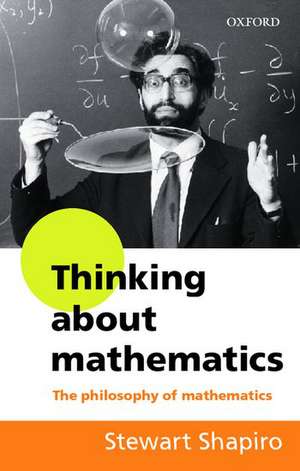
Thinking about Mathematics: The Philosophy of Mathematics
Autor Stewart Shapiroen Limba Engleză Paperback – 13 iul 2000
Preț: 345.30 lei
Preț vechi: 390.63 lei
-12%
Puncte Express: 518
Carte tipărită la comandă
Livrare economică 20 noiembrie-01 decembrie
Livrare express 17-23 octombrie pentru 78.79 lei
Livrare prin curier în România Termenul estimat este afișat lângă disponibilitate.
Transport gratuit de la 400.00 lei Plată online sau ramburs, în funcție de opțiunile comenzii.
Retur gratuit în 14 zile Comandă securizată și suport în română.
Specificații
ISBN-13: 9780192893062
ISBN-10: 0192893068
Pagini: 328
Ilustrații: 4 line figures
Dimensiuni: 137 x 214 x 19 mm
Greutate: 0.42 kg
Editura: OUP OXFORD
Colecția OUP Oxford
Locul publicării:Oxford, United Kingdom
ISBN-10: 0192893068
Pagini: 328
Ilustrații: 4 line figures
Dimensiuni: 137 x 214 x 19 mm
Greutate: 0.42 kg
Editura: OUP OXFORD
Colecția OUP Oxford
Locul publicării:Oxford, United Kingdom
V-ar putea interesa
-
 The Oxford Handbook of Philosophy of Mathematics and LogicStewart Shapiro-28%Preț: 386.11 lei533.49 lei
 -
 Formal LogicPrior-21%Preț: 289.33 lei368.19 lei
 -
 Past, Present and FutureArthur Prior-33%Preț: 722.95 lei1075.70 lei
 -
 Probability and Hume's Inductive ScepticismD. C. Stove-21%Preț: 372.01 lei473.04 lei
 -
 -28%Preț: 399.38 lei557.06 lei
 -
 Naturalism in MathematicsPenelope Maddy-28%Preț: 371.08 lei518.77 lei
 -
 Plural PredicationThomas McKay-33%Preț: 787.10 lei1171.01 lei
 -
 Vagueness in ContextStewart Shapiro-21%Preț: 352.31 lei447.71 lei
 -
 -13%Preț: 279.98 lei321.31 lei
 -
 Varieties of LogicStewart Shapiro-31%Preț: 555.84 lei806.74 lei
 -
 Logic: An IntroductionGreg RestallPreț: 390.58 lei
 -
 Fallacies and Argument AppraisalChristopher W. TindalePreț: 230.25 lei
 -
 The Logic of Real ArgumentsAlec FisherPreț: 371.33 lei
 -
 Preț: 419.54 lei
 -
 An Introduction to Philosophical LogicAnthony C. GraylingPreț: 334.08 lei
Recenzii
"Stewart Shapiro admirably provides an accessible introduction to contemporary thinking in mathematics, while avoiding caricature of the technicalities. His ease with the subject and lucid style makes this book a succinct introduction to a fascinating intellectual discipline." Times Literary Supplement
Notă biografică
Professor of Philosophy, Department of Philosophy, Ohio State University at Newark and Professorial Fellow, Department of Logic and Metaphysics at the University of St Andrews, Scotland.
Cuprins
- Part I. Perspective
- Chapter 1. What is so interesting about mathematics (for philosopher)?
- Attraction - of opposites?
- Philosophy and mathematics: chicken or egg?
- Naturalism and mathematics
- Chapter 2. A Potpourri of questions and attempted answers
- Necessity and a priori knowledge
- Global matters: objects and objectivity
- The mathematical and the physical
- Local maters: theorems, theories, and concepts
- Part II. History
- Chapter 3. Plato's Rationalism, and Aristotle
- The world of Being
- Plato on mathematics
- Mathematics on Plato
- Aristotle, the worthy opponent
- Further reading
- Chapter 4. Near opposites: Kant and Mill
- Reorientation
- Kant
- Mill
- Further reading
- Part III. The big three
- Chapter 5. Logicism: Is mathematics (just) logic?
- Frege
- Russell
- Carnap and logical positivism
- Contemporary views
- Further reading
- Chapter 6. Formalism: Do mathematical statements mean anything?
- Basic views: Freg's onslaught
- Deductivism: Hilbert's Grundlagen der Geometrie
- Finitism: the Hilbert program
- Incompleteness
- Curry
- Further reading
- Chapter 7. Intuitionism: is something wrong with our logic?
- 1. Revising classical logic
- 2. The teacher, Brouwer
- 3. The student, Heyting
- 4. Dummett
- 5. Further reading
- Part IV. The contemporary scene
- Chapter 8. Numbers exist
- Gödel
- The web of belief
- Set-theoretic realism
- Further reading
- Chapter 9. No they don't
- Fictionalism
- Modal construction
- What should we make of all this?
- Addendum: Young Turks
- Further reading
- Chapter 10. Structuralism
- The underlying idea
- Ante rem structures, and objects
- Structuralism without structures
- Knowledge of structures
- Further reading
- References
- Index