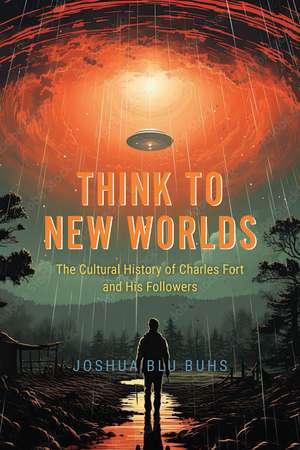
Think to New Worlds: The Cultural History of Charles Fort and His Followers
Autor Joshua Blu Buhsen Limba Engleză Hardback – 3 iul 2024
Flying saucers. Bigfoot. Frogs raining from the sky. Such phenomena fascinated Charles Fort, the maverick writer who scanned newspapers, journals, and magazines for reports of bizarre occurrences: dogs that talked, vampires, strange visions in the sky, and paranormal activity. His books of anomalies advanced a philosophy that saw science as a small part of a larger system in which truth and falsehood continually transformed into one another. His work found a ragged following of skeptics who questioned not only science but the press, medicine, and politics. Though their worldviews varied, they shared compelling questions about genius, reality, and authority. At the center of this community was adman, writer, and enfant terrible Tiffany Thayer, who founded the Fortean Society and ran it for almost three decades, collecting and reporting on every manner of oddity and conspiracy.
In Think to New Worlds, Joshua Blu Buhs argues that the Fortean effect on modern culture is deeper than you think. Fort’s descendants provided tools to expand the imagination, explore the social order, and demonstrate how power is exercised. Science fiction writers put these ideas to work as they sought to uncover the hidden structures undergirding reality. Avant-garde modernists—including the authors William Gaddis, Henry Miller, and Ezra Pound, as well as Surrealist visual artists—were inspired by Fort’s writing about metaphysical and historical forces. And in the years following World War II, flying saucer enthusiasts convinced of alien life raised questions about who controlled the universe.
Buhs’s meticulous and entertaining book takes a respectful look at a cast of oddballs and eccentrics, plucking them from history’s margins and spotlighting their mark on American modernism. Think to New Worlds is a timely consideration of a group united not only by conspiracies and mistrust of science but by their place in an ever-expanding universe rich with unexplained occurrences and visionary possibilities.
Preț: 262.56 lei
Puncte Express: 394
Carte disponibilă
Livrare economică 17 noiembrie-01 decembrie
Livrare express 31 octombrie-06 noiembrie pentru 44.78 lei
Livrare prin curier în România Termenul estimat este afișat lângă disponibilitate.
Transport gratuit de la 400.00 lei Plată online sau ramburs, în funcție de opțiunile comenzii.
Retur gratuit în 14 zile Comandă securizată și suport în română.
Specificații
ISBN-13: 9780226831480
ISBN-10: 0226831485
Pagini: 384
Ilustrații: 10 halftones
Dimensiuni: 152 x 229 x 30 mm
Greutate: 0.71 kg
Editura: University of Chicago Press
Colecția University of Chicago Press
ISBN-10: 0226831485
Pagini: 384
Ilustrații: 10 halftones
Dimensiuni: 152 x 229 x 30 mm
Greutate: 0.71 kg
Editura: University of Chicago Press
Colecția University of Chicago Press
Notă biografică
Joshua Blu Buhs is the author of Bigfoot: The Life and Times of a Legend and The Fire Ant Wars: Nature, Science, and Public Policy in Twentieth-Century America, both published by the University of Chicago Press.
Cuprins
1: First Must We Think to New Worlds
2: A Budget of Paradoxes
3: The Motor of History
4: The Mermaids Have Come to the Desert
5: The Cosmic Aquarium
6: Future History
Notes
Select Bibliography
Index
2: A Budget of Paradoxes
3: The Motor of History
4: The Mermaids Have Come to the Desert
5: The Cosmic Aquarium
6: Future History
Notes
Select Bibliography
Index
Recenzii
“Enthralling . . . Buhs’s erudite narrative is jam-packed with minor and major 20th-century figures who he shows were influenced by Fort. The result is a lively alternative history of modernity.”
“Buhs makes a strong case in Think to New Worlds: The Cultural History of Charles Fort and His Followers that the eccentric writer cast a long shadow, leaving a mark not only on the world of Bigfoot hunters and UFO buffs but also in literature, where his fans stretched from the modernist avant garde to the science fiction pulps. . . . Buhs’ engaging study displays the libertarian-leaning strains of Fort’s following, from the San Francisco Renaissance to the Discordians, and it shows the milieu’s less liberty-friendly sides as well.”
“This is a fantastic book. I will never think the same again, particularly about science fiction and its conscious attempt to see and control the ‘motor of history’ in the weird. . . . Think to New Worlds is a literarily beautiful and intellectually sophisticated treatment of science fiction, surrealist and modern art, the UFO phenomenon (the cover is gorgeous), modernism and postmodernism, and conspiracy thinking in American politics. Buhs demonstrates any number of theses, including the theme that the literary history of Fort is the history of avant-garde modernism as it transitioned out of earlier Luciferian Romantic and decadent literature eras. Modernism, it turns out, is suffused with occultism and the amazing from the very beginning as forms of radical reflexivity, a kind of paradoxical (dis)enchantment that was at once skeptical and believing.”
“[Fort’s] penchant for compiling earnest reports of bizarre happenings by scanning through newspapers, magazines and scientific journals set off an army of emulators—the Forteans, as cultural historian and author Buhs skillfully recounts in a compelling narrative about the birth of modern ‘anomaly hunting.’”
“Ultimately, the problem (and the allure) of Fort is that the revelation that runs through his work is explicitly anti-discipline, anti-methodology. The facts of the damned, by definition, simply cannot be incorporated into any kind of stable system. Again and again, reading Think to New Worlds, one is reminded that as soon as doubt ossifies into a stance, it ceases to be radical and becomes dogmatic.”
“Indispensable for students of Fort’s work, especially those interested in his literary and cultural influence. . . . I have studied Fort’s life, career, and reception for almost thirty years and still learned an enormous amount from Buhs’s book. . . . All future studies should aspire to meet its standards.”
“As Buhs demonstrates in the meticulously researched Think to New Worlds, Fort was always popular with those attuned to the arts.”
“[The] tradition of collecting anomalies and cataloging them into paranormal, supernatural, extraterrestrial, mystical, and magical worlds just beyond the horizons of science can be traced back a century to Charles Fort (1874–1932) and his Fortean followers, which in turn shaped science fiction, avant-garde modernism, Surrealist art, and UFOlogy throughout the twentieth century, skillfully recounted in a compelling narrative by cultural historian and author Buhs, whose previous book, Bigfoot: The Life and Times of a Legend, set the tone for this deeper dive into who and what gave rise to the original New Age.”
“Buhs distinguishes Charles Fort from Forteanism itself. In fact, this represents a strength of this volume. As Buhs notes, several biographies of Fort exist, but the literature on the social movement that formed around him and his ideas is scant. Scholars of new religions will find much of value here in the study of Forteanism as something akin to a new religious movement. They will also appreciate Buhs’ argument for the entanglement of Forteanism within the Theosophical, esoteric, and alternative religiosity of the early-to-mid-twentieth century.”
“The apostle of wonder Charles Fort damned scientific expertise and modern institutions that ignored the anomalous, the marvelous, and the unforeseen. But what happened when his iconoclastic acolytes institutionalized Forteanism? In this deeply researched, original history, Buhs impressively excavates the little-known, yet seminal, influence Forteanism had on aesthetic modernism, science fiction, UFOlogy, and contemporary conspiracy culture. Buhs reveals that Forteanism, usually regarded as a peripheral phenomenon, is actually central to any understanding of modernity’s perils and potentials.”
“Marvelous, skeptical, conspiracist, ironic: Charles Fort’s modernism has pollinated many strange flowers in recent culture. This fascinating book introduces readers to the many (contradictory, unexpected) bearers of the label ‘Fortean’ in the hundred years since Fort’s The Book of the Damned was published, showing how art, literature, science, and politics all curved under its weird yet apparently inevitable gravitational pull. Buhs’s writing is sparkling, sprinkled with vignettes that pay homage to the bluster and whirl of Fort’s unmistakable style.”