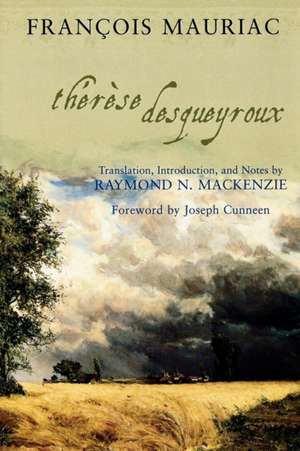
Therese Desqueyroux
Autor François Mauriacen Limba Engleză Paperback – 11 mar 2005
Raymond N. MacKenzie's translation of Thérèse Desqueyroux, the first since 1947, captures the poetic lyricism of Mauriac's prose as well as the intensity of his stream-of-consciousness narrative. MacKenzie also provides notes and a biographical and interpretive introduction to help readers better appreciate the mastery of François Mauriac, who was awarded the Nobel Prize in Literature in 1952. This volume also includes a translation of "Conscience, The Divine Instinct," Mauriac's first draft of the story, never before available in English.
Preț: 115.08 lei
Preț vechi: 138.23 lei
-17%
Puncte Express: 173
Carte tipărită la comandă
Livrare economică 26 noiembrie-10 decembrie
Livrare prin curier în România Termenul estimat este afișat lângă disponibilitate.
Transport gratuit de la 400.00 lei Plată online sau ramburs, în funcție de opțiunile comenzii.
Retur gratuit în 14 zile Comandă securizată și suport în română.
Specificații
ISBN-13: 9780742548657
ISBN-10: 0742548651
Pagini: 156
Dimensiuni: 146 x 226 x 12 mm
Greutate: 0.23 kg
Editura: SHEED & WARD
Locul publicării:New York, United States
ISBN-10: 0742548651
Pagini: 156
Dimensiuni: 146 x 226 x 12 mm
Greutate: 0.23 kg
Editura: SHEED & WARD
Locul publicării:New York, United States
V-ar putea interesa
-
 Religious LiteracyStephen ProtheroPreț: 118.36 lei
 -
 Therese DesqueyrouxFrancois Mauriac-28%Preț: 50.96 lei70.68 lei
 -
 Theravada Buddhism: A Social History from Ancient Benares to Modern ColomboRichard F. GombrichPreț: 413.13 lei
 -
 A Quaker Book of WisdomRobert Lawrence SmithPreț: 92.82 lei
 -
 Bad Religion: The Psychology of Religious MisbehaviorMichael L. Klassen-28%Preț: 258.65 lei357.25 lei
 -
 -28%Preț: 259.71 lei359.73 lei
 -
 Created to Be God's Friend: How God Shapes Those He LovesHenry BlackabyPreț: 106.24 lei
 -
 Listening to Children on the Spiritual JourneyCatherine StonehousePreț: 133.09 lei
 -
 Dictionary of the Old Testament: PentateuchT. Desmond Alexander-8%Preț: 452.81 lei492.19 lei
 -
 Sacred UnionsThomas E. Breidental-16%Preț: 108.77 lei130.07 lei
 -
 The Indwelling Life of ChristIan ThomasPreț: 88.58 lei
 -
 Monks and Monasteries of the Egyptian DesertsOtto Friedrich Augus MeinardusPreț: 155.14 lei
Cuprins
Part 1 Foreword
Part 2 Introduction
Part 3 Thérèse Desqueyroux
4 Conscience, The Divine Instinct
Part 2 Introduction
Part 3 Thérèse Desqueyroux
4 Conscience, The Divine Instinct
Recenzii
Aimed at the American English ear, MacKenzie's syntax restores the Jazz Age punch of Mauriac's original. Thanks to MacKenzie's introduction, notes, and translated first draft of Mauriac's text ('Conscience'), Therese's sexuality is also restored, making her once again an ambivalent 'new woman' [la garçonne] of the 1920s and a scandalous protagonist for a 'Catholic novel.' As a result, the interwar 'Catholic revival' [renouveau catholique] also recovers its punch with Mauriac's challenge to bourgeois Catholicism. With new eyes and ears, another generation of readers can now wade with Therese Desqueyroux into 'the human river.'
An invaluable volume for those exploring Mauriac or his place in the French Catholic renaissance. MacKenzie's fresh, highly readable translation of Mauraic's disturbing masterpiece includes translator's notes and an excellent introduction. His inclusion of Mauriac's first draft permits rare insights into the startling evolution of the eponymous heroine.
It is safe to say that Francois Mauriac's Thérèse Desqueyroux has achieved the most coveted form of 'immortality' that any writer could hope for: inclusion on countless university and secondary school reading lists for both courses and exams. Only a few French novels share this distinction. Thus, Professor MacKenzie's excellent translation is well timed, for Thérèse, a great novel by any criterion, will be read by many throughout the rest of the new century. The Gerard Hopkins translation, competent and reliable in its day, nonetheless shows signs of wear. The English language, particularly in North America, has evolved considerably in the intervening three quarters of a century since its publication, and a fresh new translation in today's idiom is most welcome. This bright new translation is a valuable addition to Mauriac studies, and will add to the luster of Mauriac's reputation in the English-speaking world. Thanks to Professor MacKenzie, a new generation of readers in the English-speaking world will be able to have a direct, lively and utterly reliable interaction with Mauriac 's great novel.
An invaluable volume for those exploring Mauriac or his place in the French Catholic renaissance. MacKenzie's fresh, highly readable translation of Mauraic's disturbing masterpiece includes translator's notes and an excellent introduction. His inclusion of Mauriac's first draft permits rare insights into the startling evolution of the eponymous heroine.
It is safe to say that Francois Mauriac's Thérèse Desqueyroux has achieved the most coveted form of 'immortality' that any writer could hope for: inclusion on countless university and secondary school reading lists for both courses and exams. Only a few French novels share this distinction. Thus, Professor MacKenzie's excellent translation is well timed, for Thérèse, a great novel by any criterion, will be read by many throughout the rest of the new century. The Gerard Hopkins translation, competent and reliable in its day, nonetheless shows signs of wear. The English language, particularly in North America, has evolved considerably in the intervening three quarters of a century since its publication, and a fresh new translation in today's idiom is most welcome. This bright new translation is a valuable addition to Mauriac studies, and will add to the luster of Mauriac's reputation in the English-speaking world. Thanks to Professor MacKenzie, a new generation of readers in the English-speaking world will be able to have a direct, lively and utterly reliable interaction with Mauriac 's great novel.