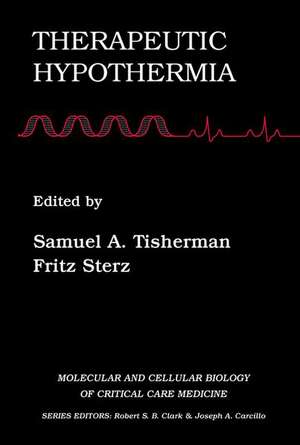
Therapeutic Hypothermia
Editat de Samuel Tisherman, Fritz H Sterzen Limba Engleză Hardback – 9 iun 2005
Preț: 1366.63 lei
Preț vechi: 1438.56 lei
-5%
Puncte Express: 2050
Carte tipărită la comandă
Livrare economică 12-26 iunie
Specificații
ISBN-13: 9780387254029
ISBN-10: 0387254021
Pagini: 258
Ilustrații: XIV, 258 p.
Dimensiuni: 162 x 244 x 20 mm
Greutate: 0.59 kg
Ediția:2005 edition
Editura: Springer Us
Locul publicării:New York, NY, United States
ISBN-10: 0387254021
Pagini: 258
Ilustrații: XIV, 258 p.
Dimensiuni: 162 x 244 x 20 mm
Greutate: 0.59 kg
Ediția:2005 edition
Editura: Springer Us
Locul publicării:New York, NY, United States
V-ar putea interesa
-
 Emergencies in Critical CareMartin Beed-27%Preț: 352.31 lei481.31 lei
 -
 Critical Care Medicine: Principles of Diagnosis and Management in the AdultJoseph E. Parrillo-32%Preț: 1032.81 lei1519.51 lei
 -
 Bedside Procedures for the IntensivistHeidi L. Frankel-5%Preț: 608.09 lei640.09 lei
 -
 -5%Preț: 291.10 lei306.42 lei
 -
 -5%Preț: 868.69 lei914.41 lei
 -
 -5%Preț: 1212.75 lei1276.58 lei
 -
 Manual of Pediatric AnesthesiaJerrold Lerman-5%Preț: 1261.10 lei1327.48 lei
 -
 Complications and Mishaps in AnesthesiaMatthias Hübler-5%Preț: 645.73 lei679.72 lei
 -
 Clinical Neurophysiology in Disorders of ConsciousnessAndrea O. Rossetti-5%Preț: 566.80 lei596.63 lei
 -
 Non Invasive Artificial VentilationStefano Nava-5%Preț: 627.19 lei660.21 lei
Public țintă
ResearchCuprins
Global Brain Ischemia: Animal Studies.- Global Cerebral Ischemia: Clinical Studies.- Focal Cerebral Ischemia: Mechanisms.- Focal Cerebral Ischemia: Clinical Studies.- Traumatic Brain Injury: Laboratory Studies.- Traumatic Brain Injury: Clinical Studies.- Spinal Cord Ischemia and Trauma.- Asphyxia.- Neonatal Asphyxia.- Hemorrhagic Shock and Exsanguination Cardiac Arrest.- Adult Respiratory Distress Syndrome and Sepsis.- Liver Failure and Intracerebral Hypertension.- Myocardial Ischemia and Infarction.- Cooling Methods.- Detrimental Effects of Hypothermia.- Future Directions.
Textul de pe ultima copertă
The use of hypothermia for a variety of therapeutic purposes has a long and erratic history. Hypothermia was used for protection and preservation of the heart and entire organism during planned operative ischemia. Attempts were also made to use hypothermia for resuscitation from cardiac arrest and for management of head trauma.
Therapeutic Hypothermia will provide a review of the subject, in particular, resuscitative hypothermia and include known mechanisms of action and results from both mechanistic and outcome laboratory studies and clinical trials. Cooling methods and potential side effects of hypothermia will be addressed as well as recommendations for future laboratory and clinical research.
This volume will be of interest to both the researcher interested in therapeutic hypothermia as well as the clinician interested in the potential use of therapeutic hypothermia in their patient population.
Samuel A. Tisherman is an Associate Professor in the Department of Surgery, the University of Pittsburgh, Pennsylvania, USA.
Fritz Sterz is a Professor in Emergency Medicine at the University of Vienna, Vienna, Austria.
Therapeutic Hypothermia will provide a review of the subject, in particular, resuscitative hypothermia and include known mechanisms of action and results from both mechanistic and outcome laboratory studies and clinical trials. Cooling methods and potential side effects of hypothermia will be addressed as well as recommendations for future laboratory and clinical research.
This volume will be of interest to both the researcher interested in therapeutic hypothermia as well as the clinician interested in the potential use of therapeutic hypothermia in their patient population.
Samuel A. Tisherman is an Associate Professor in the Department of Surgery, the University of Pittsburgh, Pennsylvania, USA.
Fritz Sterz is a Professor in Emergency Medicine at the University of Vienna, Vienna, Austria.
Caracteristici
Fourth book in the Molecular and Cellular Biology of Critical Care Medicine series Emphasizes resuscitative hypothermia Global perspective on topic