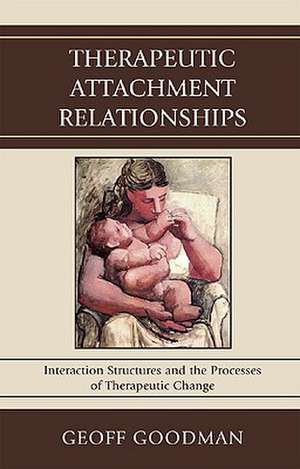
Therapeutic Attachment Relationships: Interaction Structures and the Processes of Therapeutic Change
Autor Geoff Goodmanen Limba Engleză Hardback – 28 dec 2009
Preț: 558.17 lei
Preț vechi: 753.53 lei
-26%
Puncte Express: 837
Carte tipărită la comandă
Livrare economică 08-22 iunie
Specificații
ISBN-13: 9780765707451
ISBN-10: 0765707454
Pagini: 144
Dimensiuni: 164 x 239 x 16 mm
Greutate: 0.39 kg
Ediția:New.
Editura: Bloomsbury Publishing
Colecția Jason Aronson Inc
Locul publicării:New York, United States
ISBN-10: 0765707454
Pagini: 144
Dimensiuni: 164 x 239 x 16 mm
Greutate: 0.39 kg
Ediția:New.
Editura: Bloomsbury Publishing
Colecția Jason Aronson Inc
Locul publicării:New York, United States
Recenzii
Starting with a provocative analysis of how Freud's own attachment problems limited his ideas on technique, Goodman reviews the psychotherapy literature through the lens of attachment theory, then proposes an integrative model of why some patients and therapists just seem to 'click.'
This book is a sequel to Goodman's two-volume Transforming the Internal World and Attachment (2010), in which he reviews theoretical and empirical perspectives of therapeutic change and linked psychodynamic and attachment perspectives in an effort to clarify processes involved in patient-therapist interaction. Here Goodman (Long Island Univ.) looks at how the attachment history of the therapist may play a key role in the therapeutic process. The book starts with a review of a selection of Freud's writingsand his personal history, making the case that Freud's predominant attachment relationship contained dismissing features that became components of his model for conducting psychoanalysis. Goodman then presents the caregiver-infant attachment relationshipas a metaphor for the therapist-patient relationship. He introduces the principle of noncomplementarity as a potential means for the therapist to provide a 'gentle challenge' that assists the patient in developing new modes of regulating affect and relating to others. The author addresses empirical means of assessing the effectiveness of this strategic approach. In sum, Goodman presents a model for understanding how four potential interaction structures, which develop from the secondary attachment strat
Geoff Goodman is that rare psychologist-psychoanalyst who imbues a rich understanding of the clinical process with a skillful working knowledge of clinical research for conceptualizing attachment theory and its therapeutic implications. Attachment theoryis arguably the most important new development in contemporary psychoanalytic thinking, and Therapeutic Attachment Relationships and its related volumes are superb examples of the most creative clinical thinking in this field. Building on his earlier book on object relations and attachment theories, Goodman here extends the model of the caregiver-infant attachment relationship to explain how dissimilar, noncomplementary attachment configurations in therapist-patient relationships may promote more favorable treatment outcomes than closely matched attachment patterns between therapists and patients. He demonstrates how therapists' and patients' complementary and noncomplementary deactivating and hyperactivating attachment strategies produce four distinctive therapist-patient interaction structures that are clinically important to recognize and understand, while at the same time serving an important heuristic purpose for empirical examination. This is a creative and bold conceptualization of attachment
This book is a sequel to Goodman's two-volume Transforming the Internal World and Attachment (2010), in which he reviews theoretical and empirical perspectives of therapeutic change and linked psychodynamic and attachment perspectives in an effort to clarify processes involved in patient-therapist interaction. Here Goodman (Long Island Univ.) looks at how the attachment history of the therapist may play a key role in the therapeutic process. The book starts with a review of a selection of Freud's writingsand his personal history, making the case that Freud's predominant attachment relationship contained dismissing features that became components of his model for conducting psychoanalysis. Goodman then presents the caregiver-infant attachment relationshipas a metaphor for the therapist-patient relationship. He introduces the principle of noncomplementarity as a potential means for the therapist to provide a 'gentle challenge' that assists the patient in developing new modes of regulating affect and relating to others. The author addresses empirical means of assessing the effectiveness of this strategic approach. In sum, Goodman presents a model for understanding how four potential interaction structures, which develop from the secondary attachment strat
Geoff Goodman is that rare psychologist-psychoanalyst who imbues a rich understanding of the clinical process with a skillful working knowledge of clinical research for conceptualizing attachment theory and its therapeutic implications. Attachment theoryis arguably the most important new development in contemporary psychoanalytic thinking, and Therapeutic Attachment Relationships and its related volumes are superb examples of the most creative clinical thinking in this field. Building on his earlier book on object relations and attachment theories, Goodman here extends the model of the caregiver-infant attachment relationship to explain how dissimilar, noncomplementary attachment configurations in therapist-patient relationships may promote more favorable treatment outcomes than closely matched attachment patterns between therapists and patients. He demonstrates how therapists' and patients' complementary and noncomplementary deactivating and hyperactivating attachment strategies produce four distinctive therapist-patient interaction structures that are clinically important to recognize and understand, while at the same time serving an important heuristic purpose for empirical examination. This is a creative and bold conceptualization of attachment