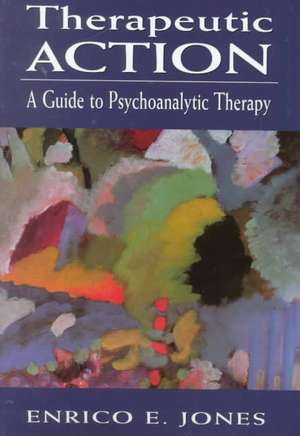
Therapeutic Action: A Guide to Psychoanalytic Therapy
Autor Enrico E. Jonesen Limba Engleză Hardback – iun 2000
Preț: 675.58 lei
Preț vechi: 1009.03 lei
-33%
Puncte Express: 1013
Carte tipărită la comandă
Livrare economică 30 noiembrie-14 decembrie
Livrare prin curier în România Termenul estimat este afișat lângă disponibilitate.
Transport gratuit pentru acest produs Plată online sau ramburs, în funcție de opțiunile comenzii.
Retur gratuit în 14 zile Comandă securizată și suport în română.
Specificații
ISBN-13: 9780765702432
ISBN-10: 0765702436
Pagini: 381
Dimensiuni: 164 x 236 x 27 mm
Greutate: 0.71 kg
Editura: Bloomsbury Publishing
Colecția Jason Aronson Inc
Locul publicării:New York, United States
ISBN-10: 0765702436
Pagini: 381
Dimensiuni: 164 x 236 x 27 mm
Greutate: 0.71 kg
Editura: Bloomsbury Publishing
Colecția Jason Aronson Inc
Locul publicării:New York, United States
V-ar putea interesa
-
 Great Ideas Civilization and Its DiscontentsSigmund Freud-21%Preț: 43.93 lei55.48 lei
 -
 WinnicottAdam Phillips-32%Preț: 62.58 lei92.11 lei
 -
 Interpreting DreamsSigmund Freud-27%Preț: 81.10 lei110.39 lei
 -
 Freud: A Very Short IntroductionAnthony Storr-19%Preț: 57.46 lei71.30 lei
 -
 Divine Therapy: Love, Mysticism and PsychoanalysisJanet Sayers-26%Preț: 942.43 lei1279.81 lei
 -
 The Portable Kristeva 2eJulia KristevaPreț: 297.31 lei
 -
 Transference And ProjectionJan Grant-28%Preț: 191.11 lei264.34 lei
 -
 A Critical Dictionary of Jungian AnalysisAndrew SamuelsPreț: 403.95 lei
 -
 The Clinical Thinking of Wilfred BionJoan SymingtonPreț: 337.04 lei
 -
 Preț: 431.51 lei
 -
 Introduction to Psychoanalysis: Contemporary Theory and PracticeAnthony W. BatemanPreț: 344.07 lei
 -
 Preț: 209.76 lei
 -
 The Cambridge Companion to JungPolly Young-EisendrathPreț: 282.14 lei
 -
 Melanie KleinMeira Likierman-11%Preț: 165.57 lei185.80 lei
 -
 Jung & the Alchemical ImaginationJeffrey RaffPreț: 122.31 lei
 -
 How To Read FreudJosh CohenPreț: 76.58 lei
Recenzii
Enrico Jones is a first-rank researcher and a wise clinician. Therapeutic Action: A Guide to Psychoanalytic Therapy tells how to select patients who will benefit from psychodynamic therapy, how to characterize what happens in the treatment, and how to assess the outcome. It proposes a new and integrative concept of therapeutic action-interaction structures-and provides lively verbatim exchanges between patient and therapist. The book is a psychodynamic treatment primer for clinicians at all levels of experience. It should find a place on the shelf of every mental health professional.
A masterful achievement! A genuine integration of systematic observation with the art of clinical practice, this is an invaluable book to guide all therapists, the experienced and the novice, through the troubled waters of psychodynamic treatment. I cannot imagine anyone who reads this book not becoming a more effective therapist as a consequence. The rich and comprehensive examples also make it an extraordinary teaching aid, providing countless opportunities for group discussion to highlight technical and theoretical differences. It is a wonderful, thoughtful, mature contribution from a clinician who has also mastered the highest levels of research sophistication.
A masterful achievement! A genuine integration of systematic observation with the art of clinical practice, this is an invaluable book to guide all therapists, the experienced and the novice, through the troubled waters of psychodynamic treatment. I cannot imagine anyone who reads this book not becoming a more effective therapist as a consequence. The rich and comprehensive examples also make it an extraordinary teaching aid, providing countless opportunities for group discussion to highlight technical and theoretical differences. It is a wonderful, thoughtful, mature contribution from a clinician who has also mastered the highest levels of research sophistication.