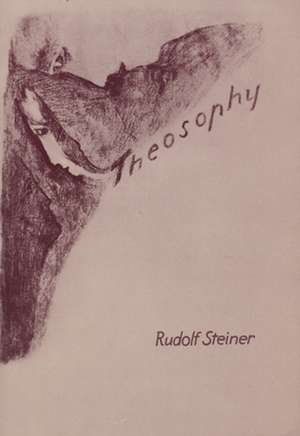
Theosophy
Autor Rudolf Steiner Traducere de Henry B Mongesen Limba Engleză Paperback – 19 dec 1994
- Material, physical body
- Ether body, or body of life forces
- Sentient soul body
- Mind soul
- Spirit-filled consciousness soul
- Life spirit
- Spirit body
Finally, we are given a succinct description of the path of knowledge, along which each person can begin to understand the marvelous and harmonious complexity of the psycho-spiritual worlds in their fullness.
This volume is a translation of Theosophie, Einf hrung in bersinnliche Welterkenntnis und Menschenbestimmung (GA 9).
Preț: 104.31 lei
Puncte Express: 156
Carte indisponibilă temporar
Doresc să fiu notificat când acest titlu va fi disponibil:
Se trimite...
Specificații
ISBN-13: 9780880101790
ISBN-10: 0880101792
Pagini: 224
Dimensiuni: 134 x 190 x 20 mm
Greutate: 0.24 kg
Editura: Steiner Books
ISBN-10: 0880101792
Pagini: 224
Dimensiuni: 134 x 190 x 20 mm
Greutate: 0.24 kg
Editura: Steiner Books
V-ar putea interesa
-
 How to Know Higher WorldsRudolf SteinerPreț: 99.84 lei
 -
 An Outline of Esoteric ScienceRudolf SteinerPreț: 123.61 lei
 -
 Jed McKenna's Theory of EverythingJed MckennaPreț: 90.07 lei
 -
 -10%Preț: 110.54 lei122.43 lei
 -
 Esoteric HollywoodJay DyerPreț: 117.38 lei
Notă biografică
Rudolf Steiner (1861-1925) was born in the small village of Kraljevec, Austro-Hungarian Empire (now in Croatia), where he grew up. As a young man, he lived in Weimar and Berlin, where he became a well-published scientific, literary, and philosophical scholar, known especially for his work with Goethe's scientific writings. At the beginning of the twentieth century, he began to develop his early philosophical principles into an approach to systematic research into psychological and spiritual phenomena. Formally beginning his spiritual teaching career under the auspices of the Theosophical Society, Steiner came to use the term Anthroposophy (and spiritual science) for his philosophy, spiritual research, and findings. The influence of Steiner's multifaceted genius has led to innovative and holistic approaches in medicine, various therapies, philosophy, religious renewal, Waldorf education, education for special needs, threefold economics, biodynamic agriculture, Goethean science, architecture, and the arts of drama, speech, and eurythmy. In 1924, Rudolf Steiner founded the General Anthroposophical Society, which today has branches throughout the world. He died in Dornach, Switzerland.
Cuprins
Translator's foreword Elizabeth Douglas Shields; Preface to the first edition; Preface to the third edition; Introduction; Part I. The Constitution of the Human Being: 1. The corporeal being of man; 2. The soul being of man; 3. The spiritual being of man; 4. Body, soul, and spirit; Part II. Re-Embodiment of the Spirit and Destiny, or Re-Incarnation and Karma; Part III. The Three Worlds: 1. The soul world; 2. The soul in the soul world after death; 3. The spiritland; 4. The spirit in the spiritland after death; 5. The physical world and its connection with the soul and spiritlands; 6. Thought forms and the human aura; Part IV. The Path of Knowledge; Notes and amplifications.
Descriere
Descriere de la o altă ediție sau format:
A work on the development of body, soul, and spirit, by the Austrian philosopher and educationalist Rudolf Steiner.
A work on the development of body, soul, and spirit, by the Austrian philosopher and educationalist Rudolf Steiner.