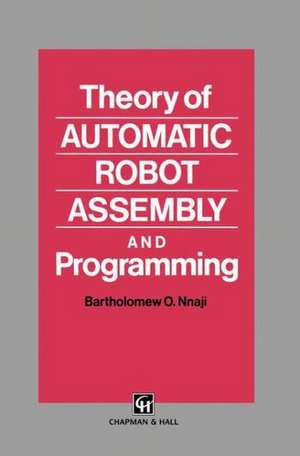
Theory of Automatic Robot Assembly and Programming
Autor B. O. Nnajien Limba Engleză Hardback – 31 dec 1992
Preț: 981.53 lei
Preț vechi: 1196.99 lei
-18%
Puncte Express: 1472
Carte tipărită la comandă
Livrare economică 08-22 decembrie
Livrare prin curier în România Termenul estimat este afișat lângă disponibilitate.
Transport gratuit pentru acest produs Plată online sau ramburs, în funcție de opțiunile comenzii.
Retur gratuit în 14 zile Comandă securizată și suport în română.
Specificații
ISBN-13: 9780412393105
ISBN-10: 0412393107
Pagini: 328
Ilustrații: XVII, 306 p.
Dimensiuni: 160 x 241 x 23 mm
Greutate: 0.61 kg
Ediția:1993
Editura: SPRINGER NETHERLANDS
Locul publicării:Dordrecht, Netherlands
ISBN-10: 0412393107
Pagini: 328
Ilustrații: XVII, 306 p.
Dimensiuni: 160 x 241 x 23 mm
Greutate: 0.61 kg
Ediția:1993
Editura: SPRINGER NETHERLANDS
Locul publicării:Dordrecht, Netherlands
V-ar putea interesa
-
 Arduino Robot BonanzaGordon McComb-38%Preț: 210.57 lei339.85 lei
 -
 Robotics: A Very Short IntroductionAlan Winfield-20%Preț: 57.20 lei71.12 lei
 -
 The Technological SingularityMurray Shanahan-20%Preț: 98.51 lei122.92 lei
 -
 Optimal ControlFrank L Lewis-9%Preț: 992.25 lei1090.39 lei
 -
 Practical Field RoboticsRobert H Sturges-8%Preț: 658.21 lei715.44 lei
 -
 Human-Robot Interaction in Social RoboticsTakayuki Kanda-18%Preț: 1666.19 lei2031.93 lei
 -
 Parallel Robots: Mechanics and ControlHamid D. Taghirad-20%Preț: 1784.20 lei2230.26 lei
 -
 Process Control: Problems, Techniques and ApplicationsSamuel P. Werther-27%Preț: 1165.46 lei1585.77 lei
 -
 Autonomous Tracked Robots in Planar Off-Road ConditionsRamón González-15%Preț: 660.37 lei776.91 lei
 -
 Preț: 459.50 lei
 -
 Sensorgeführte Programmierung bahngesteuerter IndustrieroboterGerhard GruhlerPreț: 412.37 lei
 -
 FTK '88, Fertigungstechnisches KolloquiumStuttgart Gesellschaft Für FertigungstechnikPreț: 410.42 lei
 -
 Robuste RegelungJürgen AckermannPreț: 499.83 lei
 -
 Messen und Prüfen von GewindenKarl KressPreț: 392.75 lei
 -
 Cognitive Neuroscience Robotics AMasashi Kasaki-24%Preț: 784.84 lei1032.68 lei
 -
 Cognitive Neuroscience Robotics BMasashi Kasaki-20%Preț: 649.84 lei812.30 lei
Public țintă
ResearchCuprins
1 Machine programming.- 1.1 Introduction.- 1.2 Problems of machine reasoning.- 1.3 Robot programming.- 1.4 Machine task-level programming.- 1.5 Organization of this book.- 2 CAD in automatic machine programming.- 2.1 Introduction.- 2.2 Desired CAD data.- 2.3 Feature, feature classification and representation.- 2.4 Feature reasoning for mechanical components.- 3 Spatial relationships.- 3.1 Introduction.- 3.2 Background.- 3.3 Spatial relationships.- 3.4 Product specification attributes.- 3.5 Applications.- 4 Structure of an automatic robot programmer.- 4.1 Introduction.- 4.2 An overview of RALPH.- 4.3 World knowledge database.- 4.4 RALPH commands.- 4.5 Mathematical consideration.- 4.6 Task planner.- 4.7 An example of assembly task.- 4.8 Programming issues.- 4.9 Discussion.- 5 Sensors and representation.- 5.1 Background.- 5.2 Internal and external sensors.- 5.3 Sensor fusion.- 5.4 Sensor architecture.- 5.5 Representation.- 5.6 Probability of sensor usage.- 5.7 Processing.- 6 World modeling and task specification.- 6.1 World modeling.- 6.2 Task specification.- 6.3 Assembly stability model.- 6.4 Designing for stability.- 6.5 Relative stability.- 6.6 Summary.- 7 Gross motion planning and collision avoidance.- 7.1 Introduction.- 7.2 Gross motion in RALPH.- 7.3 Robot motion planning problems.- 7.4 The path planning algorithm.- 7.5 Discussion.- 7.6 Summary.- 8 Grasp planning.- 8.1 Introduction.- 8.2 Background.- 8.3 World spatial relationships in grasping.- 8.4 Grasping concepts.- 8.5 Design and implementation.- 8.6 Summary.- 9 Trajectory planning and control.- 9.1 Introduction.- 9.2 Evaluation of trajectories.- 9.3 Other trajectory evaluation approaches.- 9.4 Background material.- 9.5 Robots with more than 3 degrees of freedom.- 9.6 Evaluation and analysis.- 9.7 Summary.- 10 Considerations for generic kinematic structures.- 10.1 Introduction.- 10.2 Kinematic structures.- 10.3 Kinematic implementation.- 10.4 Kinematic analysis.- 10.5 Example.- 10.6 Pattern of kinematic behavior.- 10.7 Summary.- 11 Program synthesis and other planners.- 11.1 Introduction.- 11.2 Spanning vector for assembly directions and other applications.- 11.3 Precedence generation.- 11.4 Fine motion planning.- 11.5 Program synthesis.- References.
Recenzii
This book is appropriate for a course in robot programming, machine programming and robotic assembly. It can also serve as a major part of a course in robotics or any other automated manufacturing course. - Inspec - The Institute of Electrical Engineers; The material is well laid out and presented in a logical fashion...For any serious worker in assembly, either in an industrial context or as an academic researcher, this book will be extremely valuable. - Int.J.Prod.Res.