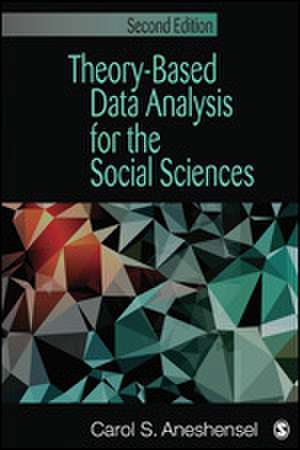
Theory-Based Data Analysis for the Social Sciences
Autor Carol S. Aneshenselen Limba Engleză Electronic book text – 18 iun 2013
Preț: 382.20 lei
Puncte Express: 573
Indisponibil temporar
Doresc să fiu notificat când acest titlu va fi disponibil:
Se trimite...
Specificații
ISBN-13: 9781452287164
ISBN-10: 1452287163
Pagini: 472
Dimensiuni: 187 x 232 mm
Ediția:Second Edition
Editura: SAGE Publications
Colecția Sage Publications, Inc
Locul publicării:Thousand Oaks, United States
ISBN-10: 1452287163
Pagini: 472
Dimensiuni: 187 x 232 mm
Ediția:Second Edition
Editura: SAGE Publications
Colecția Sage Publications, Inc
Locul publicării:Thousand Oaks, United States
V-ar putea interesa
-
 Education and Development: Measuring the Social BenefitsWalter W. McMahon-24%Preț: 355.77 lei466.38 lei
 -
 Unequal Lives: Health and Socioeconomic InequalitiesHilary Graham-29%Preț: 186.17 lei262.49 lei
 -
 -28%Preț: 189.48 lei264.29 lei
 -
 -15%Preț: 447.56 lei526.54 lei
 -
 Measuring the Real WorldHeiner Thiessen-9%Preț: 827.32 lei909.13 lei
 -
 Research Methods for Cultural StudiesMichael Pickering-18%Preț: 178.08 lei216.69 lei
 -
 The Life Story InterviewRobert AtkinsonPreț: 337.91 lei
 -
 Conducting Interpretive Policy AnalysisDvora YanowPreț: 338.72 lei
 -
 The Qualitative Researcher's CompanionMichael Huberman-18%Preț: 843.77 lei1028.98 lei
 -
 Narrative Methods for the Human SciencesCatherine Kohler Riessman-26%Preț: 641.78 lei867.28 lei
 -
 Using Documents in Social ResearchLindsay Prior-15%Preț: 538.75 lei633.82 lei
 -
 Understanding Qualitative Research and EthnomethodologyPaul Ten Have-8%Preț: 419.85 lei456.35 lei
 -
 The Practitioner-ResearcherPeter JarvisPreț: 288.44 lei
 -
 Summated Rating Scale ConstructionPaul E. SpectorPreț: 336.63 lei
 -
 Systematic Reviews in the Social SciencesHelen RobertsPreț: 438.78 lei
 -
 Doing Visual ResearchClaudia Mitchell-15%Preț: 416.49 lei489.99 lei
Recenzii
“In
clear
and
accessible
prose,
this
book
presents
a
compelling
logic
for
the
analysis
of
non-experimental
data.
In
the
process,
it
clarifies
the
concepts
of
statistical
association,
confounding,
and
statistical
control,
and
it
provides
really
compelling
elaboration
schemes
to
make
substantive,
rather
than
purely
statistical,
sense
of
it
all.
It
also
provides
a
means
for
making
causal
assertions
when
the
criteria
of
association,
causal
priority,
non-spuriousness,
and
theoretical
rationale
are
met.”
“This text does a superb job of explaining critical concepts such as mediation, moderation, spuriousness, and control variable, using graphic illustrations as well as published articles as examples. I think the illustrated examples are really helpful for illuminating these concepts. Furthermore, the majority of empirical research in the social behavioral sciences utilizes regression, logistic regression, and path analysis. The book discusses many empirical articles utilizing these analytic approaches as examples. Thus, the contents of this book are highly relevant and understandable for those in early stages of research training.”
I think this is a very much awaited book. I think it is very well suited for PG level, particularly for those MA students who are writing their dissertations (and PhD students as well). As strange as it may seem, students struggle to understand what theory is and how it relates to data. For me this book engages comprehensively in these questions. There is a good discussion of how to work with variables, about the construction of associations and causalities. I wish I could teach more of this book in my MA course, but due to time constraints I would definitely recommend Chapter 1-4 (where the focus is on conceptual discussion). The book is very helpful for those constructing and designing their research. The book is not the ‘beginner level’. It would be helpful if students already have some background in quantitative analysis, therefore I would not, however, recommend for BA level.
“This text does a superb job of explaining critical concepts such as mediation, moderation, spuriousness, and control variable, using graphic illustrations as well as published articles as examples. I think the illustrated examples are really helpful for illuminating these concepts. Furthermore, the majority of empirical research in the social behavioral sciences utilizes regression, logistic regression, and path analysis. The book discusses many empirical articles utilizing these analytic approaches as examples. Thus, the contents of this book are highly relevant and understandable for those in early stages of research training.”
I think this is a very much awaited book. I think it is very well suited for PG level, particularly for those MA students who are writing their dissertations (and PhD students as well). As strange as it may seem, students struggle to understand what theory is and how it relates to data. For me this book engages comprehensively in these questions. There is a good discussion of how to work with variables, about the construction of associations and causalities. I wish I could teach more of this book in my MA course, but due to time constraints I would definitely recommend Chapter 1-4 (where the focus is on conceptual discussion). The book is very helpful for those constructing and designing their research. The book is not the ‘beginner level’. It would be helpful if students already have some background in quantitative analysis, therefore I would not, however, recommend for BA level.
Cuprins
Preface
Acknowledgments
About the Author
Part I. Conceptual Foundations of the Elaboration Model
Chapter 1. Introduction to Theory-Based Data Analysis
Chapter 2. The Logic of Theory-Based Data Analysis
Chapter 3. Relationships as Associations
Chapter 4. The Focal Relationship: Causal Inference
Part II. Regression with Simple Random Samples and Complex Samples
Chapter 5. The Elaboration Model With Multiple Linear Regression
Chapter 6. Regression With Survey Data From Complex Samples
Part III. The Elaboration Model With Multiple Linear Regression
Chapter 7. Ruling Out Alternative Explanations: Spuriousness and Control Variables
Chapter 8. Ruling Out Alternative Theoretical Explanations: Rival Independent Variables
Chapter 9. Elaborating the Focal Relationship: Mediation and Intervening Variables
Chapter 10. Elaborating the Focal Relationship: Antecedent and Consequent Variables
Chapter 11. Specifying Conditions of Influence: Moderating Variables
Part IV. The Elaboration Model With Logistic Regression
Chapter 12. The Elaboration Model With Logistic Regression
Part V. Conclusion
Chapter 13. Synthesis and Comments
Glossary
References
Abbreviations
Index
Acknowledgments
About the Author
Part I. Conceptual Foundations of the Elaboration Model
Chapter 1. Introduction to Theory-Based Data Analysis
Chapter 2. The Logic of Theory-Based Data Analysis
Chapter 3. Relationships as Associations
Chapter 4. The Focal Relationship: Causal Inference
Part II. Regression with Simple Random Samples and Complex Samples
Chapter 5. The Elaboration Model With Multiple Linear Regression
Chapter 6. Regression With Survey Data From Complex Samples
Part III. The Elaboration Model With Multiple Linear Regression
Chapter 7. Ruling Out Alternative Explanations: Spuriousness and Control Variables
Chapter 8. Ruling Out Alternative Theoretical Explanations: Rival Independent Variables
Chapter 9. Elaborating the Focal Relationship: Mediation and Intervening Variables
Chapter 10. Elaborating the Focal Relationship: Antecedent and Consequent Variables
Chapter 11. Specifying Conditions of Influence: Moderating Variables
Part IV. The Elaboration Model With Logistic Regression
Chapter 12. The Elaboration Model With Logistic Regression
Part V. Conclusion
Chapter 13. Synthesis and Comments
Glossary
References
Abbreviations
Index
Descriere
This
book
presents
a
method
for
bringing
data
analysis
and
statistical
technique
into
line
with
theory.