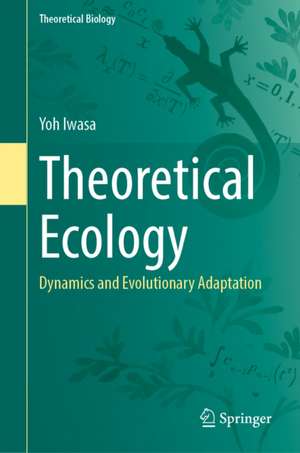
Theoretical Ecology: Theoretical Biology
Autor Yoh Iwasaen Limba Engleză Hardback – 28 oct 2026
In recent years, mathematical modeling has become increasingly important for understanding biological phenomena. Such models now play crucial roles in fields ranging from neuronal electrical activity and the molecular mechanisms of muscle contraction to the formation of morphological patterns during development and the study of brain function. Advances in modeling ecological and social behavior, as well as evolutionary processes, have further established mathematical modeling as an indispensable tool in theoretical and mathematical biology.
Mathematical models clarify logical structures, uncover unexpected patterns, and reveal commonalities across seemingly different disciplines. They also enable quantitative predictions that allow hypotheses to be tested against experimental and observational data.
Chapters in this book cover topics such as population dynamics, adaptive strategies, and principles of coexistence. Readers are introduced to dynamic optimization, control theory, and game theory, along with stochastic modeling techniques based on Markov and diffusion processes.
The purpose of this book is to present mathematical ideas in an intuitive and accessible way, helping biology students appreciate the fascination of mathematical modeling while acquiring essential analytical skills. With a focus on ecological contexts, it provides the background knowledge and core concepts needed to show how simple models can clarify underlying logic and unify diverse biological phenomena.








Preț: 476.86 lei
Preț vechi: 548.11 lei
-13% Precomandă
Puncte Express: 715
Carte nepublicată încă
Livrare prin curier în România Precomanda se expediază când titlul devine disponibil.
Transport gratuit pentru acest produs Plată online sau ramburs, în funcție de opțiunile comenzii.
Retur gratuit în 14 zile Comandă securizată și suport în română.
Doresc să fiu notificat când acest titlu va fi disponibil:
Se trimite...
Specificații
ISBN-13: 9789819211708
ISBN-10: 9819211700
Pagini: 344
Dimensiuni: 155 x 235 mm
Editura: Springer Verlag, Singapore
Colecția Theoretical Biology
Seria Theoretical Biology
ISBN-10: 9819211700
Pagini: 344
Dimensiuni: 155 x 235 mm
Editura: Springer Verlag, Singapore
Colecția Theoretical Biology
Seria Theoretical Biology
Notă biografică
Dr. Yoh Iwasa is Professor Emeritus at Kyushu University. His research covers theoretical studies of ecology, evolution, animal behavior, biological rhythms, cancer, development, immune systems, and cultural and social processes, with a focus on applying common mathematical principles across diverse biological questions. He received his PhD in Theoretical Biophysics from Kyoto University, completed postdoctoral research at Stanford and Cornell, and joined Kyushu University in 1985. He is a Fellow of the American Academy of Arts and Sciences. He serves on editorial boards of 12 journals in ecology and mathematical biology. He is the series editor of two book series, "Ecological Research Monographs" and "Theoretical Biology", from Springer-Nature. His honors include the Akira Okubo Prize (2018), the Ecological Society of Japan Award (2003), and the Motoo Kimura Memorial Prize (2003).
Cuprins
Chapter 1. Dynamics of a single species population.- Chapter 2. Competition between species.- Chapter 3. The predator-prey cycle.- Chapter 4. Discrete time models.- Chapter 5. Age structure and size distribution.- Chapter 6. Dynamics of continuous distributions.- Chapter 7. Biological diffusion.- Chapter 8. Spatial aggregation of individuals.- Chapter 9. The extinction of populations.- Chapter 10. How to choose and find food.- Chapter 11. Life history strategies.- Chapter 12. Dynamic optimization of growth and reproduction.- Chapter 13. Adaption in variable environments.- Chapter 14. Various game models.- Chapter 15. The game of schedules.- Chapter 16. Sex allocation and sexual systems.- Chapter 17. Mate choice.- Chapter 18. Genetic basis of adaptive strategies.- Chapter 19. Diversity of coexisting species.- Chapter 20. Community stability and coevolution.- Chapter 21. Ecosystems.