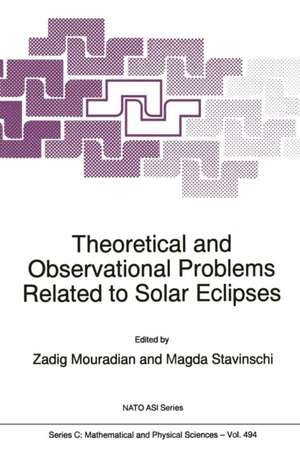
Theoretical and Observational Problems Related to Solar Eclipses
Editat de Z. Mouradian, Magda Stavinschien Limba Engleză Paperback – 14 oct 2012
Preț: 377.04 lei
Puncte Express: 566
Carte tipărită la comandă
Livrare economică 09-23 noiembrie
Livrare prin curier în România Termenul estimat este afișat lângă disponibilitate.
Transport gratuit de la 400.00 lei Plată online sau ramburs, în funcție de opțiunile comenzii.
Retur gratuit în 14 zile Comandă securizată și suport în română.
Specificații
ISBN-13: 9789401063111
ISBN-10: 9401063117
Pagini: 292
Ilustrații: XVIII, 270 p.
Dimensiuni: 160 x 240 x 16 mm
Greutate: 0.47 kg
Ediția:Softcover reprint of the original 1st ed. 1997
Editura: Springer
Locul publicării:Dordrecht, Netherlands
ISBN-10: 9401063117
Pagini: 292
Ilustrații: XVIII, 270 p.
Dimensiuni: 160 x 240 x 16 mm
Greutate: 0.47 kg
Ediția:Softcover reprint of the original 1st ed. 1997
Editura: Springer
Locul publicării:Dordrecht, Netherlands
V-ar putea interesa
-
 Feynman's Lost LectureDavid L Goodstein-34%Preț: 51.48 lei77.57 lei
 -
 The Mathematical Theory of Black HolesS. Chandrasekhar-31%Preț: 654.81 lei942.78 lei
 -
 Flat and Curved Space-TimesG. F. R. Ellis-28%Preț: 508.50 lei707.91 lei
 -
 Astrophysical LasersVladilen Letokhov-31%Preț: 870.64 lei1263.75 lei
 -
 -19%Preț: 286.85 lei352.05 lei
 -
 In Search of Dark MatterKen FreemanPreț: 276.38 lei
 -
 Unmasking EuropaRichard GreenbergPreț: 339.93 lei
 -
 Measuring and Modeling the UniverseWendy L. FreedmanPreț: 373.60 lei
 -
 Galaxies in the UniverseLinda S. Sparke-8%Preț: 480.51 lei522.29 lei
 -
 Gravitational Million-Body ProblemDouglas Heggie-23%Preț: 708.77 lei920.48 lei
 -
 -27%Preț: 554.06 lei763.17 lei
 -
 Physics of the Interstellar and Intergalactic MediumBruce T Draine-19%Preț: 663.90 lei819.64 lei
 -
 Stellar Spectral ClassificationRichard O. Gray-19%Preț: 635.72 lei784.84 lei
 -
 The Sky Is Not the LimitNeil De Grasse TysonPreț: 120.77 lei
Public țintă
ResearchCuprins
Session 1: Principal scientifique results from the past eclipse observations.- Results from the coronal observations of the 1994 and 1995 total solar eclipses.- Distribution on halfwidths for the green coronal line (5303 Å).- Results of polarization observations of the white-light corona.- Distribution of polarization degree for the solar corona of 03 November 1994.- Fundamental contributions of the solar eclipse observations to solar physics in the second half of the 20th century.- Polarization of the 530.3 nm coronal line as observed on July 11, 1991.- Measurement of the coronal electron temperature at the total solar eclipse on 1994, November 3.- High resolution coronal imaging.- Session 2.: Small and large scale models of coronal structures.- Coronal physics inferred from the analysis of fine structures.- Radiative transfer in atmospheres with randomly distributed inhomogeneities.- Probing the solar atmosphere through radiophysics. A review of eclipse radio observations.- Computation of nonlinear force-free coronal magnetic fields: theory face to observations.- Comparing the large-scale coronal electron density distribution of the 1991 and 1994 solar eclipses.- 2D MHD numerical model for the study of dynamic and magnetic structures in the solar atmosphere.- MHD turbulences in the solar corona.- Post -flare loops in the chromosphere and corona.- Chromospheric and coronal heating mechanisms.- Reconstruction of the large-scale distribution of coronal electrons from eclipse data.- A new understanding of the coronal shape changes during the solar cycle.- Thermal evolution of a coronal condensation.- Medium and large scale structures of the low corona from decimeter and meter wavelength observations.- Session 3.: Low temperature structures in coronal environment.-Filament channels in the corona.- Faint “chromospheric” emission in the solar corona : observational and theoretical problems.- Creation of prominences and filaments — New vista on familiar sunscapes.- Unsolved problems in prominence research.- Session 4: Specific problems of solar eclipse observations.- Eclipse E-corona recording at far distances.- Simulation method to compute accurately the Einstein effect during a total solar eclipse. New ideas.- Emission line spectrum of the solar corona.- A possibility for studying subtelescopic structures in the solar corona.- Eclipse observations relevant to the coronal heating problem.- The indication of neutral hydrogen in the solar corona.- Relevant radio observations during a total solar eclipse.- Session 5.: Tasks for total solar eclipse of 11 August 1999.- NASA bulletin for the total solar eclipse of 1999.- Romanians prepararations for the’ 99 eclipse.- JOSO Working Group 7 : A focal point for collaboration around the 1999 solar eclipse.- A radio observation project for the 1999 solar eclipse.- Romanian projects for the 1999 total solar eclipse.- Session 6.: Instrumental improvement for future observations.- EIT, the Extreme-Ultraviolet Imaging Telescope on board SOHO:first results.- Objectives of a Ukrainian solar-oriented satellite.- A project for infrared observations during the total solar eclipses from the circumterrestrial orbit.- Session 7.: Public education at eclipse and eye safety.- Eye safety during solar eclipses — Myths and realities.- Solar eclipses as a vehicle for international astronomy education.- Variations of geophysical and biological parameters observed at a solar eclipse.- List of Poster Papers.- Notes on General Discussion.- Author Index.