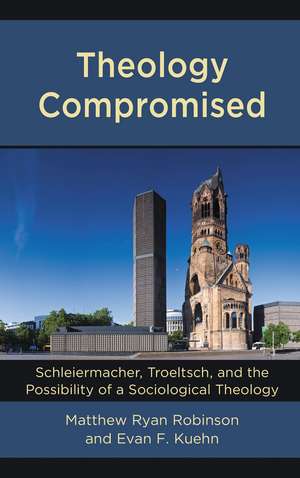
Theology Compromised: Schleiermacher, Troeltsch, and the Possibility of a Sociological Theology
Autor Matthew Ryan Robinson, Evan F. Kuehnen Limba Engleză Hardback – 17 oct 2019
Matthew Ryan Robinson and Evan F. Kuehn approach this question, not by reconstructing a history of ideas, but rather by telling a story about the development of churches and theological institutions. They take the turbulent and dynamic ecclesiological situation of nineteenth-century Germany as a representative case, focusing on the sociological methodological orientation of Friedrich Schleiermacher and Ernst Troeltsch in the context of the rise of theological liberalism, the history of religions, and the German churches' confrontation with social and political challenges. Robinson and Kuehn then connect this orientation with the sociology of religion of Hans Joas and Niklas Luhmann, arguing for a functional focus in theological research on what doctrines do rather than what the reality behind or in any particular doctrine is.
Preț: 549.46 lei
Preț vechi: 815.32 lei
-33%
Puncte Express: 824
Carte tipărită la comandă
Livrare economică 01-15 decembrie
Livrare prin curier în România Termenul estimat este afișat lângă disponibilitate.
Transport gratuit pentru acest produs Plată online sau ramburs, în funcție de opțiunile comenzii.
Retur gratuit în 14 zile Comandă securizată și suport în română.
Specificații
ISBN-13: 9781978704084
ISBN-10: 1978704089
Pagini: 170
Ilustrații: 2 b/w illustrations;
Dimensiuni: 152 x 229 x 18 mm
Greutate: 0.41 kg
Editura: Bloomsbury Publishing
Colecția Fortress Academic
Locul publicării:New York, United States
ISBN-10: 1978704089
Pagini: 170
Ilustrații: 2 b/w illustrations;
Dimensiuni: 152 x 229 x 18 mm
Greutate: 0.41 kg
Editura: Bloomsbury Publishing
Colecția Fortress Academic
Locul publicării:New York, United States
Cuprins
Part I - Doing Theology: A Different Theological History
Chapter 1 - From Friedrich Schleiermacher to Friedrich Naumann: How Systematic Theology and Social Formation Mutually Respond to and Produce One Another
Chapter 2 - Troeltsch on (Concepts of) the Church
Chapter 3 - Troeltsch's Theory of Compromise
Chapter 4 - Troeltsch and the Politics of Compromise
Part II - Contemporary Models
Chapter 5 - Hans Joas on Troeltsch, Transcendence, and the Formation of Values
Chapter 6 - Niklas Luhmann and Religious Community under Conditions of Modernity
Conclusion
Bibliography
Appendix - Translation
Translator's Note
Foreword to the Book Schleiermacher, Philosopher of (the) Faith, by Friedrich Naumann
"Schleiermacher and the Church," by Ernst Troeltsch
Chapter 1 - From Friedrich Schleiermacher to Friedrich Naumann: How Systematic Theology and Social Formation Mutually Respond to and Produce One Another
Chapter 2 - Troeltsch on (Concepts of) the Church
Chapter 3 - Troeltsch's Theory of Compromise
Chapter 4 - Troeltsch and the Politics of Compromise
Part II - Contemporary Models
Chapter 5 - Hans Joas on Troeltsch, Transcendence, and the Formation of Values
Chapter 6 - Niklas Luhmann and Religious Community under Conditions of Modernity
Conclusion
Bibliography
Appendix - Translation
Translator's Note
Foreword to the Book Schleiermacher, Philosopher of (the) Faith, by Friedrich Naumann
"Schleiermacher and the Church," by Ernst Troeltsch
Recenzii
Theology Compromised: Schleiermacher, Troeltsch, and the Possibility of a Sociological Theology, by Matthew Ryan Robinson and Evan F. Kuehn, is a gem of a book-small, finely crafted, and valuable. This book should inform any discussions of theological method in both precincts favorable and hostile to theology. It provides a powerful, if underdeveloped, paradigm for theological reflection with both historical sanction and reasoned justification.
How relevant is sociology for a theological understanding of church and doctrine? This provocative little book offers a new perspective on Schleiermacher and Troeltsch by connecting their contributions to contemporary social theory.
At least since the 1990s, theologians have been suspicious of sociology and social theory. Yet in this short and striking book, Matthew Ryan Robinson and Evan F. Kuehn revive what they view as the sociological heartbeat of all theology, presenting Ernst Troeltsch as the pacemaker who has kept it going from the past to the present. Required reading for anyone interested in theological methodology.
For the innovative (and much misunderstood) turn-of-the-century German theologian, Ernst Troeltsch (1865-1923), 'compromise' in theology did not mean 'selling out' to contemporary cultural mores, but sensitively and critically assessing how the Christian tradition, in all its complexity, could best respond prophetically to the pressing questions of the day. Moreover, it could not do this, according to Troeltsch, without understanding its own particular social and political locations, and the pressures arising from them. It is a pleasure to see this crucial element in Troeltsch's thinking assessed afresh for today in this book by Robinson and Kuehn, and particularly to have available for the first time in English Troeltsch's uniquely important essay on the social theology of Schleiermacher. In a growth period for new 'political theologies' in the West, Troeltsch's historic insights repay new reflection.
Sociology and social theory are without a doubt constitutive for the understanding of the Christian faith, its dogmatic concepts and narratives and its everyday practice. Hence, it is the outstanding and innovative achievement of Robinson and Kuehn to offer their excellent expertise on Schleiermacher and Troeltsch not only for their historical understanding but to open highly innovative perspectives on our ongoing cultural, social, and political transitions.
How relevant is sociology for a theological understanding of church and doctrine? This provocative little book offers a new perspective on Schleiermacher and Troeltsch by connecting their contributions to contemporary social theory.
At least since the 1990s, theologians have been suspicious of sociology and social theory. Yet in this short and striking book, Matthew Ryan Robinson and Evan F. Kuehn revive what they view as the sociological heartbeat of all theology, presenting Ernst Troeltsch as the pacemaker who has kept it going from the past to the present. Required reading for anyone interested in theological methodology.
For the innovative (and much misunderstood) turn-of-the-century German theologian, Ernst Troeltsch (1865-1923), 'compromise' in theology did not mean 'selling out' to contemporary cultural mores, but sensitively and critically assessing how the Christian tradition, in all its complexity, could best respond prophetically to the pressing questions of the day. Moreover, it could not do this, according to Troeltsch, without understanding its own particular social and political locations, and the pressures arising from them. It is a pleasure to see this crucial element in Troeltsch's thinking assessed afresh for today in this book by Robinson and Kuehn, and particularly to have available for the first time in English Troeltsch's uniquely important essay on the social theology of Schleiermacher. In a growth period for new 'political theologies' in the West, Troeltsch's historic insights repay new reflection.
Sociology and social theory are without a doubt constitutive for the understanding of the Christian faith, its dogmatic concepts and narratives and its everyday practice. Hence, it is the outstanding and innovative achievement of Robinson and Kuehn to offer their excellent expertise on Schleiermacher and Troeltsch not only for their historical understanding but to open highly innovative perspectives on our ongoing cultural, social, and political transitions.