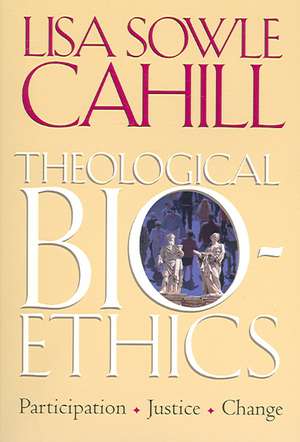
Theological Bioethics
Autor Lisa Sowle Cahillen Limba Engleză Paperback – 16 noi 2005
Observăm o lacună persistentă în literatura academică contemporană: marginalizarea perspectivelor teologice în favoarea unui liberalism politic care, deși se prezintă drept neutru, prioritizează autonomia individuală în detrimentul binelui comun. Theological Bioethics: Participation, Justice, and Change intervine în acest spațiu critic, oferind o fundamentare teoretică pentru ceea ce Lisa Sowle Cahill numește „bioetică participativă”. Notăm cu interes modul în care autoarea refuză să lase discursul religios exclusiv în sfera fundamentalismului, propunând în schimb o implicare civică activă a credincioșilor în politici de sănătate publică. Această lucrare din seria Moral Traditions series a editurii Georgetown University Press reîncadrează justiția socială ca prioritate zero a eticii medicale. Stilul este riguros și programatic, evitând abstracțiunile teoretice în favoarea unui apel la mobilizarea în rețele globale. Textul completează perspectiva oferită de Secular Bioethics in Theological Perspective, care analizează eroziunea influenței religioase, adăugând un cadru de acțiune concret pentru recuperarea rolului profetic al teologiei în dezbaterile despre bioetică. De asemenea, rezonează cu Communities of Health Care Justice prin accentul pus pe participarea comunitară, însă Cahill extinde discuția dincolo de granițele naționale, către o solidaritate globală. Credem că relevanța acestui volum pentru curriculumul de etică și teologie morală rezidă în capacitatea sa de a integra tradiția catolică progresistă cu cerințele contemporane de echitate economică. Este o resursă esențială pentru studenții și cercetătorii care caută o alternativă solidă la modelele bioetice pur seculare.
Preț: 263.26 lei
Preț vechi: 277.11 lei
-5%
Carte tipărită la comandă
Livrare economică 25 noiembrie-09 decembrie
Specificații
ISBN-10: 1589010752
Pagini: 322
Dimensiuni: 155 x 227 x 19 mm
Greutate: 0.44 kg
Ediția:1
Editura: Georgetown University Press
Locul publicării:United States
V-ar putea interesa
-
 -31%Preț: 712.45 lei1032.04 lei
 -
 -31%Preț: 726.37 lei1054.10 lei
 -
 Concilium 2011/3Hille HakerPreț: 129.58 lei
 -
 Friendship, Altruism and Morality (Routledge Revivals)Laurence A. BlumPreț: 464.56 lei
 -
 Coping with Choices to DieC. G. Prado-11%Preț: 528.90 lei594.27 lei
 -
 Human Rights and the Ethics of GlobalizationDaniel E. LeePreț: 269.20 lei
 -
 Sex, Gender, and Christian EthicsLisa S. CahillPreț: 449.51 lei
 -
 Poverty and MoralityWilliam A. Galston-11%Preț: 584.24 lei656.44 lei
 -
 -36%Preț: 535.36 lei835.91 lei
 -
 The Nature of DignityRon Bontekoe-27%Preț: 354.08 lei484.60 lei
 -
 Niccolo Machiavelli: The Laughing Lion and the Strutting FoxRaymond Angelo Belliotti-23%Preț: 321.63 lei416.71 lei
 -
 Moral Desert: A CritiqueHoward Simmons-28%Preț: 252.16 lei349.96 lei
 -
 Animal Minds, Animal Souls, Animal RightsJames V. Parker-27%Preț: 261.05 lei358.54 lei
 -
 Between the SexesLisa S CahillPreț: 129.32 lei
 -
 Love Your EnemiesLisa S CahillPreț: 176.59 lei
 -
 FamilyLisa Sowle CahillPreț: 153.69 lei
 -
 The A to Z of Hume's PhilosophyKenneth R. Merrill-28%Preț: 347.76 lei485.15 lei
 -
 People's Peace: Prospects for a Human FutureYasmin SaikiaPreț: 318.74 lei
 -
 Genetics, Theology, and Ethics An Interdiscipinary ConversationLisa Sowle CahillPreț: 196.13 lei
 -
 Sexuality and the U.S. Catholic Church Crisis and RenewalLisa Sowle CahillPreț: 174.85 lei
 -
 In the Name of GodTeehanPreț: 194.98 lei
 -
 Blessed Are the PeacemakersLisa Sowle CahillPreț: 255.58 lei
 -
 -15%Preț: 631.39 lei742.81 lei
 -
 Becoming a Modest SocietyG V LoewenPreț: 177.33 lei
 -
 My Brain Made Me Do ItEliezer J. SternbergPreț: 166.77 lei
 -
 -11%Preț: 633.38 lei711.65 lei
De ce să citești această carte
Recomandăm această carte cercetătorilor și studenților la teologie sau filozofie morală care doresc să înțeleagă cum valorile religioase pot modela politici publice juste. Cititorul câștigă o perspectivă nouă asupra bioeticii, văzută nu doar ca disciplină clinică, ci ca instrument de transformare socială. Este un text esențial pentru oricine contestă ideea că bioetica ar trebui să fie neutră față de inegalitățile economice globale.