Theaetetus
Autor Plato Introducere de Bernard Williams Traducere de M. J. Levett Revizuit de Myles Burnyeaten Limba Engleză Hardback – 14 oct 1992
Preț: 243.15 lei
Preț vechi: 294.67 lei
-17%
Puncte Express: 365
Carte indisponibilă temporar
Doresc să fiu notificat când acest titlu va fi disponibil:
Se trimite...
Specificații
ISBN-13: 9780872201590
ISBN-10: 0872201597
Pagini: 128
Dimensiuni: 9 x 215 x 139 mm
Greutate: 0.3 kg
Editura: Hackett Publishing Company
Colecția Hackett Publishing Company, Inc (US)
Locul publicării:United States
ISBN-10: 0872201597
Pagini: 128
Dimensiuni: 9 x 215 x 139 mm
Greutate: 0.3 kg
Editura: Hackett Publishing Company
Colecția Hackett Publishing Company, Inc (US)
Locul publicării:United States
V-ar putea interesa
-
 RepublicPlatoPreț: 30.76 lei
 -
 -25%Preț: 215.40 lei289.00 lei
 -
 -25%Preț: 218.86 lei290.91 lei
 -
 The First Philosophers: The Presocratics and SophistsRobin Waterfield-18%Preț: 65.53 lei79.80 lei
 -
 -20%Preț: 51.39 lei63.99 lei
 -
 PhaedrusPlato-20%Preț: 57.15 lei71.12 lei
 -
 -19%Preț: 52.70 lei64.76 lei
 -
 -18%Preț: 65.53 lei79.80 lei
 -
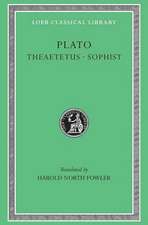 Theaetetus. SophistPlatoPreț: 233.70 lei
 -
 Preț: 229.26 lei
 -
 -14%Preț: 515.26 lei599.14 lei
 -
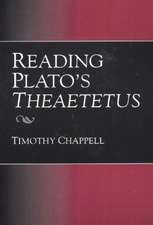 Reading Plato's TheaetetusTimothy Chappell-17%Preț: 137.44 lei164.95 lei
 -
 The Pocket Book of PlatoMichael MoorePreț: 72.54 lei
 -
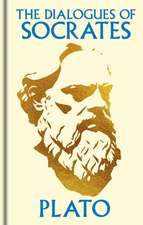 Preț: 66.00 lei
 -
 Why Plato Matters NowAngie Hobbs-25%Preț: 92.15 lei122.47 lei
 -
 The RepublicPlato Plato-28%Preț: 51.95 lei71.85 lei
 -
 ParmenidesPlatoPreț: 43.40 lei
 -
 SophistPlatoPreț: 41.26 lei
 -
 PhilebusPlatoPreț: 45.99 lei
 -
 PhaedoPlatoPreț: 43.59 lei
 -
 The Problems of PhilosophyBertrand RussellPreț: 38.67 lei
 -
 Preț: 58.13 lei
 -
 De AnimaAristotlePreț: 70.31 lei
 -
 -23%Preț: 1154.13 lei1498.88 lei
Descriere
Descriere de la o altă ediție sau format:
'What exactly is knowledge?'The Theaetetus is a seminal text in the philosophy of knowledge, and is acknowledged as one of Plato's finest works. Cast as a conversation between Socrates and a clever but modest student, Theaetetus, it explores one of the key issues in philosophy: what is knowledge? Though no definite answer is reached, the discussion is penetrating and wide-ranging, covering the claims of perception to be knowledge, the theory that all is in motion, and the perennially tempting idea that knowledge and truth are relative to different individuals or states. The inquirers go on to explore the connection between knowledge and true judgement, and the famous threefold definition of knowledge as justified true belief. Packed with subtle arguments, the dialogue is also a work of literary genius, with an unforgettable portrait of Socrates as a midwife of wisdom. This new edition uses the acclaimed translation by John McDowell. It includes a valuable introduction that locates the work in Plato's oeuvre, and explains some of the competing interpretations of its overall meaning. The notes elucidate Plato's arguments and draw connections within the work and with other philosophical discussions.ABOUT THE SERIES: For over 100 years Oxford World's Classics has made available the widest range of literature from around the globe. Each affordable volume reflects Oxford's commitment to scholarship, providing the most accurate text plus a wealth of other valuable features, including expert introductions by leading authorities, helpful notes to clarify the text, up-to-date bibliographies for further study, and much more.
'What exactly is knowledge?'The Theaetetus is a seminal text in the philosophy of knowledge, and is acknowledged as one of Plato's finest works. Cast as a conversation between Socrates and a clever but modest student, Theaetetus, it explores one of the key issues in philosophy: what is knowledge? Though no definite answer is reached, the discussion is penetrating and wide-ranging, covering the claims of perception to be knowledge, the theory that all is in motion, and the perennially tempting idea that knowledge and truth are relative to different individuals or states. The inquirers go on to explore the connection between knowledge and true judgement, and the famous threefold definition of knowledge as justified true belief. Packed with subtle arguments, the dialogue is also a work of literary genius, with an unforgettable portrait of Socrates as a midwife of wisdom. This new edition uses the acclaimed translation by John McDowell. It includes a valuable introduction that locates the work in Plato's oeuvre, and explains some of the competing interpretations of its overall meaning. The notes elucidate Plato's arguments and draw connections within the work and with other philosophical discussions.ABOUT THE SERIES: For over 100 years Oxford World's Classics has made available the widest range of literature from around the globe. Each affordable volume reflects Oxford's commitment to scholarship, providing the most accurate text plus a wealth of other valuable features, including expert introductions by leading authorities, helpful notes to clarify the text, up-to-date bibliographies for further study, and much more.
Recenzii
Sachs’s outstanding new translation of Plato’s Theaetetus is lucid, readable, and faithful to the original. More than that, it is a translation for the thoughtful reader. Through his striking translations of key terms, Sachs compels the reader to think more deeply about Plato’s intent. He shows that Plato’s return within the dialogue to the same word or to its cognates is no accident but signals a philosophical trope in Plato’s thought. The work’s introduction avoids presenting a stock summary of the topics covered or a rehearsal of the failed arguments. Instead, it makes the case for regarding the Theaetetus as Plato’s ‘missing’ work on The Philosopher. Through the ‘variety of attempts, errors, new beginnings, and false turns that the dialogue presents,’ Sachs argues, Socrates provokes his interlocutors and Plato’s readers to strive to cross the boundary between mere opinion and the kind of thinking that is philosophy.
-- Roslyn Weiss, Lehigh University
Translation close to the original text, providing notes and an introduction to the work designed to give the intelligent reader access to thought and thought processes of one of the seminal works in the Socratic tradition.
Notă biografică
Plato was an ancient Greek philosopher born in Athens during the Classical period in Ancient Greece. In Athens, Plato founded the Academy, a philosophical school where he taught the philosophical doctrines that would later become known as Platonism. Plato (or Platon) was a pen name derived, apparently, from the nickname given to him by his wrestling coach - allegedly a reference to his physical broadness. According to Alexander of Miletus quoted by Diogenes of Sinope his actual name was Aristocles, son of Ariston, of the deme Collytus (Collytus being a district of Athens).Plato was an innovator of the written dialogue and dialectic forms in philosophy. He raised problems for what later became all the major areas of both theoretical philosophy and practical philosophy. His most famous contribution is the Theory of forms, which has been interpreted as advancing a solution to what is now known as the problem of universals. He is also the namesake of Platonic love and the Platonic solids.His own most decisive philosophical influences are usually thought to have been, along with Socrates, the pre-Socratics Pythagoras, Heraclitus, and Parmenides, although few of his predecessors' works remain extant and much of what we know about these figures today derives from Plato himself.[a]Along with his teacher, Socrates, and his student, Aristotle, Plato is a central figure in the history of philosophy.[b] Unlike the work of nearly all of his contemporaries, Plato's entire body of work is believed to have survived intact for over 2,400 years.[6] Although their popularity has fluctuated, Plato's works have consistently been read and studied. Through Neoplatonism Plato also greatly influenced both Christian and Islamic philosophy (through e.g. Al-Farabi). In modern times, Alfred North Whitehead famously said: "the safest general characterization of the European philosophical tradition is that it consists of a series of footnotes to Plato.