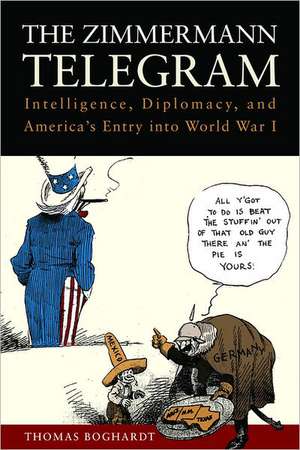
The Zimmermann Telegram
Autor Thomas Boghardten Limba Engleză Hardback – 15 oct 2012
În cadrul programelor de studiu dedicate istoriei secolului XX și relațiilor internaționale, episodul telegramei Zimmermann este adesea predat ca factorul declanșator decisiv pentru intrarea Statelor Unite în Primul Război Mondial. Apreciem modul în care Thomas Boghardt reconstruiește acest moment în The Zimmermann Telegram, oferind o perspectivă revizionistă necesară asupra mecanismelor de spionaj și diplomație care au definit iarna anului 1916/17. Volumul publicat de US Naval Institute Press nu se limitează la a relata faptele, ci deconstruiește mitul conform căruia oferta Germaniei către Mexic — de a recupera teritoriile pierdute din Texas, New Mexico și Arizona — a fost rezultatul unei strategii imperiale pe termen lung. Remarcăm acuratețea cu care autorul documentează colaborarea clandestină dintre serviciile secrete anglo-americane, prezentând interceptarea telegramei ca pe un punct culminant al unei alianțe de intelligence preexistente. Lucrarea extinde cadrul propus de The United States` Entry into the First World War – The Role of British and German Diplomacy cu date noi din arhivele germane, oferind o imagine mult mai nuanțată a haosului administrativ de la Berlin. Spre deosebire de Murder and Counterrevolution in Mexico, care se concentrează pe rețelele de informatori ale ambasadorului von Hintze, Boghardt demonstrează că schema Zimmermann a fost mai degrabă o inițiativă spontană, lipsită de coordonare la nivel înalt. Tonul este unul analitic și echilibrat, autorul reușind să demonteze ideea că publicarea documentului în presă a generat un sprijin unanim pentru război; dimpotrivă, datele arată o polarizare accentuată a societății americane de la acea vreme.
Preț: 243.48 lei
Cartea se retipărește
Specificații
ISBN-10: 1612511481
Pagini: 320
Dimensiuni: 159 x 241 x 32 mm
Greutate: 0.64 kg
Editura: US Naval Institute Press
De ce să citești această carte
Recomandăm această carte cercetătorilor și pasionaților de istorie militară care doresc să înțeleagă complexitatea spionajului din Marele Război. Cititorul va câștiga o perspectivă critică asupra modului în care o singură eroare diplomatică și o interceptare de intelligence pot schimba cursul istoriei globale. Este o resursă esențială pentru a înțelege cum informația a fost folosită ca instrument de presiune politică și cum a influențat memoria istorică a secolului trecut.
Recenzii
Descriere scurtă
A golden opportunity to force American intervention seemed at hand when British naval intelligence intercepted a secret telegram detailing a German alliance offer to Mexico. In it, Berlin s foreign secretary, Arthur Zimmermann, offered his country s support to Mexico for re-conquering the lost territory in Texas, New Mexico, and Arizona in exchange for a Mexican attack on the United States, should the latter enter the war on the side of the Allies. The British handed a copy of the Telegram to the American government, which in turn leaked it to the press. On March 1, 1917, the Telegram made headline news across the United States, and five weeks later, America entered World War I.
Based on an examination of virtually all available German, British, and U.S. government records, this book presents the definitive account of the Telegram and questions many traditional views on the origins, cryptanalysis, and impact of the German alliance scheme. While the Telegram has often been described as the final step in a carefully planned German strategy to gain a foothold in the western hemisphere, this book argues that the scheme was a spontaneous initiative by a minor German foreign office official, which gained traction only because of a lack of supervision and coordination at the top echelon of the German government. On the other hand, the book argues, American and British secret services had collaborated closely since 1915 to bring the United States into the war, and the Telegram s interception and disclosure represented the crowning achievement of this clandestine Anglo-American intelligence alliance. Moreover, the book explicitly challenges the widely accepted notion that the Telegram s publication in the U.S. press rallied Americans for war. Instead, it contends that the Telegram divided the public by poisoning the debate over intervention, and by failing to offer peace-minded Americans a convincing rationale for supporting the war. The book also examines the Telegram s effect on the memory of World War I through the twentieth century and beyond."