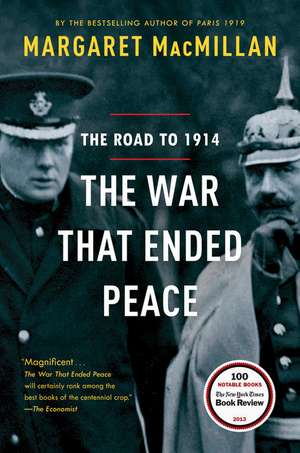
The War That Ended Peace
Autor Margaret Macmillanen Limba Engleză Paperback – 29 iul 2014
Pentru studenții la istorie, cercetătorii în relații internaționale sau candidații la examene de diplomație, The War That Ended Peace reprezintă o resursă academică fundamentală pentru înțelegerea mecanismelor care au declanșat Marele Război. Suntem de părere că Margaret MacMillan reușește să depășească simpla cronologie a evenimentelor, oferind o analiză psihologică și politică profundă a Europei dintre anii 1900 și 1914. Într-o perioadă în care continentul părea să marșeze spre o eră de aur a prosperității, deciziile fatidice ale unei elite restrânse — de la monarhi precum Franz Joseph la reformatori navali precum Jacky Fisher — au precipitat prăbușirea ordinii mondiale. Apreciem în mod deosebit modul în care această lucrare completează temele explorate anterior de autoare în Paris 1919, unde analiza consecințele păcii, mutând acum lupa asupra cauzelor care au făcut războiul posibil. Dacă în War: How Conflict Shaped Us MacMillan examina războiul ca trăsătură inherentă a umanității, aici ea demonstrează cum pacea a fost pierdută prin erori diplomatice și rivalități coloniale. Considerăm acest volum o alternativă necesară la The Sleepwalkers de Christopher Clark pentru cursurile de istorie europeană modernă. În timp ce The Sleepwalkers se concentrează pe modul în care liderii au „alunecat” spre război, The War That Ended Peace aduce avantajul unei perspective mai largi asupra mișcărilor pacifiste și a avertismentelor ignorate ale unor figuri precum Bertha von Suttner. Stilul narativ este dens, dar extrem de clar, oferind o panoramă vastă a unei lumi ce se îndrepta, aparent inexplicabil, spre autodistrugere.
Preț: 166.40 lei
Carte disponibilă
Livrare economică 13-27 noiembrie
Specificații
ISBN-10: 0812980662
Pagini: 784
Dimensiuni: 156 x 234 x 48 mm
Greutate: 0.82 kg
Editura: Random House
V-ar putea interesa
-
 To Fight Alongside FriendsGerry HarrisonPreț: 112.60 lei
 -
 -31%Preț: 95.52 lei138.74 lei
 -
 Paris 1919Margaret MacmillanPreț: 153.07 lei
 -
 War: How Conflict Shaped UsMargaret MacmillanPreț: 125.51 lei
 -
 German Military Ribbon BarsMark HaydenPreț: 108.42 lei
 -
 Nixon and MaoMargaret MacmillanPreț: 157.12 lei
 -
 Women of the RajMargaret MacmillanPreț: 133.66 lei
 -
 Russia in War and RevolutionSalzmanPreț: 356.80 lei
 -
 A Journey Through France in War Time (WWI Centenary Series)Joseph G. ButlerPreț: 167.72 lei
 -
 The War as I Saw ItHarvey L. HarrisPreț: 88.96 lei
 -
 SavasMargaret MacmillanPreț: 123.82 lei
De ce să citești această carte
Această carte este esențială pentru oricine dorește să înțeleagă fragilitatea păcii globale. Cititorul câștigă o perspectivă nuanțată asupra modului în care personalitățile liderilor și alianțele complexe pot transforma stabilitatea în haos. Este o recomandare obligatorie pentru cei care apreciază istoria narativă de înaltă ținută, oferind lecții valabile și astăzi despre diplomație și eșecul comunicării între marile puteri.
Despre autor
Margaret Olwen MacMillan (născută în 1943) este o istorică canadiană de renume mondial și profesoară la Universitatea din Oxford. Fost provost al Trinity College din Toronto, ea este recunoscută ca expertă în istoria relațiilor internaționale. În 2018, a susținut prestigioasele prelegeri Reith pentru BBC sub titlul „The Mark of Cain”, explorând impactul războiului asupra societății. Opera sa, care include bestsellerul Paris 1919, se distinge prin capacitatea rară de a combina rigoarea academică cu o scriitură captivantă, fiind recompensată cu numeroase premii literare și istorice de prestigiu.
Descriere scurtă
"The New York Times Book Review The Economist The Christian Science Monitor Bloomberg Businessweek The Globe and Mail"
From the bestselling and award-winning author of "Paris 1919" comes a masterpiece of narrative nonfiction, a fascinating portrait of Europe from 1900 up to the outbreak of World War I.
The century since the end of the Napoleonic wars had been the most peaceful era Europe had known since the fall of the Roman Empire. In the first years of the twentieth century, Europe believed it was marching to a golden, happy, and prosperous future. But instead, complex personalities and rivalries, colonialism and ethnic nationalisms, and shifting alliances helped to bring about the failure of the long peace and the outbreak of a war that transformed Europe and the world.
""
"The War That Ended Peace "brings vividly to life the military leaders, politicians, diplomats, bankers, and the extended, interrelated family of crowned heads across Europe who failed to stop the descent into war: in Germany, the mercurial Kaiser Wilhelm II and the chief of the German general staff, Von Moltke the Younger; in Austria-Hungary, Emperor Franz Joseph, a man who tried, through sheer hard work, to stave off the coming chaos in his empire; in Russia, Tsar Nicholas II and his wife; in Britain, King Edward VII, Prime Minister Herbert Asquith, and British admiral Jacky Fisher, the fierce advocate of naval reform who entered into the arms race with Germany that pushed the continent toward confrontation on land and sea.
There are the would-be peacemakers as well, among them prophets of the horrors of future wars whose warnings went unheeded: Alfred Nobel, who donated his fortune to the cause of international understanding, and Bertha von Suttner, a writer and activist who was the first woman awarded Nobel s new Peace Prize. Here too we meet the urbane and cosmopolitan Count Harry Kessler, who noticed many of the early signs that something was stirring in Europe; the young Winston Churchill, then First Lord of the Admiralty and a rising figure in British politics; Madame Caillaux, who shot a man who might have been a force for peace; and more. With indelible portraits, MacMillan shows how the fateful decisions of a few powerful people changed the course of history.
Taut, suspenseful, and impossible to put down, "The War That Ended Peace" is also a wise cautionary reminder of how wars happen in spite of the near-universal desire to keep the peace. Destined to become a classic in the tradition of Barbara Tuchman s "The Guns of August," "The War That Ended Peace" enriches our understanding of one of the defining periods and events of the twentieth century.
Praise for "The War That Ended Peace"
Magnificent . . . "The War That Ended Peace" will certainly rank among the best books of the centennial crop. "The Economist"
Superb. "The New York Times Book Review"
""
Masterly . . . marvelous . . . Those looking to understand why World War I happened will have a hard time finding a better place to start. "The Christian Science Monitor"
""
The debate over the war s origins has raged for years. Ms. MacMillan s explanation goes straight to the heart of political fallibility. . . . Elegantly written, with wonderful character sketches of the key players, this is a book to be treasured. The Wall Street Journal
A magisterial 600-page panorama. Christopher Clark, "London Review of Books""