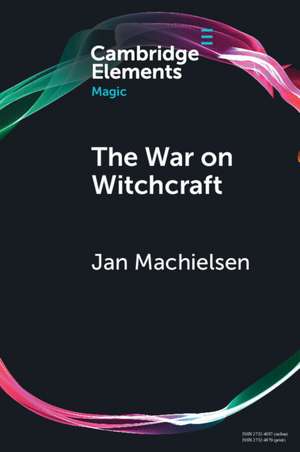
The War on Witchcraft: Elements in Magic
Autor Jan Machielsenen Limba Engleză Paperback – 29 iun 2021


Preț: 143.36 lei
Puncte Express: 215
Preț estimativ în valută:
25.35€ • 29.08$ • 21.92£
25.35€ • 29.08$ • 21.92£
Carte tipărită la comandă
Livrare economică 29 aprilie-13 mai
Specificații
ISBN-13: 9781108948746
ISBN-10: 110894874X
Pagini: 70
Dimensiuni: 152 x 229 x 5 mm
Greutate: 0.1 kg
Editura: Cambridge University Press
Seria Elements in Magic
Locul publicării:Cambridge, United Kingdom
ISBN-10: 110894874X
Pagini: 70
Dimensiuni: 152 x 229 x 5 mm
Greutate: 0.1 kg
Editura: Cambridge University Press
Seria Elements in Magic
Locul publicării:Cambridge, United Kingdom
Cuprins
1. 'Ding! Dong! The Witch is Dead'; 2. Two Historians on a Double Date: White and Burr Meet Flade and Loos; 3. History and a Reformer's Project of Reform; 4. The Reformer's Apprentice; 5. Meditations on Masculinity; 6. Reflections.
Recenzii
'… Masculinity emerges as an important theme. Machielsen shows that White and Burr both saw history as a story of Great Men, and actively valued masculine characteristics. I hope that this book will be taken up as a contribution to the history of nineteenth-century masculinity.' Julian Goodare, Folklore
Descriere
How did nineteenth-century historians construct the popular understanding of witchcraft as representing the irrational past?