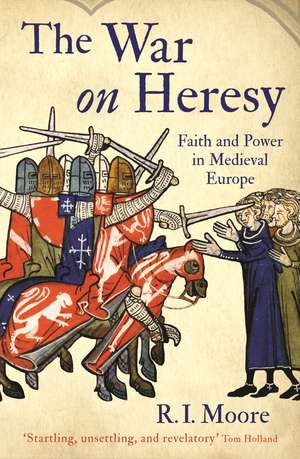
The War On Heresy: Faith and Power in Medieval Europe
Autor Professor R. I. Moore Editat de John Daveyen Limba Engleză Paperback – 10 iul 2014
Subliniem faptul că această lucrare aduce o perspectivă revizionistă esențială asupra modului în care Europa medievală a definit și a vânat dizidența religioasă. Spre deosebire de relatările tradiționale care se concentrează pe doctrinele „ereticilor”, The War On Heresy de Professor R. I. Moore mută centrul de greutate către mecanismele puterii: de ce a devenit erezia o obsesie bruscă după anul 1000 și cine a beneficiat de pe urma acestui conflict? Remarcăm rigoarea cu care Professor R. I. Moore analizează transformarea unei societăți în care erezia era aproape necunoscută într-una dominată de inchiziție și persecuție sistemică. Cititorii familiarizați cu Heresy and the Persecuting Society in the Middle Ages de Michael Frassetto vor aprecia modul în care acest volum extinde teza „societății persecutorii”, oferind o narațiune mai fluidă și mai axată pe dovezile primare ale epocii. În timp ce The Devil's World de Andrew Roach examinează opțiunile „consumatorilor” de religie, Moore investighează de ce autoritățile au ales să răspundă cu o ferocitate atât de mare unor amenințări care, în multe cazuri, erau fabricate sau exagerate din motive politice. Structura cărții ghidează cititorul prin evenimente majore, precum Cruciada Albigensiană, demontând mitul unor mișcări eretice organizate care ar fi pus în pericol fundamentele creștinătății. Este o analiză despre construcția inamicului interior și despre modul în care instituțiile își consolidează autoritatea prin definirea „altuia” ca deviant.
Preț: 76.95 lei
Preț vechi: 94.06 lei
-18%
Carte disponibilă
Livrare economică 09-23 noiembrie
Livrare express 23-29 octombrie pentru 41.13 lei
Specificații
ISBN-10: 1846682002
Pagini: 416
Dimensiuni: 130 x 200 x 34 mm
Greutate: 0.3 kg
Ediția:Main
Editura: Profile
Colecția Profile Books
Locul publicării:London, United Kingdom
V-ar putea interesa
-
 CATHEDRAL FORGE & WATERWHEE PBJoseph GiesPreț: 111.03 lei
 -
 God's WarChristopher TyermanPreț: 162.27 lei
 -
 The Crusades: A Very Short IntroductionChristopher Tyerman-19%Preț: 57.85 lei71.53 lei
 -
 How to Plan a CrusadeChristopher Tyerman-18%Preț: 77.77 lei94.54 lei
 -
 The Black Cross: A History of the Baltic CrusadesAleksander PluskowskiPreț: 193.84 lei
 -
 Terry Jones'' Medieval LivesAlan Ereira-26%Preț: 83.13 lei111.73 lei
 -
 -18%Preț: 118.53 lei144.79 lei
 -
 Europe's Inner DemonsNorman Cohn-18%Preț: 88.22 lei108.19 lei
 -
 Preț: 235.99 lei
 -
 Preț: 106.26 lei
 -
 History of the Byzantine StateGeorge OstrogorskyPreț: 486.34 lei
 -
 Crucible of LightElizabeth Drayson-30%Preț: 99.69 lei142.10 lei
 -
 The Devil's World: Heresy and Society 1100-1300Andrew Roach-18%Preț: 1011.53 lei1233.58 lei
 -
 Lady GodivaDonoghuePreț: 267.92 lei
 -
 Royal Books and Holy Bones: Essays in Medieval ChristianityProfessor Eamon Duffy-29%Preț: 137.62 lei194.99 lei
 -
 The Great HeresiesHilaire BellocPreț: 50.18 lei
 -
 The Time Traveller's Guide to Medieval EnglandIan Mortimer-18%Preț: 76.43 lei93.73 lei
 -
 The Perfect Heresy: The Life and Death of the CatharsStephen O'Shea-19%Preț: 75.90 lei93.44 lei
 -
 -22%Preț: 147.87 lei189.43 leiRecomandat
De ce să citești această carte
Recomandăm această carte istoricilor și pasionaților de Evul Mediu care doresc să înțeleagă rădăcinile intoleranței instituționalizate. Veți câștiga o perspectivă critică asupra modului în care frica și puterea politică au modelat ortodoxia religioasă. Este o lectură fundamentală pentru a înțelege nu doar credințele medievale, ci și modul în care sunt create „războaiele culturale” pentru a justifica controlul social.
Despre autor
Professor R. I. Moore este unul dintre cei mai influenți istorici medievaliști contemporani, cunoscut pentru lucrările sale care au redefinit înțelegerea structurilor sociale și religioase din Europa secolelor XI-XIV. Profesor emerit de istorie medievală la Universitatea Newcastle, Moore este celebru pentru teza sa privind apariția „societății persecutorii” în Occident, argumentând că excluderea minorităților (eretici, evrei, leproși) a fost un instrument deliberat de consolidare a statului și a bisericii. Opera sa se distinge prin combinarea analizei sociologice cu o cercetare minuțioasă a arhivelor medievale.
Descriere scurtă
Recenzii
Moore makes a very powerful case ... if only half of his revolutionary new claims are accepted, every encyclopedia entry on the Cathars will have to be completely rewritten
Brilliantly told, profoundly thought-provoking.
Moore's latest book is as good, and as provocative, as anything he has produced. The book is one of the finest accounts of medieval heresy that you are likely to encounter ... serves to enhance Moore's status as one of the finest historians of medieval heresy.
Elegant and intelligent.
Wide-ranging, beautifully written, and compellingly argued, this is a book that overturns the traditional picture.
Moore's approach to Catharism is intriguing and provocative. [This is] an accessible and up-to-date history of the rise of heresy persecution in the medieval West. The book will inspire ample criticism and defenses among scholars. Amateur historians will find a pleasing expository style burnished with colorful details.
A bold new vision.
An intellectual thriller ... An absolute page-turner ... Startling, unsettling and revelatory, The War on Heresy is Homeland in cowls.
The The War on Heresy is an important and well-argued book that will force scholars to re-examine the history of medieval heresy and provides the methodological blueprint for the study of heresy in the Middle Ages.
A very impressive study, made all the more accessible by the author's admirably lucid writing style
The book under review here is a brilliant and sobering meditation on this theme ... The War on Heresy is a triumph.
Beautifully written, measured, searching, and sublimely free from jargon. We are presented with eye-witness accounts that are not knocked into pre-conceived patterns. The effect is to draw the reader into not just the story but into how the story became a story in the first place. Inevitably this affords a double-take perspective, in which history and stories excitingly grow together and the reader becomes a participant.
The War on Heresy is social and religious history at its best, the fruit of many decades of intense engagement with one of the most complex and difficult problems of medieval history. With admirable clarity, R. I. Moore tells the deeply troubling story of how heretics became a persecuted minority, not so much because of their beliefs, but because of the anxieties, needs, and ambitions of their persecutors. This is a masterfully researched and deeply thought book that tells its exciting and still relevant story with verve and with sympathy for the victims of the war on heresy.
Descriere
The war on heresy obsessed medieval Europe in the centuries after the first millennium. R. I. Moore's vivid narrative focuses on the motives and anxieties of those who declared and conducted the war: what were the beliefs and practices they saw as heretical? How might such beliefs have arisen? And why were they such a threat?In western Europe at AD 1000 heresy had barely been heard of. Yet within a few generations accusations had become commonplace and institutions were being set up to identify and suppress beliefs and practices seen as departures from true religion. Popular accounts of events, most notably of the Albigensian Crusade led by Europe against itself, have assumed the threats posed by the heretical movements were only too real. Some scholars by contrast have tried to show that reports of heresy were exaggerated or even fabricated: but if they are correct why was the war on heresy launched at all? And why was it conducted with such pitiless ferocity? To find the answers to these and other questions R. I. Moore returns to the evidence of the time. His investigation forms the basis for an account as profound as it is startlingly original.