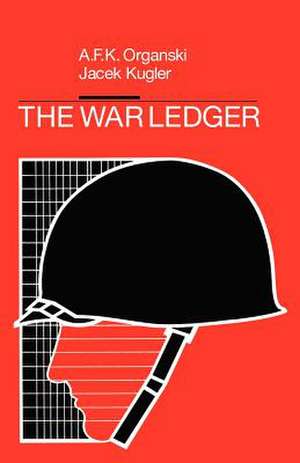
The War Ledger
Autor A. F. K. Organski, Jacek Kugleren Limba Engleză Paperback – 15 aug 1981
În literatura academică dedicată relațiilor internaționale, persistă adesea o lacună între teoriile clasice ale echilibrului de putere și realitățile empirice ale conflictelor moderne de mare amploare. The War Ledger, semnat de A. F. K. Organski și Jacek Kugler, vine să completeze acest gol prin propunerea unei paradigme alternative: teoria tranziției de putere. Remarcăm modul în care autorii demonstrează că nu echilibrul, ci diferența în ratele de creștere economică și politică dintre o națiune dominantă și un pretendent destabilizează sistemul internațional. Volumul acoperă o arie tematică similară cu The Origin and Prevention of Major Wars, însă The War Ledger adoptă o abordare mult mai axată pe modelare matematică și validare statistică, prioritizând datele economice în detrimentul analizei pur istorice. Structura cărții reflectă o progresie logică riguroasă, pornind de la definirea puterii și a creșterii naționale, continuând cu testarea modelelor de distribuție a puterii și culminând cu o analiză surprinzătoare a „Factorului Phoenix”. Putem afirma că secțiunea dedicată recuperării post-belice este una dintre cele mai originale contribuții ale lucrării, demonstrând cum statele învinse revin la traiectoria de dezvoltare anterioară în mai puțin de douăzeci de ani. De asemenea, autorii reevaluează rolul armelor nucleare, argumentând că acestea nu au alterat fundamental comportamentul statelor în crize, contrar așteptărilor teoriei descurajării. Publicată de University of Chicago Press, această ediție revizuită rămâne un pilon de referință pentru înțelegerea mecanismelor care guvernează victoria, înfrângerea și reziliența națională.
Preț: 278.57 lei
Carte tipărită la comandă
Livrare economică 26 noiembrie-10 decembrie
Specificații
ISBN-10: 0226632806
Pagini: 299
Dimensiuni: 140 x 216 x 20 mm
Greutate: 0.4 kg
Ediția:Revised
Editura: University of Chicago Press
Colecția University of Chicago Press
V-ar putea interesa
-
 Out in Force: Sexual Orientation and the MilitaryGregory M. Herek-9%Preț: 754.27 lei828.87 lei
 -
 Preț: 257.30 lei
 -
 The Dynamics of Nuclear ProliferationStephen M. MeyerPreț: 301.86 lei
 -
 Preț: 308.58 lei
 -
 Preț: 261.99 lei
 -
 Preț: 466.69 lei
 -
 China, Europe and International Security: Interests, Roles, and ProspectsFrans-Paul van der Putten-18%Preț: 789.61 lei962.94 lei
 -
 National Security Cultures: Patterns of Global GovernanceEmil J. Kirchner-15%Preț: 424.63 lei499.57 lei
 -
 Report of the Commission to Assess the Threat to the United States from Electromagnetic Pulse (Emp) Attack: The BeginningCritical National InfrastructuresPreț: 79.95 lei
 -
 Preț: 403.42 lei
 -
 Political Capacity And Economic BehaviorMarina Arbetman-15%Preț: 473.86 lei557.49 lei
 -
 -23%Preț: 577.74 lei750.32 lei
 -
 -23%Preț: 562.86 lei730.99 lei
 -
 Preț: 290.98 lei
 -
 Finding Services for an Open ArchitectureIsaac R PorchePreț: 105.21 lei
 -
 New Tools and Metrics for Evaluating Army Distributed LearningSusan G. StrausPreț: 180.53 lei
 -
 Military Simulation & Serious GamesRoger D SmithPreț: 172.96 lei
 -
 Global Power Transition and the Future of the European UnionBirol A. Yeşilada-18%Preț: 1108.96 lei1352.39 lei
 -
 The Dangers and Defences of New YorkJohn Gross BarnardPreț: 63.31 lei
 -
 Solving the People PuzzleEmily Spencer-24%Preț: 88.17 lei115.90 lei
 -
 The U.S. Marine Corps in CrisisKeith FlemingPreț: 165.76 lei
 -
 Military AirpowerCharles M. WestenhoffPreț: 159.20 lei
De ce să citești această carte
Recomandăm această lucrare cercetătorilor și studenților la științe politice care caută o alternativă riguroasă la realismul clasic. Cititorul va câștiga o înțelegere profundă a „capacității politice” ca variabilă esențială în deznodământul războaielor. Este o lectură fundamentală pentru cei care doresc să analizeze conflictele globale nu prin prisma retoricii politice, ci prin indicatori de creștere și mobilizare a resurselor de stat.
Despre autor
A. F. K. Organski a fost un influent profesor de științe politice la Universitatea din Michigan, recunoscut la nivel mondial ca părinte al teoriei tranziției de putere, care a redefinit modul în care mediul academic privește ierarhiile globale. Jacek Kugler, colaboratorul său apropiat, este profesor de relații internaționale și un expert de marcă în modelarea matematică a conflictelor politice. Împreună, cei doi au transformat studiul războiului dintr-o disciplină descriptivă într-una analitică, bazată pe date, opera lor rămânând centrală în curriculumul facultăților de profil din întreaga lume.
Descriere scurtă
The authors find such well-known theories as the balance of power and collective security systems inadequate to explain how conflict erupts in the international system. Their rigorous empirical analysis proves that the power-transition theory, hinging on economic, social, and political growth, is more accurate; it is the differential rate of growth of the two most powerful nations in the system—the dominant nation and the challenger—that destabilizes all members and precipitates world wars.
Predictions of who will win or lose a war, the authors find, depend not only on the power potential of a nation but on the capability of its political systems to mobilize its resources—the "political capacity indicator." After examining the aftermath of major conflicts, the authors identify national growth as the determining factor in a nation's recovery. With victory, national capabilities may increase or decrease; with defeat, losses can be enormous. Unexpectedly, however, in less than two decades, losers make up for their losses and all combatants find themselves where they would have been had no war occurred.
Finally, the authors address the question of nuclear arsenals. They find that these arsenals do not make the difference that is usually assumed. Nuclear weapons have not changed the structure of power on which international politics rests. Nor does the behavior of participants in nuclear confrontation meet the expectations set out in deterrence theory.
Notă biografică
Cuprins
Introduction
Of Power
Of Size and Growth
Of Nuclear Weapons
Plan of the Book
1. Causes, Beginnings and Predictions: The Power Transition
Three Models
Comparison of the Three Models
Preparation for the Testing of a Model
Empirical Tests of the Power-Distribution Models
Conclusion
2. Davids and Goliaths: Predicting the Outcomes of International Wars
Power Indicators: Existing Measures
The Missing Measure of Political Development
Construction of a Measure of Political Development
An Index of Governmental Extraction
A New Measure of National Capabilities
Tests, Hypotheses, and Findings
Conclusion
3. The Costs of Major Wars: The Phoenix Factor
Theoretical Propositions
Indexing National Capabilities or Power Resources
Estimating Consequences of War
Choice of Test Cases
Actors
Empirical Propositions
Findings
The Phoenix Factor
Conclusion
4. Nuclear Arms Races and Deterrence
Deterrents and Deterrence
Testing Deterrence: Outcomes of Crisis
Testing Mutual Deterrence: The Nuclear Arms Race
Conclusion
5. Conclusion
A Note on Architecture
Major Wars: Beginnings
Predictions of War Outcomes
The Phoenix Factor
Deterrence and Arms Races
Beyond the Data
Appendix 1: Index of Political Development
Appendix 2: Postwar American Aid
Appendix 3: Analysis of Models
Notes
Bibliography
Index